Romantic Panentheism, a review of One Thousand Gifts

Thank You Jessica for the permission to place this article !

Romantic Panentheism,

 a Review of One Thousand Gifts by Ann Voskamp

By Bob DeWaay

 Printer Friendly PDF

We live in a theological age (postmodern) where the rational and cognitive are questioned and replaced by the sensual and mysterious. Many churches promote the idea of worshipping God with all five senses. Feelings trump clear Biblical exegesis, systematic theology, statements of faith, and any other rational approach to Christian theology. Into this milieu comes a book that takes romanticism to a new level, using sensuality to invoke religious feelings and ostensibly true devotion. The book is One Thousand Gifts by Ann Voskamp, a Canadian farmer’s wife.

Written entirely in the present tense, using an approach to the English language that takes numerous liberties for the sake of creating poetic feeling (like using adjectives when the rules of grammar demand an adverb and consistently having adjectives follow rather than precede the nouns they modify), Voskamp weaves a tale of discovering devotion to God through encounters with nature and art. In her experience, Voskamp found the secret to joy through what she calls eucharisteo (“giving thanks” transliterated from the Greek).

My purpose is not to begrudge Voskamp her religious feelings, nor to disagree with the basic thesis that Christians ought to give thanks to God in all things, but to object to the panentheistic worldview revealed in the book and the romanticism that accompanies it. First we will explore those two ideas.

Continue reading

The freedom of the will by Jonathan Edwards

I found this  gem and I am sharing with you all. God bless. These are audio files.


A Careful And Strict Inquiry Into The Prevailing Notions Of The Freedom Of Will.

  1. Preface.
  2. Part 1Wherein are explained and stated various Terms and things belonging to the subject of the ensuing Discourse.
    1. Section 1 Concerning the Nature of the Will
    2. Section 2 Concerning the Determination of the Will.
    3. Section 3 Concerning the meaning of the terms, Necessity, Impossibility, Inability, &c. and of Contingence.
    4. Section 4 Of the distinction of natural and moral Necessity, and Inability.
    5. Section 5Concerning the notion of Liberty, and of moral Agency. Continue reading

Why I Am a Calvinist, Part 1-4 of 8

by Phil Johnson – Grace to You

Why I Am a Calvinist, Part 1

. . and why every Christian is a Calvinist of sorts.  


Part I: Is Arminianism damnable heresy?

I love the doctrines of grace and don’t shy away from the label “Calvinist.” I believe in the sovereignty of God. I’m convinced Scripture teaches that God is completely sovereign not only in salvation (effectually calling and granting faith to those whom He chooses); but also in every detail of the outworking of Providence. “Whom He predestined, these He also called; whom He called, these He also justified; and whom He justified, these He also glorified” (Romans 8:30). And He makes “all things work together for good to those who love God, [i.e.,] to those who are the called according to His purpose” (Romans 8:28). Quite simply, He “works all things according to the counsel of His will” (Ephesians 1:11).

That’s what people commonly mean when they speak of “Calvinism.” When I accept that label, I am not pledging allegiance to the man John Calvin. I am not affirming everything he taught, and I’m not condoning everything he did. I’m convinced Calvin was a godly man and one of the finest biblical expositors and theological minds ever, but he wasn’t always right. As a matter of fact, my own convictions are baptistic, so I am by no means one of Calvin’s devoted followers. In other words, when I accept the label “Calvinist,” it’s only for convenience’s sake. I’m not saying “I am of Calvin” in the Corinthian sense.

Continue reading

Mohamedanism, or to the fierce doctrines of Budha……

  C. H. Spurgeon

Delivered on Sabbath Morning, September 16, 1855,
At New Park Street Chapel, Southwark.

Storming the Battlements

“Go ye up upon her walls, and destroy; but make not a full end: take away her battlements; for they are not the Lord’s.”—Jeremiah 5:10.

E HAVE BEEN talking very freely during this last week of “glorious victories,” of “brilliant successes,” of “sieges,” and of “stormings.” We little know what the dread reality is of which we boast. Could our eyes once behold the storming of a city, the sacking of a town, the pillage of the soldiery, the barbarous deeds of fury, when the blood is up and long delay has maddened their souls; could we see the fields saturated with blood, and soaked with gore; could we spend one hour amongst the corpses and the dying; or if we could only let the din of battle, and the noise of the guns reach our ears, we should not so much rejoice, if we had anything of fellow feeling for others as well as for ourselves. The death of an enemy is to me a cause of regret as well as the death of a friend. Are not all my brethren? and doth not Jesus tell me so? Are we not all made of one flesh? and hath not God “made of one blood all nations that dwell upon the face of the earth?” Let us, then, when we hear of slaughtered enemies, and of thousands that have fallen, cease to rejoice in their death.

It would betray a spirit utterly inconsistent with the Christian religion, more akin to Mohamedanism, or to the fierce doctrines of Budha, but not in the least to be brought into compatibility with the truths of the gospel of the glorious God. And yet with all that, far be it from me to check any gladness which this nation may experience, now that it hopes that the incubus of war may at last be removed.

Continue reading

Cracking the “Code” of Preterism


Article removed by Admin 

Is There Power in the Blood of the Pope?

By Dr. Paul M. Elliott

May 1, 2011 ─ In scenes evoking old Bela Lugosi vampire movies and trampling the blood of Christ underfoot, Pope Benedict XVI, along with officials of the Roman Catholic church-state and a crowd of 1.5 million, worshipped the body, blood, and images of Pope John Paul II during beatification ceremonies at the Vatican. More than fifty heads of state were present for the ceremony. At the end of this article are pictures of the macabre ritual.

The Worship of Saints

The ceremony marked a major step in the Vatican’s move to confer the status of “sainthood” on the dead Pope. Roman Catholicism practices what it calls the veneration of saints. In Roman Catholic terminology it is called “the cult of the saints”. Rome encourages a level of devotion to so-called saints that can truly be called worship, and in fact Roman Catholic literature speaks of the worship of saints.

Continue reading

Osama Bin Laden killed: Why it’s OK to rejoice, (but not gloat)

Grant Swart

In the light of developments earlier today in the international war on terror, I thought it appropriate to re-post this article by Pastor Bill Randles, himself a citizen of theUSA. Hundreds of secular articles written under the guise of Christian opinion, have been placed on the internet by proponents of the ecumenical church such as Brian McLaren, following the merciful removal of the threat of the terrorist, Osama Bin Laden. Those articles are mostly in keeping with the immensely popular social gospel of tolerance above truth, which discredits the Christian position rather than represents it. The article by Bill Randles, which I have added at the bottom, offers a Christian perspective an is certainly worth reading again.

Shortly after the international incident, President Obama of the USA, in his televised address, missed yet another great opportunity to thank, (or at the very least mention), the Lord God for assisting their armed forces efforts in protecting the freedom of Christians. Continue reading

Ready to Discriminate?

John MacArthur – Grace to You

(9min Audio)

The issue of who is truly a Christian is at the very center of the church’s life and ministry. This has to be protected. There isn’t any fellowship between light and darkness, is there, 2 Corinthians 6? There isn’t any concord between Christ and Satan. Two can’t walk together unless they be…what?…agreed. You have to come out from among them and be ye separate and touch not the unclean thing.

And here is the church absorbing all of this. And now it’s so confusing that the church itself doesn’t even know who’s a Christian and frankly I don’t think they particularly care as long as you say you believe in Jesus. A friend, Iain Murray who is a gifted theologian and a great biographer, wrote the massive two-volume biography of Martyn Lloyd-Jones has also written on Jonathan Edwards and many others, he is a very esteemed Englishman and has been here many times, we’ve spent many hours together, has written a new book called Evangelicalism Divided in which I read it, just devoured it over the last few weeks while I was in Italy in the plain, in the back of the bus, in the room, everywhere because it just consumed me. Murray is tracking the twentieth century decline of evangelicalism and it’s a book of history that is very, very revealing. And Murray says, and I think he’s absolutely right, he says, the inability of the evangelical church to distinguish between a Christian and a non-Christian is quote: “The greatest failure of professing Christianity in the English-speaking world in the twentieth century,” end quote.

Continue reading

Another Word Concerning the Down-Grade C H Spurgeon

“These destroyers of our churches appear to be as content with their work as monkeys with their mischief. The case is mournful. Certain ministers are making infidels. …. A little plain-speaking would do a world of good just now.

Continue reading

How to Treat False Teachers, Part 1

John MacArthur – Grace to You

1 Timothy 1:3-6

Turn in your Bible to the first chapter of 1 Timothy.  We have recently begun a study of 1 Timothy.  We’ve had a couple of messages getting started, looking at the introduction, and now we come in this next section to verses 3 through 11.  This section has to do with dealing with false teachers.  I want us to take verses 3 through 11 as a unit, but we’re going to divide it between two weeks, this Lord’s day and next.

Let me introduce our study today by reminding you of something I’m sure you’re very much aware of.  In John’s gospel chapter 8 and verse 44, it reminds us that Satan is not only a murderer but Satan is also a liar.  One of the manifestations of the lying intent of Satan is the proliferation of false teachers that besiege the gospel and the church through all the history of the church’s life.  False prophets and false teachers are a part and parcel of the battle the church has to fight in every age.

Continue reading

The Doctrines of Grace (Part 4 of 10)

John MacArthur – Grace to You

The Doctrine of Election, Part 1

As you know, a couple of weeks ago we completed our study in the wonderful epistle written by Jude which ended with a promise that God is able to keep us from falling and to present us faultless before His presence with glory.  And because that introduced to us the wonderful doctrine of eternal security, or better stated, the perseverance of the saints, or the preservation of the saints, we spent a few weeks talking about that doctrine.  And in the discussions that I had with you regarding that, I said that the end is determined by the beginning.  Our salvation is secure to the end because our salvation was predestined in the very beginning to be completed.  And we remember that Romans 8 makes a monumental and very clear statement to that regard.  When in Romans 8 the Apostle Paul writes, “For whom He foreknew, He predestined to become conformed to the image of His Son.” That is all whom God predestined will become conformed to the image of His Son in eternal glory.  And thus whom He predestined He called, and whom He called He justified, and whom He justified these He also glorified.

Continue reading

Against Compromise

John MacArthur – Grace to You

It was Martin Luther who said:

“The world at the present time is sagaciously discussing how to quell the controversy and strife over doctrine and faith, and how to effect a compromise between the Church and the Papacy. Let the learned, the wise, it is said, bishops, emperor and princes, arbitrate. Each side can easily yield something, and it is better to concede some things which can be construed according to individual interpretation, than that so much persecution, bloodshed, war, and terrible, endless dissension and destruction be permitted.

Here is lack of understanding, for understanding proves by the Word that such patchwork is not according to God’s will, but that doctrine, faith and worship must be preserved pure and unadulterated; there must be no mingling with human nonsense, human opinions or wisdom.

The Scriptures give us this rule: ‘We must obey God rather than men’ (Acts 5:29).”

Continue reading

Why would someone hate the word Exegesis? part 1

Someone said : I am really beginning to hate the word exegesis. What’s wrong with the word summary? It’s simple, easy to understand!

It made me think. Why would the word Exegesis be an issue for someone if they are christian? If one is a believer I believe it is important to understand the meaning of Exegesis before we study the Word of God. there is a big difference between the word summary and the word exegesis. Should Bible teachers now change using the word exegesis to summary?

Summary = Presenting the substance in a condensed form; concise: a summary review.

Exegesis = This is a Latin term relating to correct Biblical understanding. It means literally ‘to lead out’. In the context of studying the Bible it means to get out of the text what the text is saying. This may include a number of things to aid the process such as reading the context in the chapter, in the particular book as a whole eg. Jeremiah or Matthew and even where it fits within the whole Bible. It may also include cultural awareness, the timing of the writing, and identifying the author and even the target audience.

Continue reading

Who’s Afraid of the Big, Bad Heretic?

Evangelical Apathy and the Danger of False Teaching
by John MacArthur

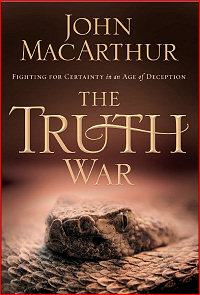
The following is excerpted from The Truth War (Nelson, 2007, pp. 165-68)

Why do so many evangelicals act as if false teachers in the church could never be a serious problem in this generation? Vast numbers seem convinced that they are “rich, have become wealthy, and have need of nothing’; and do not know that [they] are wretched, miserable, poor, blind, and naked” (Revelation 3:17).

In reality, the church today is quite possibly more susceptible to false teachers, doctrinal saboteurs, and spiritual terrorism than any other generation in church history. Biblical ignorance within the church may well be deeper and more widespread than at any other time since the Protestant Reformation. If you doubt that, compare the typical sermon of today with a randomly-chosen published sermon from any leading evangelical preacher prior to 1850. Also compare today’s Christian literature with almost anything published by evangelical publishing houses a hundred years ago or more.

Continue reading

Metamorphosis, Part 3 (questioning everything)

John MacArthur – Grace to You

I have examined and critiqued postmodernism elsewhere (see The Truth War, 2007). It should be sufficient for our purposes in this context to summarize the postmodern mind-set by describing it as dubiousness about practically everything. As we noted, the starting point for modernity was a rejection of biblical authority (setting aside belief in the supernatural as an untenable or merely irrelevant opinion). Instead, science and human reason were foolishly treated as reliable and authoritative. In the end, the disastrous failure of so many modern ideologies utterly debunked modern rationalism and delivered a deathblow to modern certitude. Postmodernism therefore subjects every idea and every authority to endless skepticism.

Modernity’s most basic assumption was that the way to achieve unshakable certainty is through a rigorous application of the scientific method. (Whatever could be tested and proved in the laboratory—or logically deduced from scientific “facts”—was deemed true; everything else was written off as mere superstition.) Moderns were convinced that a basic foundation of settled scientific knowledge would easily provide a trustworthy authority by which all truth claims could be tested. That process in turn would eventually bring about a uniform consensus regarding all the fundamental realities of life and human existence.

Continue reading