Three Things Which Will Not Be Found In Heaven – Revelation 21:4

Revelation 21:4 He will wipe away every tear from their eyes, and death shall be no more, neither shall there be mourning, nor crying, nor pain anymore, for the former things have passed away.”

Don Fortner

I cannot begin to describe the bliss and glory of our heavenly inheritance. Much that awaits us is yet unknown. And that which is revealed is seen here “through a glass darkly.” But here are three things, with which all who live upon the earth are very familiar, which shall not be found in heaven.

THERE WILL BE NO TEARS IN HEAVEN – “God shall wipe away all tears from their eyes; and there shall be no more death, neither sorrow, nor crying, neither shall there be any more pain: for the former things are passed away” (Rev. 21:4). Here we see much death, experience much sorrow, and feel much pain. And these things cause our eyes to swell and our cheeks to burn. But our God shall soon dry our eyes.In heaven, all that causes us to weep now, shall cease to be. Once we have left this world of sorrow, we shall never weep again! Continue reading

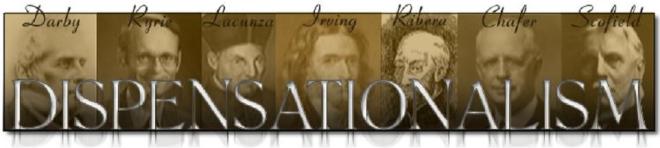
Dispensationalism: Focusing eschatology on assumption and human politics, and reducing Christ’s role in Bible prophecy

Grant Swart

1.

Dispensational Premillenialism sharply focuses the events surrounding the end times, on the so-called “secret” rapture and a perceived forthcoming millennium. At the center of this focus is national Israel, daily events which take place in the Middle-East and in the realm of international politics and, of course, the increasing popularization of any number of future personalities representing the Antichrist. Sensational speculation and enthusiastic debate, motivated mainly by geo-political human affairs and major natural events, are designed to divert attention away from biblical prophecy regarding the end times. The end time is thereby reduced to a small window of time in the future and fragmented and isolated events in recent human history, rather than an ongoing eschatological understanding of biblical prophecy which stretches from Genesis to Revelation.

Some of the most commercially successful books, television shows and even certain reference Bibles, have been remarkably innovative and convincingly sincere in finding ways to support the false assumptions which are necessary to support the  “concept” of dispensational premillenialism in its various forms. Continue reading

False Doctrine Is Worse Than Division

J.C. Ryle  ~

When Peter came to Antioch, I opposed him to his face, because he was clearly in the wrong.  Before certain men  came from James, he used to eat with the Gentiles.  But when  they arrived, he began to draw back and separate himself  from the Gentiles because he was afraid of those who belonged to the circumcision group.

The other Jews joined him in his hypocrisy, so that by their   hypocrisy even Barnabas was led astray.  When I saw that they were not acting in line with the truth of the gospel, I  said to Peter in front of them all, “You are a Jew, yet you live like a Gentile and not like a Jew.  How is it, then,  that you force Gentiles to follow Jewish customs?”

We who are Jews by birth and not “Gentile sinners” know that a man is not justified by observing the law, but by faith in Jesus Christ.  So we, too, have put our faith in Christ Jesus  that we may be justified by faith in Christ and not by observing the law, because by observing the law no one will be justified.  Galatians 2:11-16

The second is,  “That to keep the truth of Christ in His Church is even more important than to keep peace.”  Continue reading

Is Arminianism a damnable heresy?

Stephen Pribble

Having been condemned by the Synod of Dordrecht (Dort) in 1618-1619, Arminianism is indeed a heresy, a serious departure from the historic faith of the Christian church. “Arminius, a theological professor at the University of Leyden, departed from the Reformed faith in his teaching concerning five important points. He taught conditional election on the ground of foreseen faith, universal atonement, partial depravity, resistible grace, and the possibility of a lapse from grace. These views were rejected by the Synod…” (from the introduction to the Canons of Dort in the Psalter Hymnal, 1959 ed.).

The Bible teaches that God elected His people in Christ before time began. “According as he hath chosen us in him before the foundation of the world…” (Eph. 1:4). This election was out of God’s mere free grace and love, with nothing in the creature as a condition or cause inducing Him to do this. “(For the children being not yet born, neither having done any good or evil, that the purpose of God according to election might stand, not of works, but of him that calleth;)… So then it is not of him that willeth, nor of him that runneth, but of God that showeth mercy” (Rom. 9:11, 16).

The Bible teaches that Christ did His atoning work on behalf of His elect people, and no others. “Christ also loved the church, and gave himself for it” (Eph. 5:25). “I lay down my life for the sheep” (Jn. 10:15). “I pray for them: I pray not for the world, but for them which thou hast given me; for they are thine” (John 17:9). Continue reading

The History of Dispensationalism

“My brother, I am a constant reader of my Bible, and I soon found that what I was taught to believe did not always agree with what my Bible said. I came to see that I must either part company with John Darby, or my precious Bible, and I chose to cling to my Bible and part from Mr. Darby.” George Müeller (1805–1898)

I am quite convinced that all the promises to Israél are found, are finding and will find their perfect fulfilment in the Church. It is true that in time past, in my expositions, I gave a definite place to Israél in the purposes of God. I have now come to the conviction, as I have just said, that it is, the new and spiritual Israél that is intended. G. Campbell Morgan (1863-1945)

Dispensationalism is a device of the enemy, designed to rob the children of no small part of that bread which their heavenly Father has provided for their souls; a device wherein the wily serpent appears as an angel of light, feigning to “make the Bible a new book” by simplifying much in it which perplexes the spiritually unlearned. It is sad to see how widely successful the devil has been by means of this subtle innovation. A. W. Pink(1886-1952)

It is mortifying to remember that I not only held and taught these novelties myself, but that I even enjoyed a complacent sense of superiority because thereof, and regarded with feelings of pity and contempt those who had not received the “new light” and were unacquainted with this up-to-date method of “rightly dividing the word of truth.” For I fully believed what an advertising circular says in presenting “Twelve Reasons why you should use THE SCOFIELD REFERENCE BIBLE,” namely, that: “First, the Scofield Bible outlines the Scriptures from the standpoint of DISPENSATIONAL TRUTH, and there can be no adequate understanding or rightly dividing of the Word of God except from the standpoint of dispensational truth.”

What a slur is this upon the spiritual understanding of the ten thousands of men, “mighty in the Scriptures,” whom God gave as teachers to His people during all the Christian centuries before “dispensational truth” (or dispensational error), was discovered! And what an affront to the thousands of men of God of our own day, workmen that need not to be ashamed, who have never accepted the newly invented system! Yet I was among those who eagerly embraced it (upon human authority solely, for there is none other) and who earnestly pressed it upon my fellow Christians. I am deeply thankful, however, that the time came (it was just ten years ago) when the inconsistencies and self contradictions of the system itself, and above all, the impossibility of reconciling its main positions with the plain statements of the Word of God, became so glaringly evident that I could not do otherwise than renounce it. Philip Mauro (1859-1952) Continue reading

His Number is 666

“His Number is 666”
By Kim Riddlebarger ~ Sermons on the Book of Revelation # 20
Texts: Revelation 13:11-18; Daniel 8:15-26

There is no subject–with the possible exception of the unpardonable sin–which has caused as much consternation for the people of God as has the so-called “mark of the beast.” John pointedly warns his hearers against taking such a mark on the back of the hand or the forehead. He also tells us that anyone who takes such a mark swears allegiance to the beast. This has given Christians throughout the ages a healthy suspicion of any government which persecutes the church or hinders the preaching of the gospel. It has lead to a number of questions in our own day about advancing technology and increasing government control over many areas of our personal lives. Such a warning from an apostle creates a climate in which sensational predictions and warnings about political events and technology are the norm. So we must do our best to bring clarity to this most difficult and controversial of subjects.

In past sermons, we have been working our way through Revelation 12-14 in which John introduces his reader to seven of the main characters in the great drama of redemption. Like the seal judgments of Revelation 6-8:1 and the trumpet judgments of Revelation 8-11, the vision recorded in Revelation 12-14 describes the entire period of time between the first advent and the second coming of Christ from a distinct theological perspective (or “camera” angle as we have been calling it). In this section of Revelation, John gives us a vivid description of the struggle between the people of God and our great adversary, Satan, who has been cast down from heaven to earth where he now seeks to wage war upon the church of Jesus Christ through the agency of his henchmen, the beast and the false prophet. Continue reading

In the world, but not of the world, but which world is that, really?

by Grant Swart

The things of this world, wars, famine, suffering, poverty, etc., impact Christians and non-Christians alike. By remembering that we, as Christians, are “not of this world,” remembering that these things are just for a little while, we can see them in a different light. We are still in this world but we are no longer of it (John 17:14).

Believers are no longer of the world—we are no longer ruled by sin, nor are we bound by the principles of the world. In addition, we are being changed into the image of Christ, causing our interest in the things of the world to become less and less as we mature in Christ. Believers in Jesus Christ are simply in the world—physically present—but not of it, not part of its values. As believers, we should be set apart from the world, we often hear this, even refer to this and remind each other of it, but do we know what that world entails?   Continue reading

A Present or Future Millennium?

by Kim Riddlebarger

Most American Evangelicals are firmly committed to the idea that an earthly millennial age will begin immediately after our Lord Jesus Christ’s Second Advent. Since premillennialism is so dominant in American church circles, many who encounter historic Protestantism for the first time are quite surprised when they discover that all of the Protestant Reformers and the entire Reformed and Lutheran traditions are amillennial. Amillennialism is that understanding of eschatology which sees the millennium not as a future golden age as does premillennialism (the age of the church triumphant), but instead as the present course of history between the First and Second Advent’s of our Lord (the age of the church militant). And indeed, I am sure that there are many readers who will express shock and disappointment upon learning of my own amillennial convictions. But I am convinced, however, that many readers simply do not understand the basic end-times scenario found in the New Testament. Part of the problem is that dispensational premillennial writers have completely dominated Christian media and publishing. There are literally hundreds of books, churches, and parachurch ministries all devoted to taking premillennialism and the “pretribulation” rapture idea to the masses. And so, I can only lament the fact that my own tradition has done so little to produce popular books introducing and defending amillennialism. It is my guess that many who read this article will have never heard the case for the classical position held by the church regarding the return of Christ and the millennial age.

Another problem encountered when examining this subject is that discussions of it often generate a great deal of heat but not very much light. One local prophecy pundit has quipped that the people in heaven with the lowest IQs will be amillennial. Hal “Late Great” Lindsey goes so far as to label amillennialism as “anti-Semitic,” demonic and heretical.1 It is not uncommon to hear prophecy teachers label amillennial Christians as “liberal” or to accuse them of not taking the Bible literally. The result of such diatribes is that American Christians cannot help but be prejudiced by such unfortunate comments, and many simply reject outright (without due consideration of the other side) the eschatology of the Reformers and classical Protestantism-an eschatology that is amazingly simple, biblical, and Christ centered. And so, if you should be in that camp, instead of simply turning me off at this point, please bear with me, hear my case, and then decide for yourself on the basis of Scripture. Continue reading

Entertainment and Style of Music Do Not Convert People

John MacArthur,

“It’s not the style of our music that gets people converted. It’s not because of the entertainment level that they enjoy that gets them converted. Sooner or later you’ve got to get down to confronting them with the message and my judgment is sooner is better than later. So what are we waiting for? Let’s just get them to hear the message, that’s how they’re going to be saved. Take out the preaching of sin, take out the preaching of hell, take out repentance, take out the cross, and then people will feel comfortable. That’s the new trend. Build an image of love, care, being nice and if everybody is nice, they like us, they might like Jesus. That is tragically not the case. Continue reading

How to Discern : What of the Watchmen? (Part 6/6)

Ephesians 6:10-18 ~  

 Finally, be strong in the Lord and in the strength of his might. (11) Put on the whole armor of God, that you may be able to stand against the schemes of the devil. (12) For we do not wrestle against flesh and blood, but against the rulers, against the authorities, against the cosmic powers over this present darkness, against the spiritual forces of evil in the heavenly places. (13) Therefore take up the whole armor of God, that you may be able to withstand in the evil day, and having done all, to stand firm. (14) Stand therefore, having fastened on the belt of truth, and having put on the breastplate of righteousness, (15) and, as shoes for your feet, having put on the readiness given by the gospel of peace. (16) In all circumstances take up the shield of faith, with which you can extinguish all the flaming darts of the evil one; (17) and take the helmet of salvation, and the sword of the Spirit, which is the word of God, (18) praying at all times in the Spirit, with all prayer and supplication. To that end keep alert with all perseverance, making supplication for all the saints, (ESV)

By Pastor Anton Bosch 

What of the Watchmen?  (Part  6/6)

Each believer has responsibility for himself to be on the lookout for error and deception (Revelation 3:11). The Lord has also set the elders in the local church with the duty to watch for wolves who would seek to attack the flock (Acts 20:28-30).

In these last days error is multiplying and spreading faster than the average believer or shepherd can track. Every day brings some new heresy, and modern electronic media and world travel has resulted in new heresies spreading across the globe within hours of being hatched. Often these teachings are so cleverly disguised that it literally takes a specialist to recognize them and to formulate a defense against them.

As a result the Lord has raised up a special group of people who have been uniquely gifted and prepared to act as watchmen to the churches. When Nehemiah rebuilt the walls of Jerusalem, the attacks were so incessant that in addition to every man carrying his sword whilst building (Nehemiah 4:17-18), a select group was tasked with looking out for the enemy (Nehemiah 4:9, 16). As a shepherd in a local church, it would be impossible for me to fulfill my duties and keep track of the many new errors that arise almost daily. I am therefore very grateful for those who have dedicated themselves to the work of monitoring, researching, warning and formulating answers to the many winds of false doctrine of our time. Continue reading

How to Discern : Check, Check and Check Again (Part4/6)

By Pastor Anton Bosch 

Check, Check and Check Again (Part4/6)

This is a principle that holds true in most areas in life. Carpenters speak about measuring twice and cutting once. We teach our children that when they cross the street they must look left, look right and look left again. And when it comes to our faith we must be even more careful and check everything we hear.

1Thessalonians 5:21 says: “Test all things; hold fast what is good.” In other words, not everything is good and can be trusted, so everything must be tested first. The noble-minded Bereans even subjected Paul’s teaching to scrutiny and they were commended for doing so (Acts 17:11).

We live in dangerous times and the world is filled with deceivers, false prophets, wolves in sheep’s clothing and heretics. Those who preach the Truth are a small minority while the false apostles wield massive budgets with which they dominate every form of media. No matter whether you listen to “Christian” radio, watch “Christian” television look at “Christian” websites or enter a “Christian” bookstore, the odds are stacked against the possibility that you will be exposed to truth. Yet every day thousands are deceived into believing anything that is sold under the banner of “Christian.” Continue reading

How to Discern : How to Smell a Rat (Part 1 /6)

By Pastor Anton Bosch 

 How to Smell a Rat (Part 1 /6)

A toddler will eat anything. It does not matter if it is nutritious or poison, it has no ability to discern between food and poison.

As Christians mature in the faith they should learn to discern between spiritual poison and spiritual food. “But solid food belongs to those who are of full age, that is, those who by reason of use have their senses exercised to discern both good and evil” (Hebrews 5:14). The problem is that the vast majority of modern-day “Christians” are either not born again or have been kept in a perpetual state of babyhood and thus are unable to discern the difference between truth and error. Because of this, and because we have a new generation of church-goers who do not know the Bible, false teachers have multiplied and millions believe anything these preachers say.

Discriminating between truth and error is really not that difficult as long as we abide by a few basic principles. The first of these is that truth is absolute. I use the term “absolute” as the opposite of “relative”. For most people – Christian and non-Christian – truth is relative. We hear: Continue reading

Remembering Biblical Principles For Christian Women in the Digital World

Young Women and Discretion

by Walter E. Isenhour

“The aged women likewise, that they be in behaviour as becometh holiness . . .  that they may teach the young women to be sober . . . to be discreet, chaste . . .  that the word of God be not blasphemed” —Titus 2:3-5.

In the fifth verse of the second chapter of Titus the aged women are to teach young women “to be discreet.” What does it mean to be discreet? It means to be prudent, judicious, cautious; wise in conduct and management, especially as to matters of propriety and self-control.

A young woman who measures up to these qualities in mind, heart, soul, spirit, and life certainly rises above the degrading principles of sin and wickedness. Her life is one of nobility, beauty, usefulness, and sublimity. She sets examples before her husband, children, and neighbors that areworthy of emulation. They know her life is hid with Christ in God. She possesses the Spirit of our Lord, and this enables her to discern between the evil and the good, and to avoid evil, error, and anything and all things that would mislead her. She likewise shields her husband and children from evils and errors, sins and wickedness, that they are environed with. At least she warns and cautions them against such, and shows them the higher, better, holier, and more beautiful and worthwhile things in life.

The discreet woman is possessed with the spirit and ability to adopt “means to an end,” and of course this means that which brings her and the family to a good end. She avoids the means that would injure her life, character, soul, and influence, and that would likewise injure her family and those about her. She must realize that what she takes into her life will have its effect, through the years—and will bring her to a good end, only as the means are good. She knows that the good will work out right, while the bad will work out wrong. She realizes that the good is a means to a good end, but the bad is a means to a bad end. Therefore she takes into her very soul the good and rejects the bad. She is discreet. Those who know her realize that she is a woman of great and commendable discretion. Continue reading

But Spiritual Discernment is Wholly Lost Until we are Regenerated

by John Calvin

The following selection by John Calvin was taken from book 2, chapter 2 parts 18-21 ofThe Institutes of The Christian Religion, translated by by Henry Beveridge, Esq. A must read for all Christians who aspire to better understand the Bible’s teaching on man’s spiritual impotence prior to the regeneration of the Holy Spirit.

18. The limits of our understanding

We must now explain what the power of human reason is, in regard to the kingdom of God, and spiritual discernments which consists chiefly of three things – the knowledge of God, the knowledge of his paternal favour towards us, which constitutes our salvation, and the method of regulating of our conduct in accordance with the Divine Law. With regard to the former two, but more properly the second, men otherwise the most ingenious are blinder than moles. I deny not, indeed, that in the writings of philosophers we meet occasionally with shrewd and apposite remarks on the nature of God, though they invariably savour somewhat of giddy imagination. As observed above, the Lord has bestowed on them some slight perception of his Godhead that they might not plead ignorance as an excuse for their impiety, and has, at times, instigated them to deliver some truths, the confession of which should be their own condemnation. Still, though seeing, they saw not. Their discernment was not such as to direct them to the truth, far less to enable them to attain it, but resembled that of the bewildered traveller, who sees the flash of lightning glance far and wide for a moment, and then vanish into the darkness of the night, before he can advance a single step. So far is such assistance from enabling him to find the right path. Besides, how many monstrous falsehoods intermingle with those minute particles of truth scattered up and down in their writings as if by chance. In short, not one of them even made the least approach to that assurance of the divine favour, without which the mind of man must ever remain a mere chaos of confusion. To the great truths, What God is in himself, and what he is in relation to us, human reason makes not the least approach. (See Book 3 c. 2 sec. 14, 15, 16.) Continue reading

The Beatitudes and Christ

by Arthur Pink

The Beatitudes and Christ The Beatitudes and Christ Our meditations upon the Beatitudes would not be complete unless they turned our thoughts to the person of our blessed Lord. As we have endeavored to show, they describe the character and conduct of a Christian, and as Christian character is nothing more or less than being experimentally conformed to the image of God’s Son we must turn to Him for the perfect pattern. In the Lord Jesus Christ we find the brightest manifestations of the highest exemplifications of the different spiritual graces which are found, dimly reflected, in His followers. Not one or two but all of these perfections were displayed by Him, for Me is not only “lovely,” but “altogether lovely.” May the Holy Spirit who is here to glorify Him take now of the things of Christ and show them unto us.

First, “Blessed are the poor in spirit.” Most blessed is it to see how the Scriptures speak of Him who was rich becoming poor for our sakes, that we through His poverty might be rich. Great indeed was the poverty into which He entered. Born of parents who were poor in this world’s goods, He commenced His earthly life in a manger. During His youth and early manhood He toiled at the carpenter’s bench. After His public ministry had begun He declared that though the foxes had their holes and the birds of the air their nests, the Son of Man had not where to lay His head. If we trace out the Messianic utterances recorded in the Psalms by the Spirit of prophecy, we shall find that again and again He confessed to God His poverty of spirit: “I am poor and sorrowful” (Ps. 69:29); and, “Bow down thine ear, O Jehovah, for I am poor and needy” (Ps. 86:1); and again, “For I am poor and needy, and My heart is wounded within me” (Ps. 109:22). Continue reading