How is the Church like the moon?

Dr Paul M Elliot

Like the moon, the Church shines with reflected light – is bigger than it looks – is the “lesser light to rule the night” – affects the world greatly but silently – has different phases – and at times, has its eclipses!

Just as God “appointed the moon for seasons,” He has appointed the Church for His eternal purpose. Commenting on Psalm 104:19, Dr. J. Sidlow Baxter draws some pithy parallels between the moon and the Church:

A scoffer who was as empty of truth as he was full of bluff derisively remarked, “Religion is all moonshine.” Unwittingly he came close to uttering a remarkable similitude. The moon and the Christian Church have much in common! What the one is to the physical world the other is to the spiritual; and we should be dark indeed without either! Trace the parallel.

The moon shines with reflected light. It has no light in itself. It shines with the reflected light of the sun. So the Church reflects the light of Christ. Apart from Him it has no light to give. In these days when the ecumenical movement gives large prominence to the so-called “world church”, and talks more about it than about HIM, it is well to remember that the Church was never put into the world to witness to itself. It can only give light as it forgets itself in reflecting Christ….

Continue reading

Discernment: Detecting the Voice of the Enemy

By

on Oct 12, 2011

A shepherd protects his sheep from their enemies. Wolves enter in among the sheep. The wolves which harass the church of God are emissaries of false doctrine and of evil practice. Satan is never out of his diocese and his specialty is to destroy the pure witness and the fellowship of the church of God.

Perhaps there is no more ominous feature of members of the church than the lack of discernment; they can listen to what is good and true, and to what is bad and false, without discrimination.

Continue reading

The Ministry of The Holy Spirit

John MacArthur – Strength for today (Devotionals)

“By this we know that we abide in Him and He in us, because He has given us of His Spirit.” – 1 John 4:13
Experiencing the ministry of the Holy Spirit is evidence of genuine saving faith.

In John 14:26, Jesus described the Holy Spirit as “the Helper.” One of the most important ways He helps us is by assuring us that we belong to God. Several works of the Holy Spirit, if present in our lives, give evidence of the genuineness of our salvation. In 1 Corinthians 12:3 Paul writes, “No one can say, ‘Jesus is Lord,’ except by the Holy Spirit.” Apart from the convicting work of the Holy Spirit, you would not know who Christ was, nor would you confess Him as Savior and Lord. If you have experienced that work of the Holy Spirit, that is evidence you are a true child of God.

Continue reading

Discerning Discernment

Discerning Discernment

The Meaning and Significance of Hebrews 5:12-14 in the Christian’s Call of Discernment

By Ryan Habbena

“What is your spirtual gift ?” I have heard this question asked and answered many times. In my experience, the most common response to this inquiry is: “I have the gift of discernment. When asked what this means, the person often answers, “I can automatically tell when something is evil.”

The Scriptures speak to the subject of discernment in various ways. While the Bible indeed affirms “discernment” as a spiritual gift (1 Corinthians 12:10),1 the truth is that all Christians are called to be “discerners” (see 1 John 4:1, 1 Thessalonians 5:21-22). The question then naturally follows: “How do we acquire the ability to discern?” There are those who would answer in unison with the above example, simply stating: “I just know it my heart! I just know.” Note, for instance, Neal Anderson’s take on this subject: “Spiritual discernment is our first line of defense against deception. The Holy Spirit has taken up residence in every believer, and He is not silent when we encounter the counterfeit. Discernment is that little ‘buzzer’ that goes off inside when something is wrong.”2 While the Holy Spirit has indeed taken up residence in every believer, rather than relying upon an automatic, subjective “buzzer” that is supposed to “go off inside,” we are informed in Hebrews that believers are equipped with discernment via different means. Hebrews 5:12-14 speaks directly to this subject. In what follows I will engage in some “basic exposition” on this central text regarding discernment. Following this I will apply its teaching to how we all are called to be trained discerners in order to avoid the deception that surrounds us.

Continue reading

Rejecting Synergism and Returning to Monergism


by Bob DeWaay

Recovering Reformation Theology

”For by grace you have been saved through faith; and that not of yourselves, it is the gift of God; not as a result of works, that no one should boast.” (Ephesians 2:8, 9)

A key idea in the contemporary evangelical movement is that revival can be engineered. The Purpose Driven Web site says, “Peter Drucker called him [Warren] ‘the inventor of perpetual revival’ and Forbes magazine has written, ‘If Warren’s church was a business it would be compared with Dell, Google or Starbucks.’”1 The Purpose Driven movement can cite this business management guru approvingly only because they have a faulty theology of human ability. For example, Rick Warren says, “It is my deep conviction that anybody can be won to Christ if you discover the key to his or her heart. . . . It may take some time to identify it. But the most likely place to start is with the person’s felt needs.”2 If this were true one could use modern marketing principles to sell people on their need for Christian religion and convince them to convert in order to find satisfaction of their felt needs. But it is not true.

Furthermore, it might surprise many people that this idea is not new. Charles Finney first proposed it one hundred fifty years ago. Finney wrote, “A revival is not a miracle according to another definition of the term ‘miracle’ — something above the powers of nature. There is nothing in religion beyond the ordinary powers of nature. It consists entirely in the right exercise of the powers of nature. It is just that, and nothing else.”3 Finney wrote more: “A revival is not a miracle, nor dependent on a miracle, in any sense. It is a purely philosophical result of the right use of the constituted means — as much so as any other effect produced by the application of means.”4 Finney’s position that there is some innate power in man that can be motivated by some discoverable process makes an engineered revival plausible.

Continue reading

Oprah and Obama: Ecumenicising an Africa in need of Christ

Grant Swart

The letter which I have attached hereto, was brought to my attention a few days ago, sent to me by a family member and friend who has a sharp eye for matters pertaining to controversial political issues. Although the letter is of secular nature, I thought it might be relevant to the times we are living in here in Africa, where, as in the rest of the world, the momentum of the ecumenical movement has become unstoppable.

The recent embarrassing repeat visit to our shores by Oprah Winfrey, accompanied this time by an even more embarrassing, (to the Christian, that is), Michelle Obama as a “socially concerned” spiritual ally, provided the incentive for me to feel this letter justifiably be re-posted on our blog. Had Michelle Obama not insisted on using the church as a platform to preach her deceptive message, I might have felt otherwise and simply have left the politicking to the politicians.

I do realise that the content of the attached letter is in contrast to the usual material we post here, but the blatantly obvious ecumenical message which Michelle and Oprah carried with them on that visit, somehow seems to tie in with this openhearted local opinion Continue reading

How Charles Finney’s Theology Ravaged the Evangelical Movement

Sharing my thoughts in short.

I stumbled on this article and more, and found it important to share with those interested and who is following the teachings of Finney. I truly hope and pray this may bring some insight to those who find the Doctrines of Grace difficult. Men like Finney and others have long ago introduced heretical teachings.

Ephesians 2:8 (Amplified Bible)

For it is by free grace (God’s unmerited favor) that you are saved (delivered from judgment and made partakers of Christ’s salvation) through [your] faith. And this [salvation] is not of yourselves [of your own doing, it came not through your own striving], but it is the gift of God;

The result thus has been that some believers, believe that they must work for their salvation. This has also been the cause of many heart aching arguments that was unnecessary.

Here is prove and more that those who follow and believe Finney’s teachings are in danger of following a heretical false teacher. It is not my intent to have any discussion on this article, it is purely for information to the reader hereof. Therefore I will close the comments section on this article. We may however be emailed see our Email us page.

Continue reading

When They Awake In Hell

By Athur W Pink

Source : http://www.gracegems.org/Video.htm

Be On Guard Against False Doctrine

J.C. Ryle

Let us be on our guard against false doctrine. Unsound faith will never be the mother of really sound practice, and in these latter days, departures from the faith abound. See then that your loins be girded about with truth, and be very jealous of receiving anything which cannot be proved by the Bible. Do not think for a moment that false doctrine will meet you face to face, saying, “I am false doctrine, and I want to come into your heart.” Satan does not go to work in that way. He dresses up false doctrine like Jezebel — he paints her face and attires her hair, and tries to make her like truth. Do not think that those who preach error will never preach anything that is true. Error would do little harm if that was the case. No! Error will come before you mingled with much that is sound and scriptural.

Continue reading

Why I Am a Calvinist, Part 5 – 8 of 8

by Phil Johnson – Grace to You

Why I Am a Calvinist, Part 5

. . . and why every Christian is a Calvinist of sorts.

Part V: Why this issue is really a lot simpler than most people think

At the end of the previous post, I described how even in my Arminian days, I affirmed an awful lot of truth about the sovereignty of God: I would have affirmed with no reservation whatsoever that God is God; that He does all His good pleasure; that no one can make Him do otherwise; that He is in control and in charge no matter how much noise evildoers try to make; and not only is He in charge, He is working all things out for my good and His glory. As a matter of fact, my confidence in the promise of Romans 8:28 was what motivated my prayer life.

That’s Calvinism. If you believe those things, you have affirmed the heart of Calvinism, even if you call yourself an Arminian. Those are the basic truths of Calvinism, and if you already believe those things, you are functioning with Calvinist presuppositions.

In fact, the truths of Calvinism so much permeate the heart of the gospel message, that even if you think you are a committed and consistent proponent of Arminianism, if you truly affirm the gospel you have already conceded the principle points of Calvinism anyway.

Continue reading

Why I Am a Calvinist, Part 1-4 of 8

by Phil Johnson – Grace to You

Why I Am a Calvinist, Part 1

. . and why every Christian is a Calvinist of sorts.  


Part I: Is Arminianism damnable heresy?

I love the doctrines of grace and don’t shy away from the label “Calvinist.” I believe in the sovereignty of God. I’m convinced Scripture teaches that God is completely sovereign not only in salvation (effectually calling and granting faith to those whom He chooses); but also in every detail of the outworking of Providence. “Whom He predestined, these He also called; whom He called, these He also justified; and whom He justified, these He also glorified” (Romans 8:30). And He makes “all things work together for good to those who love God, [i.e.,] to those who are the called according to His purpose” (Romans 8:28). Quite simply, He “works all things according to the counsel of His will” (Ephesians 1:11).

That’s what people commonly mean when they speak of “Calvinism.” When I accept that label, I am not pledging allegiance to the man John Calvin. I am not affirming everything he taught, and I’m not condoning everything he did. I’m convinced Calvin was a godly man and one of the finest biblical expositors and theological minds ever, but he wasn’t always right. As a matter of fact, my own convictions are baptistic, so I am by no means one of Calvin’s devoted followers. In other words, when I accept the label “Calvinist,” it’s only for convenience’s sake. I’m not saying “I am of Calvin” in the Corinthian sense.

Continue reading

What Theology is This?

Pastor Steven J. Cole
Flagstaff, Arizona

Dave Hunt’s Misrepresentation of God and Calvinism

As I read Dave Hunt’s latest book, What Love is This? subtitled, “Calvinism’s Misrepresentation of God,” I felt both profound sadness and righteous anger. I was sad because many unsuspecting and uneducated Christians will believe that Hunt is accurate and thereby miss out on one of the richest spiritual gold mines available, namely, the life and writings of John Calvin and his heirs in the faith. I was angry because Hunt deliberately misrepresents and slanders both Calvin and Calvinism, and in the process grossly misrepresents God Himself. I know that his misrepresentation is deliberate because many Calvinists, including myself, wrote repeatedly to Hunt as the book was being written, pointing out his errors and asking him to stop misrepresenting what we believe. But sadly, he stubbornly ignored our corrections and went full steam ahead.

The resulting book is a first magnitude theological and spiritual disaster. If you rely on the supermarket tabloids as your reliable source of news, you’ll probably find Hunt satisfying for your theology. It will give you the same sort of sensational slander as the tabloids, only it is presented as if it were biblically and historically based. But if you want to grow in your knowledge of the living God, I advise you to leave this tabloid theology on the shelf.

Continue reading

Let us not only think of ourselves

J.C. Ryle

Expository Thoughts on the Gospels: Luke volume 1,

[Carlisle, PA: Banner of Truth, 1986], 257. {Luke 8:16-21}

Let us not only think of ourselves. Let us also think of others. There are millions in the world who have no spiritual light at all. They are without God, without Christ, and without hope. (Eph. 2:12) Can we do nothing for them? There are thousands around us who are unconverted and dead in sins, seeing nothing and knowing nothing right. Can we do nothing for them?

Continue reading

Faith in the Storm

From a sermon by Charles Haddon Spurgeon entitled “Wrecked But Not Reckless,”

delivered June 9, 1872.

There are many young believers who get into such a squall, and do not know what to make of it. They say, “Why, had I been a child of God I could not have drifted into this frightful tempest.” How sayest thou so? Did not David go through it? He said, “All thy waves and thy billows have gone over me.” You must be very little acquainted with the history of the people of God if you think that they are strangers to these conflicts.

Continue reading

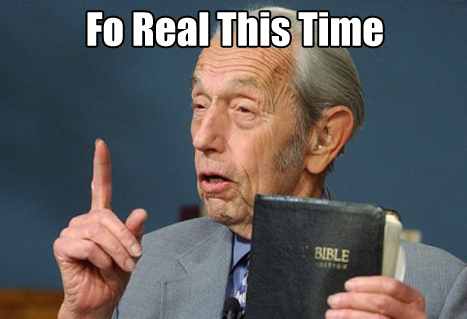
Harold Camping & May 21 Judgment Day – Update!

By Ken Silva pastor-teacher on May 20, 2011

But understand this, that in the last days there will come times of difficulty.

For people will be lovers of self, lovers of money, proud, arrogant, abusive, disobedient to their parents, ungrateful, unholy, heartless, unappeasable, slanderous, without self-control, brutal, not loving good, treacherous, reckless, swollen with conceit, lovers of pleasure rather than lovers of God, having the appearance of godliness, but denying its power.

Avoid such people. For among them are those who creep into households and capture weak women, burdened with sins and led astray by various passions, always learning and never able to arrive at a knowledge of the truth. (2 Timothy 3:1-7)

Continue reading