False Doctrine Is Worse Than Division

J.C. Ryle  ~

When Peter came to Antioch, I opposed him to his face, because he was clearly in the wrong.  Before certain men  came from James, he used to eat with the Gentiles.  But when  they arrived, he began to draw back and separate himself  from the Gentiles because he was afraid of those who belonged to the circumcision group.

The other Jews joined him in his hypocrisy, so that by their   hypocrisy even Barnabas was led astray.  When I saw that they were not acting in line with the truth of the gospel, I  said to Peter in front of them all, “You are a Jew, yet you live like a Gentile and not like a Jew.  How is it, then,  that you force Gentiles to follow Jewish customs?”

We who are Jews by birth and not “Gentile sinners” know that a man is not justified by observing the law, but by faith in Jesus Christ.  So we, too, have put our faith in Christ Jesus  that we may be justified by faith in Christ and not by observing the law, because by observing the law no one will be justified.  Galatians 2:11-16

The second is,  “That to keep the truth of Christ in His Church is even more important than to keep peace.”  Continue reading

Psalms 35:1-28

Psalms  35:1-28 ESV

Psa 35:1  Of David. Contend, O LORD, with those who contend with me; fight against those who fight against me! (2) Take hold of shield and buckler and rise for my help! (3) Draw the spear and javelin against my pursuers! Say to my soul, “I am your salvation!” (4) Let them be put to shame and dishonor who seek after my life! Let them be turned back and disappointed who devise evil against me! (5) Let them be like chaff before the wind, with the angel of the LORD driving them away! (6) Let their way be dark and slippery, with the angel of the LORD pursuing them! (7) For without cause they hid their net for me; without cause they dug a pit for my life. (8) Let destruction come upon him when he does not know it! And let the net that he hid ensnare him; let him fall into it–to his destruction! (9) Then my soul will rejoice in the LORD, exulting in his salvation. (10) All my bones shall say, “O LORD, who is like you, delivering the poor from him who is too strong for him, the poor and needy from him who robs him?” (11) Malicious witnesses rise up; they ask me of things that I do not know. (12) They repay me evil for good; my soul is bereft. (13) But I, when they were sick– I wore sackcloth; I afflicted myself with fasting; I prayed with head bowed on my chest. (14) I went about as though I grieved for my friend or my brother; as one who laments his mother, I bowed down in mourning. (15) But at my stumbling they rejoiced and gathered; they gathered together against me; wretches whom I did not know tore at me without ceasing; (16) like profane mockers at a feast, they gnash at me with their teeth. (17) How long, O Lord, will you look on? Rescue me from their destruction, my precious life from the lions! (18) I will thank you in the great congregation; in the mighty throng I will praise you. (19) Let not those rejoice over me who are wrongfully my foes, and let not those wink the eye who hate me without cause. (20) For they do not speak peace, but against those who are quiet in the land they devise words of deceit. (21) They open wide their mouths against me; they say, “Aha, Aha! Our eyes have seen it!” (22) You have seen, O LORD; be not silent! O Lord, be not far from me! (23) Awake and rouse yourself for my vindication, for my cause, my God and my Lord! (24) Vindicate me, O LORD, my God, according to your righteousness, and let them not rejoice over me! (25) Let them not say in their hearts, “Aha, our heart’s desire!” Let them not say, “We have swallowed him up.” (26) Let them be put to shame and disappointed altogether who rejoice at my calamity! Let them be clothed with shame and dishonor who magnify themselves against me! (27) Let those who delight in my righteousness shout for joy and be glad and say evermore, “Great is the LORD, who delights in the welfare of his servant!” (28) Then my tongue shall tell of your righteousness and of your praise all the day long. Continue reading

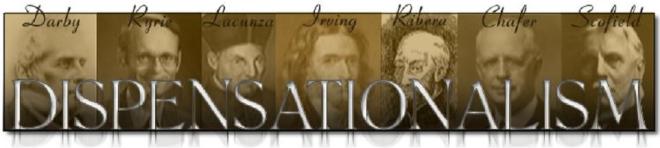
The History of Dispensationalism

“My brother, I am a constant reader of my Bible, and I soon found that what I was taught to believe did not always agree with what my Bible said. I came to see that I must either part company with John Darby, or my precious Bible, and I chose to cling to my Bible and part from Mr. Darby.” George Müeller (1805–1898)

I am quite convinced that all the promises to Israél are found, are finding and will find their perfect fulfilment in the Church. It is true that in time past, in my expositions, I gave a definite place to Israél in the purposes of God. I have now come to the conviction, as I have just said, that it is, the new and spiritual Israél that is intended. G. Campbell Morgan (1863-1945)

Dispensationalism is a device of the enemy, designed to rob the children of no small part of that bread which their heavenly Father has provided for their souls; a device wherein the wily serpent appears as an angel of light, feigning to “make the Bible a new book” by simplifying much in it which perplexes the spiritually unlearned. It is sad to see how widely successful the devil has been by means of this subtle innovation. A. W. Pink(1886-1952)

It is mortifying to remember that I not only held and taught these novelties myself, but that I even enjoyed a complacent sense of superiority because thereof, and regarded with feelings of pity and contempt those who had not received the “new light” and were unacquainted with this up-to-date method of “rightly dividing the word of truth.” For I fully believed what an advertising circular says in presenting “Twelve Reasons why you should use THE SCOFIELD REFERENCE BIBLE,” namely, that: “First, the Scofield Bible outlines the Scriptures from the standpoint of DISPENSATIONAL TRUTH, and there can be no adequate understanding or rightly dividing of the Word of God except from the standpoint of dispensational truth.”

What a slur is this upon the spiritual understanding of the ten thousands of men, “mighty in the Scriptures,” whom God gave as teachers to His people during all the Christian centuries before “dispensational truth” (or dispensational error), was discovered! And what an affront to the thousands of men of God of our own day, workmen that need not to be ashamed, who have never accepted the newly invented system! Yet I was among those who eagerly embraced it (upon human authority solely, for there is none other) and who earnestly pressed it upon my fellow Christians. I am deeply thankful, however, that the time came (it was just ten years ago) when the inconsistencies and self contradictions of the system itself, and above all, the impossibility of reconciling its main positions with the plain statements of the Word of God, became so glaringly evident that I could not do otherwise than renounce it. Philip Mauro (1859-1952) Continue reading

In the world, but not of the world, but which world is that, really?

by Grant Swart

The things of this world, wars, famine, suffering, poverty, etc., impact Christians and non-Christians alike. By remembering that we, as Christians, are “not of this world,” remembering that these things are just for a little while, we can see them in a different light. We are still in this world but we are no longer of it (John 17:14).

Believers are no longer of the world—we are no longer ruled by sin, nor are we bound by the principles of the world. In addition, we are being changed into the image of Christ, causing our interest in the things of the world to become less and less as we mature in Christ. Believers in Jesus Christ are simply in the world—physically present—but not of it, not part of its values. As believers, we should be set apart from the world, we often hear this, even refer to this and remind each other of it, but do we know what that world entails?   Continue reading

A Present or Future Millennium?

by Kim Riddlebarger

Most American Evangelicals are firmly committed to the idea that an earthly millennial age will begin immediately after our Lord Jesus Christ’s Second Advent. Since premillennialism is so dominant in American church circles, many who encounter historic Protestantism for the first time are quite surprised when they discover that all of the Protestant Reformers and the entire Reformed and Lutheran traditions are amillennial. Amillennialism is that understanding of eschatology which sees the millennium not as a future golden age as does premillennialism (the age of the church triumphant), but instead as the present course of history between the First and Second Advent’s of our Lord (the age of the church militant). And indeed, I am sure that there are many readers who will express shock and disappointment upon learning of my own amillennial convictions. But I am convinced, however, that many readers simply do not understand the basic end-times scenario found in the New Testament. Part of the problem is that dispensational premillennial writers have completely dominated Christian media and publishing. There are literally hundreds of books, churches, and parachurch ministries all devoted to taking premillennialism and the “pretribulation” rapture idea to the masses. And so, I can only lament the fact that my own tradition has done so little to produce popular books introducing and defending amillennialism. It is my guess that many who read this article will have never heard the case for the classical position held by the church regarding the return of Christ and the millennial age.

Another problem encountered when examining this subject is that discussions of it often generate a great deal of heat but not very much light. One local prophecy pundit has quipped that the people in heaven with the lowest IQs will be amillennial. Hal “Late Great” Lindsey goes so far as to label amillennialism as “anti-Semitic,” demonic and heretical.1 It is not uncommon to hear prophecy teachers label amillennial Christians as “liberal” or to accuse them of not taking the Bible literally. The result of such diatribes is that American Christians cannot help but be prejudiced by such unfortunate comments, and many simply reject outright (without due consideration of the other side) the eschatology of the Reformers and classical Protestantism-an eschatology that is amazingly simple, biblical, and Christ centered. And so, if you should be in that camp, instead of simply turning me off at this point, please bear with me, hear my case, and then decide for yourself on the basis of Scripture. Continue reading

Remembering Biblical Principles For Christian Women in the Digital World

Young Women and Discretion

by Walter E. Isenhour

“The aged women likewise, that they be in behaviour as becometh holiness . . .  that they may teach the young women to be sober . . . to be discreet, chaste . . .  that the word of God be not blasphemed” —Titus 2:3-5.

In the fifth verse of the second chapter of Titus the aged women are to teach young women “to be discreet.” What does it mean to be discreet? It means to be prudent, judicious, cautious; wise in conduct and management, especially as to matters of propriety and self-control.

A young woman who measures up to these qualities in mind, heart, soul, spirit, and life certainly rises above the degrading principles of sin and wickedness. Her life is one of nobility, beauty, usefulness, and sublimity. She sets examples before her husband, children, and neighbors that areworthy of emulation. They know her life is hid with Christ in God. She possesses the Spirit of our Lord, and this enables her to discern between the evil and the good, and to avoid evil, error, and anything and all things that would mislead her. She likewise shields her husband and children from evils and errors, sins and wickedness, that they are environed with. At least she warns and cautions them against such, and shows them the higher, better, holier, and more beautiful and worthwhile things in life.

The discreet woman is possessed with the spirit and ability to adopt “means to an end,” and of course this means that which brings her and the family to a good end. She avoids the means that would injure her life, character, soul, and influence, and that would likewise injure her family and those about her. She must realize that what she takes into her life will have its effect, through the years—and will bring her to a good end, only as the means are good. She knows that the good will work out right, while the bad will work out wrong. She realizes that the good is a means to a good end, but the bad is a means to a bad end. Therefore she takes into her very soul the good and rejects the bad. She is discreet. Those who know her realize that she is a woman of great and commendable discretion. Continue reading

But Spiritual Discernment is Wholly Lost Until we are Regenerated

by John Calvin

The following selection by John Calvin was taken from book 2, chapter 2 parts 18-21 ofThe Institutes of The Christian Religion, translated by by Henry Beveridge, Esq. A must read for all Christians who aspire to better understand the Bible’s teaching on man’s spiritual impotence prior to the regeneration of the Holy Spirit.

18. The limits of our understanding

We must now explain what the power of human reason is, in regard to the kingdom of God, and spiritual discernments which consists chiefly of three things – the knowledge of God, the knowledge of his paternal favour towards us, which constitutes our salvation, and the method of regulating of our conduct in accordance with the Divine Law. With regard to the former two, but more properly the second, men otherwise the most ingenious are blinder than moles. I deny not, indeed, that in the writings of philosophers we meet occasionally with shrewd and apposite remarks on the nature of God, though they invariably savour somewhat of giddy imagination. As observed above, the Lord has bestowed on them some slight perception of his Godhead that they might not plead ignorance as an excuse for their impiety, and has, at times, instigated them to deliver some truths, the confession of which should be their own condemnation. Still, though seeing, they saw not. Their discernment was not such as to direct them to the truth, far less to enable them to attain it, but resembled that of the bewildered traveller, who sees the flash of lightning glance far and wide for a moment, and then vanish into the darkness of the night, before he can advance a single step. So far is such assistance from enabling him to find the right path. Besides, how many monstrous falsehoods intermingle with those minute particles of truth scattered up and down in their writings as if by chance. In short, not one of them even made the least approach to that assurance of the divine favour, without which the mind of man must ever remain a mere chaos of confusion. To the great truths, What God is in himself, and what he is in relation to us, human reason makes not the least approach. (See Book 3 c. 2 sec. 14, 15, 16.) Continue reading

The Beatitudes and Christ

by Arthur Pink

The Beatitudes and Christ The Beatitudes and Christ Our meditations upon the Beatitudes would not be complete unless they turned our thoughts to the person of our blessed Lord. As we have endeavored to show, they describe the character and conduct of a Christian, and as Christian character is nothing more or less than being experimentally conformed to the image of God’s Son we must turn to Him for the perfect pattern. In the Lord Jesus Christ we find the brightest manifestations of the highest exemplifications of the different spiritual graces which are found, dimly reflected, in His followers. Not one or two but all of these perfections were displayed by Him, for Me is not only “lovely,” but “altogether lovely.” May the Holy Spirit who is here to glorify Him take now of the things of Christ and show them unto us.

First, “Blessed are the poor in spirit.” Most blessed is it to see how the Scriptures speak of Him who was rich becoming poor for our sakes, that we through His poverty might be rich. Great indeed was the poverty into which He entered. Born of parents who were poor in this world’s goods, He commenced His earthly life in a manger. During His youth and early manhood He toiled at the carpenter’s bench. After His public ministry had begun He declared that though the foxes had their holes and the birds of the air their nests, the Son of Man had not where to lay His head. If we trace out the Messianic utterances recorded in the Psalms by the Spirit of prophecy, we shall find that again and again He confessed to God His poverty of spirit: “I am poor and sorrowful” (Ps. 69:29); and, “Bow down thine ear, O Jehovah, for I am poor and needy” (Ps. 86:1); and again, “For I am poor and needy, and My heart is wounded within me” (Ps. 109:22). Continue reading

The Truth War: Fighting for Certainty in an Age of Deception

There is a vast number of “Discernment” ministries out there and this is wonderful, but we must guard not to fall into a trap of un Biblical discernment. I was there once myself and have fallen hard believe me. Be discerning when you visit a “Discernment” blog/website. There are few Biblical ones out there. To speak the truth in love should be foremost the  most outstanding character when warning others of false teachings.

Eph 4:15 Rather, speaking the truth in love, we are to grow up in every way into him who is the head, into Christ, – Gills Commentary  explains it so clearly. ~  Continue reading

Bewitched

Acts 20:29-30 I know that after my departure fierce wolves will come in among you, not sparing the flock; (30) and from among your own selves will arise men speaking twisted things, to draw away the disciples after them.

John MacArthur – Grace to You

Galatians 3:1-5


Our study tonight takes us to the third chapter of the book of Galatians in our continuing look at this most exciting and helpful book. We will be considering verses 1-5. Galatians 3:1-5.

Defection is an ugly word. So is the word deserter. Certainly, there is nothing more bewildering, and few things more sorrowing, than to see a Christian who defects, or deserts, the purity of the Christian faith by which he has been born again and by which he has been nurtured, to settle for something less. But strange as it may seem, many Christians do. We find that they begin well. They receive the grace of Christ extended in salvation; they live in humble faith, but soon they fall into systems of legalism, systems of ritual, systems of works. I wonder how many Christians, for example, have come to a knowledge of Jesus Christ in a very personal way and have then fallen into a very liturgical church pattern, where they merely go through formalities and functions that have only external symbolism and no internal significance. I wonder how many people begin well, but then begin to substitute things like confirmation and communion and baptism and the Mass and any other kind of particular church rite for the realities of the Christian faith.

This is an issue that comes to full force in the book of Galatians, because this is the issue that confronts the heart of the Apostle Paul. He had been used as the mouthpiece of God to introduce the Galatians to the truth of the Gospel. He was the one who preached the gospel of grace; he was the one who exposed them to the magnificence of the Christian experience (which was by faith plus nothing) in the perfect and finished work of Jesus Christ. But since that time when he had begun with them, they had defected. They had deserted the simple purity of a grace gospel and substituted a form of religion, inferior and impotent.

This is not to say they had lost their salvation. It is to say, rather, that they substituted for the fullness of their life in Christ a form of religion that had no power and no joy. Furthermore, the unsaved world would get it’s doctrine of salvation from their lives and if they live legalistic lives, the world then is to conclude that salvation comes by legalism and nothing could be further from the truth. Continue reading

Bad Company Corrupts Good Character


John MacArthur – Grace to You

Do not be deceived: “Bad company corrupts good morals.” Become sober–minded as you ought, and stop sinning; for some have no knowledge of God. I speak this to your shame. (1 Corinthians15:33–34)

Paul warned the Corinthians that they should not be deceived about the danger of bad companyHomilia(company) basically means an association of people, but also can have the connotation of a lecture or sermon. It seems possible, therefore, that the Corinthians were both listening to some wrong teaching and associating with some evil people. Whether the teaching was in formal messages or not, it was bad and corrupting.

People who think wrongly invariably behave wrongly. Wrong behavior comes from wrong thinking, from wrong beliefs and wrong standards. It is impossible to associate regularly with wicked people without being contaminated both by their ideas and by their habits. The context implies that the bad company was teaching the heretical theology that there is no resurrection of the dead, and that bad theology had corrupted good morals. Continue reading

Rain and Grace: A Comparison.

Job 38:28 “Has the rain a father, or who has begotten the drops of dew?

Sermon Notes From Charles Spurgeon 

These Notes from Spurgeon, famed for his expository preaching in England at Park St.
and Metropolitan Tabernacle Pulpit, are well worth studying, adapting, and making
your own, for any sound preacher of the Gospel. He is deservedly known
to this day as “the Prince of Preachers,” and is arguably the greatest
preacher who has lived since New Testament days!

Who hath divided a watercourse for the overflowing of waters, or a way for the lightning of thunder; To cause it to rain on the earth, where no man is; on the wilderness, wherein there is no man; To satisfy the desolate and waste ground; and to cause the bud of the tender herb to spring forth? Job 38:25-27

God challengeth man to compare with his Maker even in the one matter of the rain. Can he create it? Can he send a shower upon the desert, to water the lone herbs which else would perish in the burning heat? No, he would not even think of doing such a thing. That generous act cometh of the Lord alone.

We shall work out a parallel between grace and rain. Continue reading

Discerning Leadership

By John MacArthur

The language of warfare is sprinkled throughout the apostle Paul’s writing, especially where it relates to leadership. He urged Timothy to “fight the good fight of faith” (1 Timothy 6:12). And he commanded believers to take up the armor of God (1 Thessalonians 5:8) and prepare for battle. His life was a spiritual war as he combatted false teaching and religious error.

But Paul knew the real battle was not ultimately against human false teachers. It was nothing less than full-scale war against the kingdom of darkness. “We do not wrestle against flesh and blood, but against principalities, against powers, against the rulers of the darkness of this age, against spiritual hosts of wickedness in the heavenly places” (Ephesians 6:12).

All believers are engaged in that same battle. We are fighting for the preservation and proclamation of the truth. We are fighting for the honor of Jesus Christ. We are fighting for the salvation of sinners, and we are fighting for the virtue of saints. Continue reading

How We Got The Bible

John F. MacArthur, Jr.

Ever since Eve encountered Satan’s barrage of doubt and denial (Gen. 3:1-7), mankind has continued to question God’s Word. Unfortunately, Eve had little or no help in sorting through her intellectual obstacles to full faith in God’s self-disclosure (Gen. 2:16,17).

Now the Scripture certainly has more than enough content to be interrogated, considering that it’s comprised of 66 books, 1,189 chapters, 31,173 verses, and 774,746 words. When you open your English translation to read or study, you might have asked in the past or are currently asking, “How can I be sure this is the pure and true Word of God?”

A question of this kind is not altogether bad, especially when one seeks to learn with a teachable mind (Acts 17:11). The Scripture invites the kinds of queries that a sincere student asks. Continue reading

Sinners in the Hands of an Angry God (Narrative) – Jonathan Edwards

This sermon can go without any added words and a must listen to unregenerate sinners. Oh that God might bring salvation unto His elect, and be glorified. Oh sinner come to Christ while He is near and willing.