John 10:27 My sheep hear my voice, and I know them, and they follow me.
By Don Fortner
With these two simple words our Lord distinguishes his people from all the rest of mankind. Let men deny it as they will, and let them denounce me for preaching it if that gives them pleasure, but the God of the Bible does distinguish between men. He chooses some and passes by others. He redeems some and leaves others under the curse of the law. He calls some and rejects others. He saves some and damns others. Grace is God’s prerogative. He has mercy on whom he will have mercy. Continue reading →
Free-Willism, Legalism, Arminianism, Blasphemy and Idolatry are some of the parts which combine to form the body of a dreadful and monstrous beast which runs fiercely and defiantly through the church.
A vile and detestable thing exists, a pestilence and disease which causes festering sores to form on the belief system of many who congregate in so many churches today. Grotesquely seething and bubbling, it places a burden of immeasurable weight onto the backs of those who become infected by it. It is a virulent disease carried by a beast of biblical proportions, and which can only be eradicated by the dedicated and correct application of the Word of God. Such correct application as can only be facilitated by means of God’s free and Sovereign grace.
The phenomenal and odiferous beast has been proliferated from within the teachings of certain men Continue reading →
Many today are willing to forsake the very foundation truths of Holy Scripture for the sake of “unity”. This we cannot do.
There are some things, plainly revealed in the Word of God, vital to the faith of the gospel, and burned into our souls. Upon these things we must stand with unbending, absolute firmness, even if we have to stand totally alone. These things are not debatable!
There are basically two aspects in any definition of sovereignty. In order for anyone to be a king he must possess, (1) Absolute Authority, and, (2) All Power. A king must have the right to rule, and the ability to carry out his will. God said through Isaiah, “.. for I am God, and there is none else; I am God, and there is none like me .. My counsel shall stand, and I will do all my pleasure.” Isa. 46:9-10. Our God is a unique King in that his reign is eternal, “..the LORD sitteth King for ever.” Psa. 29:10.
A — DEFINITION OF SOVEREIGNTY:
“That the great God, blessed for ever, hath an absolute power and right dominion over his creatures, to dispose and determine of them as seemeth him good. Elisha Coles, God’s Sovereignty.” P 1.
B — PLACE OF SOVEREIGNTY:
We are not to think necessarily that sovereignty is an attribute of God. It is the conclusion of all His attributes. When we read that God is holy, just, love, gracious, merciful, all-wise, all-powerful, yea, all the works of God we see displayed, we reckon that He is sovereign! This is of extreme value to the child of God, to know there is no greater than his God.
“Although the sovereignty of God is universal and absolute, it is not the sovereignty of blind power. It is coupled with infinite wisdom, holiness, and love. And this doctrine, when properly understood, is a most comforting and reassuring one. Who would not prefer to have his affairs in the hands of a God of infinite power, wisdom, holiness and love, rather than to have them left to fate, or chance, or irrevocable natural law, or to short-sighted and perverted self? Those who reject God’s sovereignty should consider what alternatives they have left.” Loraine Boettner.
All of the works of God described in the Bible indicate that He is sovereign and that he has such authority and power, even as we are told in our text, “..the Lord God omnipotent reigneth.” When John, in the Revelation, saw inside heaven he saw, “the Lord God Almighty and the Lamb.” Rev.21:22 Continue reading →
As Spurgeon cried with deep insight: “Once a church or individual Christian gets on the downgrade, momentum takes over, recovery is unusual.” And there our modern church is found falling away in profound decadency with most churches having “ICHABOD” written on their doors.
The issue of Women Preachers is just one of the symptoms of this malaise of the church and so from all sides the word now used is “Post Christian Era”. But here we are dealing with this “cancer” of women preachers in the church. The Bible speaks too clearly on this subject for there to be any confusion. The problem is that churches too often are looking to sources other than the Bible for guidance; indeed they are fully steeped in the tenets of secularism. God loves women as much as He does men. Women are as important to the home, church, and society as men are. In Jesus Christ, women enjoy the same access to salvation and blessings before God as men do. This does not mean, though, there is no difference in men and women in their appearance and roles. There is a basic truth, which needs to be restated in the church and society today: Men and women are different and are not interchangeable!Continue reading →
God has recently given us the opportunity to discuss some theological issues with other Christians who believe differently than we do on a number of points, most notably the doctrines of grace. In such a circumstance, given the overwhelming supply of scriptural evidence that comes to bear on the topic, it seemed to me that the best approach would be a simple categorized scripture list: the fact that the entire paper would be scriptures, with the exception of a few brief explanatory notes, would underscore the truth that this is God’s own word and teaching; and the fact that it would be categorized would facilitate the ready comparison of scripture with scripture so as to lead one to a full-orbed understanding of the biblical teaching. Although I found a few good scripture lists of that nature available online, none of them was laid out in quite the progression that I was looking for, and so I developed my own. I’m posting it here with just the scripture references. Below, for your convenience I have provided a condensed version and a full version of the study. Continue reading →
Psa 35:1 Of David. Contend, O LORD, with those who contend with me; fight against those who fight against me! (2) Take hold of shield and buckler and rise for my help! (3) Draw the spear and javelin against my pursuers! Say to my soul, “I am your salvation!” (4) Let them be put to shame and dishonor who seek after my life! Let them be turned back and disappointed who devise evil against me! (5) Let them be like chaff before the wind, with the angel of the LORD driving them away! (6) Let their way be dark and slippery, with the angel of the LORD pursuing them! (7) For without cause they hid their net for me; without cause they dug a pit for my life. (8) Let destruction come upon him when he does not know it! And let the net that he hid ensnare him; let him fall into it–to his destruction! (9) Then my soul will rejoice in the LORD, exulting in his salvation. (10) All my bones shall say, “O LORD, who is like you, delivering the poor from him who is too strong for him, the poor and needy from him who robs him?” (11) Malicious witnesses rise up; they ask me of things that I do not know. (12) They repay me evil for good; my soul is bereft. (13) But I, when they were sick– I wore sackcloth; I afflicted myself with fasting; I prayed with head bowed on my chest. (14) I went about as though I grieved for my friend or my brother; as one who laments his mother, I bowed down in mourning. (15) But at my stumbling they rejoiced and gathered; they gathered together against me; wretches whom I did not know tore at me without ceasing; (16) like profane mockers at a feast, they gnash at me with their teeth. (17) How long, O Lord, will you look on? Rescue me from their destruction, my precious life from the lions! (18) I will thank you in the great congregation; in the mighty throng I will praise you. (19) Let not those rejoice over me who are wrongfully my foes, and let not those wink the eye who hate me without cause. (20) For they do not speak peace, but against those who are quiet in the land they devise words of deceit. (21) They open wide their mouths against me; they say, “Aha, Aha! Our eyes have seen it!” (22) You have seen, O LORD; be not silent! O Lord, be not far from me! (23) Awake and rouse yourself for my vindication, for my cause, my God and my Lord! (24) Vindicate me, O LORD, my God, according to your righteousness, and let them not rejoice over me! (25) Let them not say in their hearts, “Aha, our heart’s desire!” Let them not say, “We have swallowed him up.” (26) Let them be put to shame and disappointed altogether who rejoice at my calamity! Let them be clothed with shame and dishonor who magnify themselves against me! (27) Let those who delight in my righteousness shout for joy and be glad and say evermore, “Great is the LORD, who delights in the welfare of his servant!” (28) Then my tongue shall tell of your righteousness and of your praise all the day long. Continue reading →
“His Number is 666” By Kim Riddlebarger ~ Sermons on the Book of Revelation # 20 Texts: Revelation 13:11-18; Daniel 8:15-26
There is no subject–with the possible exception of the unpardonable sin–which has caused as much consternation for the people of God as has the so-called “mark of the beast.” John pointedly warns his hearers against taking such a mark on the back of the hand or the forehead. He also tells us that anyone who takes such a mark swears allegiance to the beast. This has given Christians throughout the ages a healthy suspicion of any government which persecutes the church or hinders the preaching of the gospel. It has lead to a number of questions in our own day about advancing technology and increasing government control over many areas of our personal lives. Such a warning from an apostle creates a climate in which sensational predictions and warnings about political events and technology are the norm. So we must do our best to bring clarity to this most difficult and controversial of subjects.
In past sermons, we have been working our way through Revelation 12-14 in which John introduces his reader to seven of the main characters in the great drama of redemption. Like the seal judgments of Revelation 6-8:1 and the trumpet judgments of Revelation 8-11, the vision recorded in Revelation 12-14 describes the entire period of time between the first advent and the second coming of Christ from a distinct theological perspective (or “camera” angle as we have been calling it). In this section of Revelation, John gives us a vivid description of the struggle between the people of God and our great adversary, Satan, who has been cast down from heaven to earth where he now seeks to wage war upon the church of Jesus Christ through the agency of his henchmen, the beast and the false prophet. Continue reading →
The things of this world, wars, famine, suffering, poverty, etc., impact Christians and non-Christians alike. By remembering that we, as Christians, are “not of this world,” remembering that these things are just for a little while, we can see them in a different light. We are still in this world but we are no longer of it (John 17:14).
Believers are no longer of the world—we are no longer ruled by sin, nor are we bound by the principles of the world. In addition, we are being changed into the image of Christ, causing our interest in the things of the world to become less and less as we mature in Christ. Believers in Jesus Christ are simply in the world—physically present—but not of it, not part of its values. As believers, we should be set apart from the world, we often hear this, even refer to this and remind each other of it, but do we know what that world entails? Continue reading →
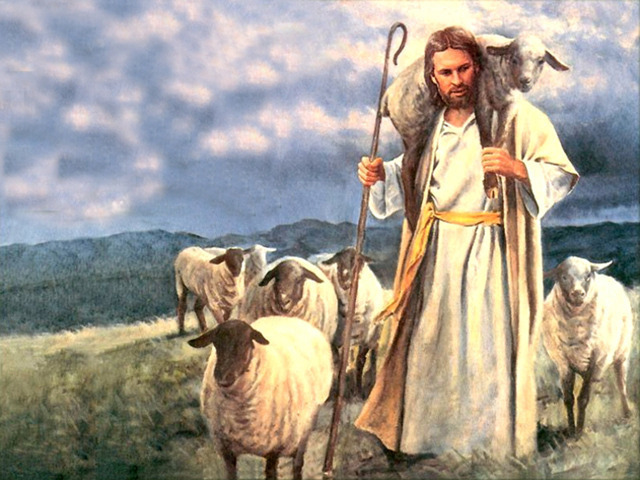
John 10:11 I am the good shepherd. The good shepherd lays down his life for the sheep.
Luke 15:3-7 So he told them this parable: (4) “What man of you, having a hundred sheep, if he has lost one of them, does not leave the ninety-nine in the open country, and go after the one that is lost, until he finds it? (5) And when he has found it, he lays it on his shoulders, rejoicing. (6) And when he comes home, he calls together his friends and his neighbors, saying to them, ‘Rejoice with me, for I have found my sheep that was lost.’ (7) Just so, I tell you, there will be more joy in heaven over one sinner who repents than over ninety-nine righteous persons who need no repentance.
THEN a shepherd has at last overtaken his poor, silly, wandering sheep, he does not straightway fall to scolding or beating it for having cost him so much toil and trouble. No; but he observes that it is very weary, that it has torn itself among thorns, and cut itself among jagged rocks, and therefore he first tenderly sees to its wounds, and then bears it back to the fold in his own arms. Poor trembling sinner, the gospel has at length laid hold upon you; you cannot longer run into the paths of sin, grace has stopped your mad career, and made you tremble at the guilt of sin. Continue reading →
John 11:52 and not for the nation only, but also to gather into one the children of God who are scattered abroad.
By Don Fortner
John11:52
Our great, sin-atoning Substitute laid down his life and died for the children of God. According to the prophecy of Caiaphas, Christ was to die, not for the nation of the Jews only, but to “gather together in one the children of God that were scattered abroad” throughout the Gentile world. Redemption and adoption belong to the same people. Those who are predestinated to adoption by Christ are said to have redemption in him through his blood (Eph 1:5,7). This blessing of adoption, in the full enjoyment of it, in the resurrection, is called “the redemption of the body”. The resurrection is called the redemption of our bodies because redemption, in so far as the application of it is concerned, will not be complete until our very bodies are redeemed from all the consequences of Adam’s fall (Rom 8:23; Eph. 1:14; 4:30). Continue reading →
Acts 20:29-30 I know that after my departure fierce wolves will come in among you, not sparing the flock; (30) and from among your own selves will arise men speaking twisted things, to draw away the disciples after them.
Our study tonight takes us to the third chapter of the book of Galatians in our continuing look at this most exciting and helpful book. We will be considering verses 1-5. Galatians 3:1-5.
Defection is an ugly word. So is the word deserter. Certainly, there is nothing more bewildering, and few things more sorrowing, than to see a Christian who defects, or deserts, the purity of the Christian faith by which he has been born again and by which he has been nurtured, to settle for something less. But strange as it may seem, many Christians do. We find that they begin well. They receive the grace of Christ extended in salvation; they live in humble faith, but soon they fall into systems of legalism, systems of ritual, systems of works. I wonder how many Christians, for example, have come to a knowledge of Jesus Christ in a very personal way and have then fallen into a very liturgical church pattern, where they merely go through formalities and functions that have only external symbolism and no internal significance. I wonder how many people begin well, but then begin to substitute things like confirmation and communion and baptism and the Mass and any other kind of particular church rite for the realities of the Christian faith.
This is an issue that comes to full force in the book of Galatians, because this is the issue that confronts the heart of the Apostle Paul. He had been used as the mouthpiece of God to introduce the Galatians to the truth of the Gospel. He was the one who preached the gospel of grace; he was the one who exposed them to the magnificence of the Christian experience (which was by faith plus nothing) in the perfect and finished work of Jesus Christ. But since that time when he had begun with them, they had defected. They had deserted the simple purity of a grace gospel and substituted a form of religion, inferior and impotent.
This is not to say they had lost their salvation. It is to say, rather, that they substituted for the fullness of their life in Christ a form of religion that had no power and no joy. Furthermore, the unsaved world would get it’s doctrine of salvation from their lives and if they live legalistic lives, the world then is to conclude that salvation comes by legalism and nothing could be further from the truth. Continue reading →
See to it that no one takes you captive through philosophy and empty deception, according to the tradition of men, according to the elementary principles of the world, rather than according to Christ. (Colossians 2: 2:8a)
Paul is concerned that those who have been transferred from Satan’s domain to Christ’s kingdom not become enslaved again. He voiced a similar concern in Galatians 5:1: “It was for freedom that Christ set us free; therefore keep standing firm and do not be subject again to a yoke of slavery.” He calls the Colossians to constant watchfulness because danger is near, as the present tense imperative form of blepo (see to it) indicates. The church constantly faces the danger of false teachers. Jesus says in Matthew 7:15, “Beware of the false prophets, who come to you in sheep’s clothing, but inwardly are ravenous wolves.” In Matthew 16:6 he warns, “Watch out and beware of the leaven of the Pharisees and Sadducees.”
The apostles also warned the church against false teachers. Paul cautioned the Ephesian elders that “after my departure savage wolves will come in among you, not sparing the flock; and from among your own selves men will arise, speaking perverse things, to draw away the disciples after them. Therefore be on the alert” (Acts 20:29–31). To the Philippians he wrote, “Beware of the dogs, beware of the evil workers, beware of the false circumcision” (Phil. 3:2). Peter also warns of the danger of false teachers. He writes in 2 Peter 3:1, “You therefore, beloved, knowing this beforehand, be on your guard lest, being carried away by the error of unprincipled men, you fall from your own steadfastness.” Continue reading →
Love is the best known but least understood of all God’s attributes. Almost everyone who believes in God these days sees Him as a God of love. I have even met agnostics who are quite certain that if God exists, He must be benevolent, compassionate, and loving.
All those things are infinitely true about God, of course, but not in the way most people think. Because of the influence of modern liberal theology, many suppose that God’s love and goodness ultimately nullify His righteousness, justice, and holy wrath. They envision God as a benign heavenly grandfather-tolerant, affable, lenient, permissive, devoid of any real displeasure over sin, who without consideration of His holiness will benignly pass over sin and accept people as they are.
Liberal thinking about God’s love also permeates much of evangelicalism today. We have lost the reality of God’s wrath. We have disregarded His hatred for sin. The God most evangelicals now describe is all-loving and not at all angry. We have forgotten that “It is a terrifying thing to fall into the hands of the living God” (Hebrews 10:31). We do not believe in that kind of God anymore. Continue reading →











 For the Love of His Truth