His Number is 666

“His Number is 666”
By Kim Riddlebarger ~ Sermons on the Book of Revelation # 20
Texts: Revelation 13:11-18; Daniel 8:15-26

There is no subject–with the possible exception of the unpardonable sin–which has caused as much consternation for the people of God as has the so-called “mark of the beast.” John pointedly warns his hearers against taking such a mark on the back of the hand or the forehead. He also tells us that anyone who takes such a mark swears allegiance to the beast. This has given Christians throughout the ages a healthy suspicion of any government which persecutes the church or hinders the preaching of the gospel. It has lead to a number of questions in our own day about advancing technology and increasing government control over many areas of our personal lives. Such a warning from an apostle creates a climate in which sensational predictions and warnings about political events and technology are the norm. So we must do our best to bring clarity to this most difficult and controversial of subjects.

In past sermons, we have been working our way through Revelation 12-14 in which John introduces his reader to seven of the main characters in the great drama of redemption. Like the seal judgments of Revelation 6-8:1 and the trumpet judgments of Revelation 8-11, the vision recorded in Revelation 12-14 describes the entire period of time between the first advent and the second coming of Christ from a distinct theological perspective (or “camera” angle as we have been calling it). In this section of Revelation, John gives us a vivid description of the struggle between the people of God and our great adversary, Satan, who has been cast down from heaven to earth where he now seeks to wage war upon the church of Jesus Christ through the agency of his henchmen, the beast and the false prophet. Continue reading


In the world, but not of the world, but which world is that, really?

by Grant Swart

The things of this world, wars, famine, suffering, poverty, etc., impact Christians and non-Christians alike. By remembering that we, as Christians, are “not of this world,” remembering that these things are just for a little while, we can see them in a different light. We are still in this world but we are no longer of it (John 17:14).

Believers are no longer of the world—we are no longer ruled by sin, nor are we bound by the principles of the world. In addition, we are being changed into the image of Christ, causing our interest in the things of the world to become less and less as we mature in Christ. Believers in Jesus Christ are simply in the world—physically present—but not of it, not part of its values. As believers, we should be set apart from the world, we often hear this, even refer to this and remind each other of it, but do we know what that world entails?   Continue reading

A Present or Future Millennium?

by Kim Riddlebarger

Most American Evangelicals are firmly committed to the idea that an earthly millennial age will begin immediately after our Lord Jesus Christ’s Second Advent. Since premillennialism is so dominant in American church circles, many who encounter historic Protestantism for the first time are quite surprised when they discover that all of the Protestant Reformers and the entire Reformed and Lutheran traditions are amillennial. Amillennialism is that understanding of eschatology which sees the millennium not as a future golden age as does premillennialism (the age of the church triumphant), but instead as the present course of history between the First and Second Advent’s of our Lord (the age of the church militant). And indeed, I am sure that there are many readers who will express shock and disappointment upon learning of my own amillennial convictions. But I am convinced, however, that many readers simply do not understand the basic end-times scenario found in the New Testament. Part of the problem is that dispensational premillennial writers have completely dominated Christian media and publishing. There are literally hundreds of books, churches, and parachurch ministries all devoted to taking premillennialism and the “pretribulation” rapture idea to the masses. And so, I can only lament the fact that my own tradition has done so little to produce popular books introducing and defending amillennialism. It is my guess that many who read this article will have never heard the case for the classical position held by the church regarding the return of Christ and the millennial age.

Another problem encountered when examining this subject is that discussions of it often generate a great deal of heat but not very much light. One local prophecy pundit has quipped that the people in heaven with the lowest IQs will be amillennial. Hal “Late Great” Lindsey goes so far as to label amillennialism as “anti-Semitic,” demonic and heretical.1 It is not uncommon to hear prophecy teachers label amillennial Christians as “liberal” or to accuse them of not taking the Bible literally. The result of such diatribes is that American Christians cannot help but be prejudiced by such unfortunate comments, and many simply reject outright (without due consideration of the other side) the eschatology of the Reformers and classical Protestantism-an eschatology that is amazingly simple, biblical, and Christ centered. And so, if you should be in that camp, instead of simply turning me off at this point, please bear with me, hear my case, and then decide for yourself on the basis of Scripture. Continue reading

Can Those Of Religions Other Than Christianity Enter The Kingdom Of God ?

MUST-SEE VIDEO: WHY “KINGDOM CIRCLES” TEACHING IS BLASPHEMOUS

Posted by: Amy Spreeman

Remember when we first shared that photo of a Saddleback pastor teaching a highly questionable method of evangelizing to other religions? Churches around the world are learning how to blend or sychretize two different faiths, thanks to movements like Jesus in the Qur’an and The Insider Movement.  These folks will often use the so-called “Kingdom Circles” illustration to explain how Muslims, Hindus, Buddhists, etc., can enter the Kingdom of God without actually converting to Christianity.

Today I sat down with Elijah Abraham, a former Muslim and now born-again Christian, who took out a pen and paper to explain to me why Kingdom Circles is flawed at best, and more truthfully, blasphemous.

He then illustrated a much better (and biblical!) way to explain the Kingdom to those who do not know Christ. Here is the video: Continue reading

Entertainment and Style of Music Do Not Convert People

John MacArthur,

“It’s not the style of our music that gets people converted. It’s not because of the entertainment level that they enjoy that gets them converted. Sooner or later you’ve got to get down to confronting them with the message and my judgment is sooner is better than later. So what are we waiting for? Let’s just get them to hear the message, that’s how they’re going to be saved. Take out the preaching of sin, take out the preaching of hell, take out repentance, take out the cross, and then people will feel comfortable. That’s the new trend. Build an image of love, care, being nice and if everybody is nice, they like us, they might like Jesus. That is tragically not the case. Continue reading

How to Discern : How to Smell a Rat (Part 1 /6)

By Pastor Anton Bosch 

 How to Smell a Rat (Part 1 /6)

A toddler will eat anything. It does not matter if it is nutritious or poison, it has no ability to discern between food and poison.

As Christians mature in the faith they should learn to discern between spiritual poison and spiritual food. “But solid food belongs to those who are of full age, that is, those who by reason of use have their senses exercised to discern both good and evil” (Hebrews 5:14). The problem is that the vast majority of modern-day “Christians” are either not born again or have been kept in a perpetual state of babyhood and thus are unable to discern the difference between truth and error. Because of this, and because we have a new generation of church-goers who do not know the Bible, false teachers have multiplied and millions believe anything these preachers say.

Discriminating between truth and error is really not that difficult as long as we abide by a few basic principles. The first of these is that truth is absolute. I use the term “absolute” as the opposite of “relative”. For most people – Christian and non-Christian – truth is relative. We hear: Continue reading

Remembering Biblical Principles For Christian Women in the Digital World

Young Women and Discretion

by Walter E. Isenhour

“The aged women likewise, that they be in behaviour as becometh holiness . . .  that they may teach the young women to be sober . . . to be discreet, chaste . . .  that the word of God be not blasphemed” —Titus 2:3-5.

In the fifth verse of the second chapter of Titus the aged women are to teach young women “to be discreet.” What does it mean to be discreet? It means to be prudent, judicious, cautious; wise in conduct and management, especially as to matters of propriety and self-control.

A young woman who measures up to these qualities in mind, heart, soul, spirit, and life certainly rises above the degrading principles of sin and wickedness. Her life is one of nobility, beauty, usefulness, and sublimity. She sets examples before her husband, children, and neighbors that areworthy of emulation. They know her life is hid with Christ in God. She possesses the Spirit of our Lord, and this enables her to discern between the evil and the good, and to avoid evil, error, and anything and all things that would mislead her. She likewise shields her husband and children from evils and errors, sins and wickedness, that they are environed with. At least she warns and cautions them against such, and shows them the higher, better, holier, and more beautiful and worthwhile things in life.

The discreet woman is possessed with the spirit and ability to adopt “means to an end,” and of course this means that which brings her and the family to a good end. She avoids the means that would injure her life, character, soul, and influence, and that would likewise injure her family and those about her. She must realize that what she takes into her life will have its effect, through the years—and will bring her to a good end, only as the means are good. She knows that the good will work out right, while the bad will work out wrong. She realizes that the good is a means to a good end, but the bad is a means to a bad end. Therefore she takes into her very soul the good and rejects the bad. She is discreet. Those who know her realize that she is a woman of great and commendable discretion. Continue reading

For Whom Did Christ Die? – The Children Of God

John 11:52 and not for the nation only, but also to gather into one the children of God who are scattered abroad.

By Don Fortner 

John11:52
Our great, sin-atoning Substitute laid down his life and died for the children of God. According to the prophecy of Caiaphas, Christ was to die, not for the nation of the Jews only, but to “gather together in one the children of God that were scattered abroad” throughout the Gentile world. Redemption and adoption belong to the same people. Those who are predestinated to adoption by Christ are said to have redemption in him through his blood (Eph 1:5,7). This blessing of adoption, in the full enjoyment of it, in the resurrection, is called “the redemption of the body”. The resurrection is called the redemption of our bodies because redemption, in so far as the application of it is concerned, will not be complete until our very bodies are redeemed from all the consequences of Adam’s fall (Rom 8:23Eph. 1:144:30). Continue reading

The Beatitudes and Christ

by Arthur Pink

The Beatitudes and Christ The Beatitudes and Christ Our meditations upon the Beatitudes would not be complete unless they turned our thoughts to the person of our blessed Lord. As we have endeavored to show, they describe the character and conduct of a Christian, and as Christian character is nothing more or less than being experimentally conformed to the image of God’s Son we must turn to Him for the perfect pattern. In the Lord Jesus Christ we find the brightest manifestations of the highest exemplifications of the different spiritual graces which are found, dimly reflected, in His followers. Not one or two but all of these perfections were displayed by Him, for Me is not only “lovely,” but “altogether lovely.” May the Holy Spirit who is here to glorify Him take now of the things of Christ and show them unto us.

First, “Blessed are the poor in spirit.” Most blessed is it to see how the Scriptures speak of Him who was rich becoming poor for our sakes, that we through His poverty might be rich. Great indeed was the poverty into which He entered. Born of parents who were poor in this world’s goods, He commenced His earthly life in a manger. During His youth and early manhood He toiled at the carpenter’s bench. After His public ministry had begun He declared that though the foxes had their holes and the birds of the air their nests, the Son of Man had not where to lay His head. If we trace out the Messianic utterances recorded in the Psalms by the Spirit of prophecy, we shall find that again and again He confessed to God His poverty of spirit: “I am poor and sorrowful” (Ps. 69:29); and, “Bow down thine ear, O Jehovah, for I am poor and needy” (Ps. 86:1); and again, “For I am poor and needy, and My heart is wounded within me” (Ps. 109:22). Continue reading

Destined to Reign ……. BUT WHERE ?

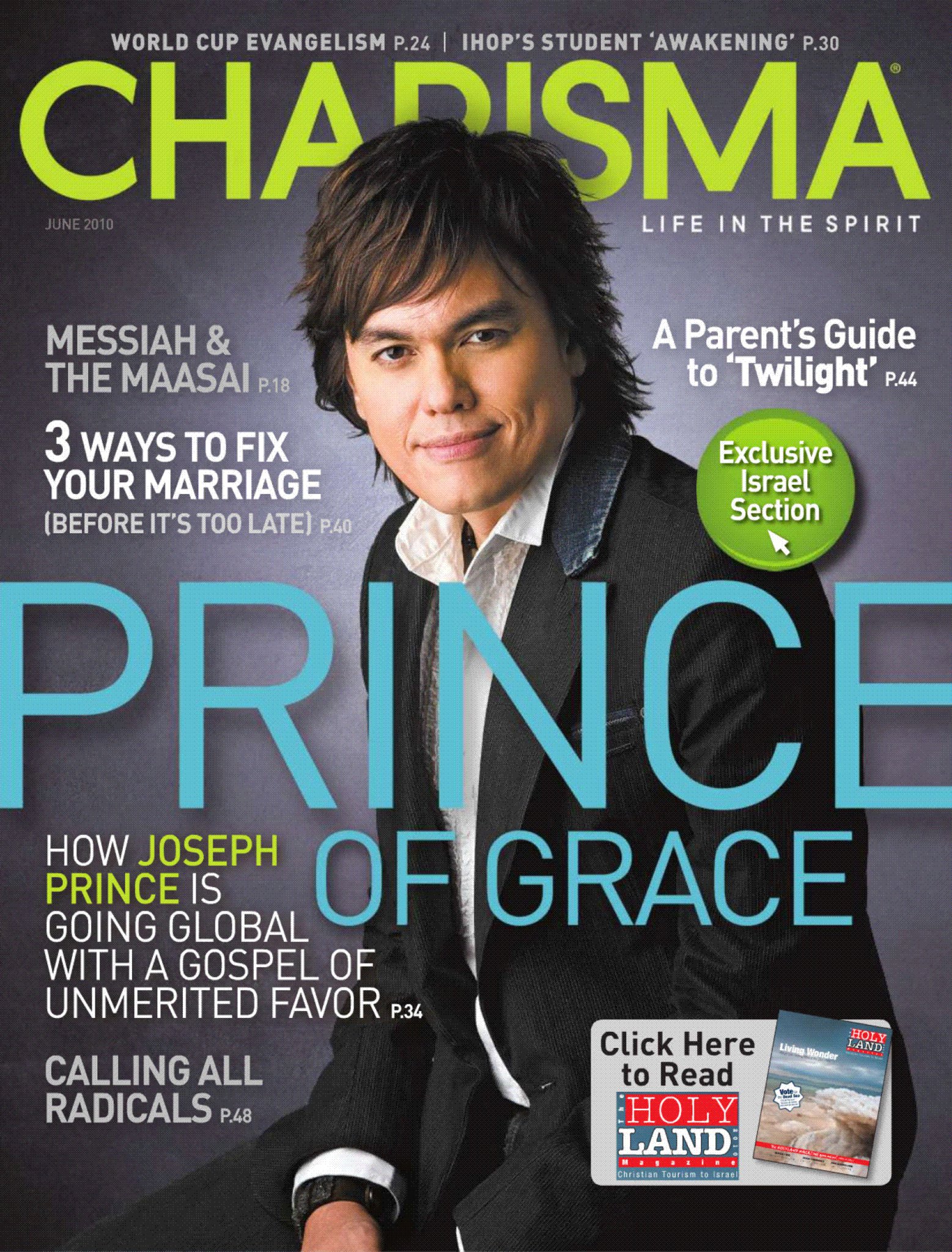
Beware !! of Joseph Prince (Televangelists ) Teachings !!! He also teaches Antinomianism (see below for more details)

Galatians 6: 7 “Do not be deceived: God is not mocked, for whatever one sows, that will he also reap. For the one who sows to his own flesh will from the flesh reap corruption, but the one who sows to the Spirit will from the Spirit reap eternal life.”

You may recognize his picture or have seen him on television. Joseph Prince is a “ MegaStar” televangelist of today.  He delivers his messages with “fire” and with “confidence.”  For the most part, he really captures a persons attention.  He appears to really know the Word of God like no others. He is very appealing.  His message is also very appealing. “Effortless Success and Grace” is the message that he preaches and boldly declares. It has been reported that his birth name was changed to Joseph Prince from Xenonamandar Jegahusiee Singh. Continue reading

Hear This: A Pastor Who Protects His Sheep From Wolves


Act 20:29 I know that after my departure fierce wolves will come in among you, not sparing the flock;

By Amy Spreeman

Here is something we don’t come across very often: A pastor protecting his flock from the latest heresies and fads that are sweeping Christendom through popular books, teachings and teachers leading millions off the path of Truth. I first heard this preacher from  First Baptist Church of Johnson City, NY last weekend after several friends shared it with me.  I was personally touched and impacted by Pastor Jim Murphy’s gracious and humble but firm conviction to stand on God’s Word and nothing else.

He titled his message, The Subtlety of Satan. Continue reading

Rain and Grace: A Comparison.

Job 38:28 “Has the rain a father, or who has begotten the drops of dew?

Sermon Notes From Charles Spurgeon 

These Notes from Spurgeon, famed for his expository preaching in England at Park St.
and Metropolitan Tabernacle Pulpit, are well worth studying, adapting, and making
your own, for any sound preacher of the Gospel. He is deservedly known
to this day as “the Prince of Preachers,” and is arguably the greatest
preacher who has lived since New Testament days!

Who hath divided a watercourse for the overflowing of waters, or a way for the lightning of thunder; To cause it to rain on the earth, where no man is; on the wilderness, wherein there is no man; To satisfy the desolate and waste ground; and to cause the bud of the tender herb to spring forth? Job 38:25-27

God challengeth man to compare with his Maker even in the one matter of the rain. Can he create it? Can he send a shower upon the desert, to water the lone herbs which else would perish in the burning heat? No, he would not even think of doing such a thing. That generous act cometh of the Lord alone.

We shall work out a parallel between grace and rain. Continue reading

Why We Must Contend Earnestly For The Faith

Why We Must Contend Earnestly For The Faith
Presented by Pastor Bob DeWaay

The book of Jude warns believers about the deception that false teachers bring into the church and the dangers they pose for the flock. We live in a time of massive deception yet many Christians think that tolerance is more important than truth. Pastor DeWaay shows from Scripture how dangerous this attitude is and how we must contend for the faith. Continue reading

Romantic Panentheism: A Review of One Thousand Gifts by Ann Voskamp

If I have a joint of meat on my table of which the smell and the taste at once convince me that it is putrid and unwholesome, should I show discretion by eating the whole of it before giving my judgment that it is not fit for food?

One mouthful is quite enough, and one sentence of some books ought to suffice for a sensible man to reject the whole mass. Let those who can relish such meat feed on it, but I have a taste for better food.

Keep to the study of the Word of God. If it be your duty to expose those evils, encounter them bravely, with prayer to God to help you. But if not, as a humble believer in Jesus, what business have you to taste and best such noxious fare when it is exposed in the market?  ~C H Spurgeon (source)

I posted this article almost a year ago, well it is time for a re-post. Please also read An Open Letter To Tim Challies

Romantic Panentheism,

 a Review of One Thousand Gifts by Ann Voskamp

By Bob DeWaay

 Printer Friendly PDF

We live in a theological age (postmodern) where the rational and cognitive are questioned and replaced by the sensual and mysterious. Many churches promote the idea of worshipping God with all five senses. Feelings trump clear Biblical exegesis, systematic theology, statements of faith, and any other rational approach to Christian theology. Into this milieu comes a book that takes romanticism to a new level, using sensuality to invoke religious feelings and ostensibly true devotion. The book is One Thousand Gifts by Ann Voskamp, a Canadian farmer’s wife. Continue reading

An Open Letter To Tim Challies

By Cathy Mathews from Sola Sisters

Dear Mr. Challies,

As you may or may not know, we recently posted an article in which we commended your book review of Ann Voskamp’s One Thousand Gifts. And then today, a reader forwarded your most recent post, entitled In Which I Ask Ann Voskamp’s Forgiveness…, an article in which you wrote that after Ann Voskamp emailed you, inviting you to lunch, you felt a twinge of remorse over some of the wording of your original article, especially in light of the fact that you might soon find yourself face to face with her, sharing a meal. Continue reading