Ancient Labyrinths are Re-emerging

Prof Johan Malan

There is a sharp increase in the building and use of labyrinths in the West, which occurs in conjunction with the resurgence of other mystical practices such as Yoga and Eastern meditation. In the USA, more than 1000 labyrinths have been built in meditation garden settings, at retreat centres, churches, hospitals and prisons.

The popularity of labyrinths is also increasing in South Africa and many other countries.

Continue reading

Ready to Discriminate?

John MacArthur – Grace to You

(9min Audio)

The issue of who is truly a Christian is at the very center of the church’s life and ministry. This has to be protected. There isn’t any fellowship between light and darkness, is there, 2 Corinthians 6? There isn’t any concord between Christ and Satan. Two can’t walk together unless they be…what?…agreed. You have to come out from among them and be ye separate and touch not the unclean thing.

And here is the church absorbing all of this. And now it’s so confusing that the church itself doesn’t even know who’s a Christian and frankly I don’t think they particularly care as long as you say you believe in Jesus. A friend, Iain Murray who is a gifted theologian and a great biographer, wrote the massive two-volume biography of Martyn Lloyd-Jones has also written on Jonathan Edwards and many others, he is a very esteemed Englishman and has been here many times, we’ve spent many hours together, has written a new book called Evangelicalism Divided in which I read it, just devoured it over the last few weeks while I was in Italy in the plain, in the back of the bus, in the room, everywhere because it just consumed me. Murray is tracking the twentieth century decline of evangelicalism and it’s a book of history that is very, very revealing. And Murray says, and I think he’s absolutely right, he says, the inability of the evangelical church to distinguish between a Christian and a non-Christian is quote: “The greatest failure of professing Christianity in the English-speaking world in the twentieth century,” end quote.

Continue reading

Social Media and Digital Discernment

Social Media and Digital Discernment a must read for all.

From Grace to You blog.

Twenty-five years ago Neil Postman observed that television had become an American “necessity” and lamented its effects on society. He correctly described the culture of the 1980s as one that was amusing itself to death. If he were alive today, Postman would be astonished at how quickly Twitter, Facebook, and other forms of social media have gripped our society. His earlier criticisms raise an interesting question about these current trends: If TV put our culture in the casket, has social media nailed the coffin shut?

In this edition of Pulpit, Pastor John takes a careful look at social networking and encourages believers to exercise discernment.

Continue reading

Bell’s Inferno

Grace to You Blog (a follow up) Friday, April 21, 2011

If anyone advocates a different doctrine and does not agree with sound words, those of our Lord Jesus Christ, and with the doctrine conforming to godliness, he is conceited and understands nothing; but he has a morbid interest in controversial questions and disputes about words, out of which arise envy, strife, abusive language, evil suspicions, and constant friction between men of depraved mind and deprived of the truth, who suppose that religion is a means of gain (1 Timothy 6:3-5).

No one in all the Scriptures had more to say about hell than Jesus. No stern messenger of doom from the era of the Judges, no fiery Old Testament prophet, no writer of imprecatory psalms, and no impassioned apostle (including the Boanerges brothers)—not even all of them combined—mentioned hell more frequently or described it in more terrifying terms than Jesus.

Continue reading

Was Jesus Polite to False Teachers?

John MacArthur – Grace to You

May 21, 2010

Many Christians today are greatly concerned about the rising influences of communism, humanism, secularism, and social injustice. Yet those evils, great as they are, do not together pose the threat to Christianity that false shepherds and pastors do. Throughout the history of redemption, the greatest threat to God’s truth and God’s work has been false prophets and teachers, because they propose to speak in His name. That is why the Lord’s most scathing denunciations were reserved for the false teachers of Israel, who claimed to speak and act for God but were liars.

Continue reading

Rob Bell: “Evangelical and orthodox to the bone?” Hardly.

Grace to You Blog (a follow up) Thursday, April 14, 2011

Rob Bell is reminiscent of the Rich Young Ruler in Mark 10:17-27. He has a warped view of goodness. He talks as if his own standard of good is the norm, and Bell even suggests that God is not good if He sends people to hell.Jesus’ reply to the young inquirer (“No one is good except God alone”—v. 18) says God himself alone is the standard of true good, not any creature—certainly not a fallen creature.The Young Ruler was not saved, nor can any person be who thinks his or her own preferences determine what is truly good. That kind of arrogance reflects a damning egotism.

n his books, sermons, and videos, Rob Bell has consistently promoted views that are antithetical to biblical Christianity and hostile to historic evangelical principles.

Continue reading

The Doctrines of Grace (Part 10 of 10)

John MacArthur – Grace to You

The Doctrine of God’s Effectual Call

We have a wonderful subject to talk about tonight and I took up a little more time than I ought to have, in one sense, but wanted to share with you what I did, so we’re going to try to squeeze it in the time we have. I want you to open your Bible to Romans 8…Romans chapter 8 and let’s begin in Romans 8 with some very familiar revelation from God.

Verse 28 which is familiar to all of us is a good starting point. Romans 8:28, “And we know that God causes all things to work together for good to those who love God, to those who are called according to His purpose, for whom He foreknew He also predestined to become conformed to the image of His Son that He might be the firstborn among many brethren, and whom He predestined these He also called and whom He called these He also justified and whom He justified, these He also glorified.”

Continue reading

The Doctrines of Grace (Part 9 of 10)

John MacArthur – Grace to You

The Doctrine of Actual Atonement, Part 2

Those of you who have been with us know we are tackling some of the more challenging and profound and difficult doctrines in the Scripture. And I trust we’re having a wonderful time digging deeply into God’s precious truth.

Last Sunday night we began to look at the subject, “For whom did Christ die?” Or, “The Nature of the Atonement.” Or as I chose to call it, “The Doctrine of Actual Atonement.” And I want to go back to that. If you weren’t here last week, it really would be helpful for you to get the tape or the CD, whatever is best for you, and to listen to what I said and pair it up with what we’re going to say tonight because you’re going to get just a very abbreviated review of that important foundation.

Continue reading

The Doctrines of Grace (Part 8 of 10)

John MacArthur – Grace to You

The Doctrine of Actual Atonement, Part 1

Well, how many of you have always wanted to go to seminary?  You’re about to go tonight.  I’m going to challenge your thinking a little bit as we talk about this issue of the question, “For whom did Christ die?”  We have been looking over the last number of weeks at some very important doctrines, the doctrine of perseverance, or the preservation of the saints; the doctrine of sovereign election in salvation.  We have looked at the doctrine of total or absolute inability, that is the depravity of the sinner which renders it impossible for him to respond to the gospel.  And tonight I want to talk to you about what I’ve chosen to call, trying to give it a more accurate name, the doctrine of actual atonement…the doctrine of actual atonement.

Continue reading

The Doctrines of Grace (Part 7 of 10)

John MacArthur – Grace to You

The Doctrine of Absolute Inability

We have embarked upon a wonderful study of some very important doctrines on these Sunday nights. And from my viewpoint, it’s kind of open ended, I’m just kind of following the flow and seeing where it goes. But I’m having a wonderful time. As you well know through all these years, we predominantly, if not almost always, work through texts of Scripture and that way we are obligated to affirm what the Word of God says because it’s what it says. And there is always the, I suppose, potential accusation that when you leave the flow of expositional preaching and you embark upon a topical study or a doctrinal study, you ….you may be caught up in something philosophical, you may be caught up in something rational, something logical and you may be drawing conclusions that wouldn’t stand the test of Scripture. And so I want to affirm to you that everything I say I trust will be before your very eyes drawn out of Scripture, and I would encourage you, like the noble Bereans, to do a little work yourself and search the Scripture and see if these things are so. I certainly don’t want to bring to you a rational theology, although it’s not irrational. I don’t want to bring to you a philosophical approach to theology. I don’t want to follow the path of human reason to conclude the things we conclude. I want to bring you what the Word of God has to say and the Word of God does speak to these very, very important doctrinal issues.

Continue reading

The Doctrines of Grace (Part 6 of 10)

John MacArthur – Grace to You

The Doctrine of Election, Part 3

We have over the last couple of Sunday-evening messages been talking about the issue of divine election. Who chose whom? And I understand that this is not a small controversy when you talk about the doctrine of election. There are many people who feel, as I noted in our original message, that this is a dangerous doctrine, that this turns God into a monster, that this is an almost blasphemous, that this is a kind of heresy. And yet no matter how much human reason, human preference might rage against this doctrine, it is inescapably taught in Scripture. And we need to bow our knees to this great truth of divine election, and once we do it may become to us the most precious of all doctrines.

Continue reading

Why would someone hate the word Exegesis? part 3

John MacArthur – Grace to You

How to Study Your Bible

Psalms 1:1-2; Deuteronomy 29:29; 1 Corinthians 8:1

Introduction

Truly the Bible is magnificent. Early twentieth-century evangelist Billy Sunday pictured the Bible like a majestic palace. He wrote,

I entered through the portico of Genesis and walked down through the Old Testament’s art gallery, where I saw the portraits of Joseph, Jacob, Daniel, Moses, Isaiah, Solomon and David hanging on the wall; I entered the music room of the Psalms and the Spirit of God struck the keyboard of my nature until it seemed to me that every reed and pipe in God’s great organ of nature responded to the harp of David, and the charm of King Solomon in his moods.

Continue reading

Why would someone hate the word Exegesis? part 1

Someone said : I am really beginning to hate the word exegesis. What’s wrong with the word summary? It’s simple, easy to understand!

It made me think. Why would the word Exegesis be an issue for someone if they are christian? If one is a believer I believe it is important to understand the meaning of Exegesis before we study the Word of God. there is a big difference between the word summary and the word exegesis. Should Bible teachers now change using the word exegesis to summary?

Summary = Presenting the substance in a condensed form; concise: a summary review.

Exegesis = This is a Latin term relating to correct Biblical understanding. It means literally ‘to lead out’. In the context of studying the Bible it means to get out of the text what the text is saying. This may include a number of things to aid the process such as reading the context in the chapter, in the particular book as a whole eg. Jeremiah or Matthew and even where it fits within the whole Bible. It may also include cultural awareness, the timing of the writing, and identifying the author and even the target audience.

Continue reading

Who’s Afraid of the Big, Bad Heretic?

Evangelical Apathy and the Danger of False Teaching
by John MacArthur

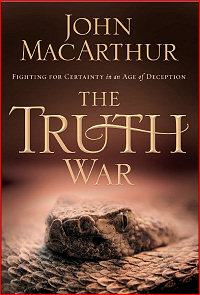
The following is excerpted from The Truth War (Nelson, 2007, pp. 165-68)

Why do so many evangelicals act as if false teachers in the church could never be a serious problem in this generation? Vast numbers seem convinced that they are “rich, have become wealthy, and have need of nothing’; and do not know that [they] are wretched, miserable, poor, blind, and naked” (Revelation 3:17).

In reality, the church today is quite possibly more susceptible to false teachers, doctrinal saboteurs, and spiritual terrorism than any other generation in church history. Biblical ignorance within the church may well be deeper and more widespread than at any other time since the Protestant Reformation. If you doubt that, compare the typical sermon of today with a randomly-chosen published sermon from any leading evangelical preacher prior to 1850. Also compare today’s Christian literature with almost anything published by evangelical publishing houses a hundred years ago or more.

Continue reading

By faith we let them go

C H SPURGEON – DAILY DEVOTIONAL

March 22

Morning
“And he went a little farther, and fell on his face, and prayed.”
– Mat_26:39

There are several instructive features in our Saviour’s prayer in his hour of trial. It was lonely prayer. He withdrew even from his three favoured disciples. Believer, be much in solitary prayer, especially in times of trial. Family prayer, social prayer, prayer in the Church, will not suffice, these are very precious, but the best beaten spice will smoke in your censer in your private devotions, where no ear hears but God’s.
It was humble prayer. Luke says he knelt, but another evangelist says he “fell on his face.” Where, then, must be THY place, thou humble servant of the great Master? What dust and ashes should cover thy head! Humility gives us good foot-hold in prayer. There is no hope of prevalence with God unless we abase ourselves that he may exalt us in due time.
It was filial prayer. “Abba, Father.” You will find it a stronghold in the day of trial to plead your adoption. You have no rights as a subject, you have forfeited them by your treason; but nothing can forfeit a child’s right to a father’s protection. Be not afraid to say, “My Father, hear my cry.”

Continue reading