Here I stand. Immovable.

standing firm

Many today are willing to forsake the very foundation truths of Holy Scripture for the sake of “unity”. This we cannot do.

There are some things, plainly revealed in the Word of God, vital to the faith of the gospel, and burned into our souls. Upon these things we must stand with unbending, absolute firmness, even if we have to stand totally alone. These things are not debatable!

1. The God of Heaven is Continue reading

THREE RELIGIOUS FABLES

To argue that God is “trying His best” to save all mankind, but that the majority of men will not let Him save them, is to insist that the will of the Creator is impotent, and that the will of the creature is omnipotent.” -A.W. Pink

Pastor Don Fortner

The prophecy made by the Apostle Paul in 2 Timothy 4:1-5 has come to pass in our day. All over the world men, and women, and boys, and girls gather in religious assemblies. Some are very solemn. Others can barely be distinguished from dance hall revelry. But they gather in the name of Christ to worship God. They read the Bible, say their prayers, invoke God’s blessing, and give their money. They are devoted. They are sincere. But they are lost! They have faith; but theirs is a false faith. They have hope; but their hope is a delusion. Having been led and taught by blind and ignorant men, “They will not endure sought doctrine; but after their own lusts…they heap to themselves teachers, having itching ears…They turn away their ears from the truth and (have been) turned into fables.”

I am not talking about Hindus, Buddhist, and Muslims. I am talking about men and women who profess to know, worship, trust, and serve the living God by faith in his Son Jesus Christ, through the power of the Holy Spirit. I am talking about our friends, relatives, and neighbors. I am talking about many of you. You have turned away from the truth have been turned unto fables. Do I have your attention? If you will pay attention to the Word of God, God just might teach you something. Continue reading

The Dangers of Arminianism: Part 2 of 2

All free will, works religion, Arminianism in every form, under any denominational name is false religion. It may call itself Christian. But it is not Christian at all. Such religion is utter paganism! It is a total denial of God’s free and sovereign grace in Jesus Christ (Gal. 5:2, 4). Any mixture of works with grace is a total denial of grace (Rom. 11:6). To assert that salvation is by the will of man is to deny that “Salvation is of the Lord” (Jon. 2:9; Rom. 9:16). – Don Fortner

I do not serve the god of the Arminians at all; I have nothing to do with him, and I do not bow down before the Baal they have set up; he is not my God, nor shall he ever be; I fear him not, nor tremble at his presence…The God that saith today and denieth tomorrow, that justifieth today and condemns the next…is no relation to my God in the least degree. He may be a relation of Ashtaroth or Baal, but Jehovah never was or can be his name.” – C.H. Spurgeon


The Dangers of Arminianism (Part 2 of 2)

by Jim Van Winkle
re-posted by Grant Swart


II. ARMINIANISM IS SUBJECTIVE AND EXPERIENTIAL RATHER THAN OBJECTIVE AND DOCTRINAL

A. ARMINIANISM IS ANTI-INTELLECTUAL
B. ARMINIANISM IS PRAGMATIC
C. ARMINIANISM IS PERFECTIONISTIC
D. ARMINIANISM APPEALS TO THE WORLDLY CHURCH
E. ARMINIANISM EMPHASIZES MAN’S ACTIVITY
F. ARMINIANISM DESTROYS FIRST-LOVE CHRISTIANITY

CONCLUSION

II. ARMINIANISM IS SUBJECTIVE AND EXPERIENTIAL RATHER THAN OBJECTIVE AND DOCTRINAL

Pietism, a reaction against Reformation orthodoxy, represented a turn inward, from God to self. Instead of focusing on God and his saving work in Christ, it shifted the focus to me and my personal relationship with Jesus. While no cardinal evangelical truth was rejected the objective focus on Christ’s justification of the sinner was subverted by the subjective focus on the experience Continue reading

The Dangers of Arminianism: Part 1 of 2

All free will, works religion, Arminianism in every form, under any denominational name is false religion. It may call itself Christian. But it is not Christian at all. Such religion is utter paganism! It is a total denial of God’s free and sovereign grace in Jesus Christ (Gal. 5:2, 4). Any mixture of works with grace is a total denial of grace (Rom. 11:6). To assert that salvation is by the will of man is to deny that “Salvation is of the Lord” (Jon. 2:9; Rom. 9:16). – Don Fortner

I do not serve the god of the Arminians at all; I have nothing to do with him, and I do not bow down before the Baal they have set up; he is not my God, nor shall he ever be; I fear him not, nor tremble at his presence…The God that saith today and denieth tomorrow, that justifieth today and condemns the next…is no relation to my God in the least degree. He may be a relation of Ashtaroth or Baal, but Jehovah never was or can be his name.” – C.H. Spurgeon


The Dangers of Arminianism (Part 1 of 2)

by Jim Van Winkle
re-posted by Grant Swart


OUTLINE

I. ARMINIANISM FOSTERS THEOLOGICAL CONFUSION

A. A FALSE DOCTRINE OF PREDESTINATION
B. A FALSE TEACHING ON GOD’S DECREE
C. A FALSE TEACHING ON FOREKNOWLEDGE
D. A FALSE DOCTRINE OF ELECTION
E. A FALSE DOCTRINE OF CALLING
F. A FALSE DOCTRINE OF REGENERATION
G. A FALSE UNDERSTANDING OF THE ATONEMENT
H. A FALSE DOCTRINE OF JUSTIFICATION
I. A FALSE TEACHING ON GOD’S PROVIDENCE
J. A FALSE DOCTRINE OF SOVEREIGNTY
K. A FALSE DOCTRINE OF ASSURANCE
L. A FALSE DOCTRINE OF OMNISCIENCE
M. A FALSE DOCTRINE OF IMPUTATION
N. A FALSE DOCTRINE OF DEPRAVITY

INTRODUCTION

Having been reared in American Evangelicalism for the better part of our lives most of us have come to hold very benign views of Arminianism. To us Calvinism versus Arminianism debates have always been rather peripheral arguments not founded upon anything substantial, doctrinally (although it was at the heart of the Protestant Reformation). Many of us in fact were taught that we were a little Continue reading

Doctrines Of Grace – Categorized Scripture List

By Monergism

God has recently given us the opportunity to discuss some theological issues with other Christians who believe differently than we do on a number of points, most notably the doctrines of grace. In such a circumstance, given the overwhelming supply of scriptural evidence that comes to bear on the topic, it seemed to me that the best approach would be a simple categorized scripture list: the fact that the entire paper would be scriptures, with the exception of a few brief explanatory notes, would underscore the truth that this is God’s own word and teaching; and the fact that it would be categorized would facilitate the ready comparison of scripture with scripture so as to lead one to a full-orbed understanding of the biblical teaching. Although I found a few good scripture lists of that nature available online, none of them was laid out in quite the progression that I was looking for, and so I developed my own. I’m posting it here with just the scripture references. Below, for your convenience I have provided a condensed version and a full version of the study. Continue reading

Is Arminianism a damnable heresy?

Stephen Pribble

Having been condemned by the Synod of Dordrecht (Dort) in 1618-1619, Arminianism is indeed a heresy, a serious departure from the historic faith of the Christian church. “Arminius, a theological professor at the University of Leyden, departed from the Reformed faith in his teaching concerning five important points. He taught conditional election on the ground of foreseen faith, universal atonement, partial depravity, resistible grace, and the possibility of a lapse from grace. These views were rejected by the Synod…” (from the introduction to the Canons of Dort in the Psalter Hymnal, 1959 ed.).

The Bible teaches that God elected His people in Christ before time began. “According as he hath chosen us in him before the foundation of the world…” (Eph. 1:4). This election was out of God’s mere free grace and love, with nothing in the creature as a condition or cause inducing Him to do this. “(For the children being not yet born, neither having done any good or evil, that the purpose of God according to election might stand, not of works, but of him that calleth;)… So then it is not of him that willeth, nor of him that runneth, but of God that showeth mercy” (Rom. 9:11, 16).

The Bible teaches that Christ did His atoning work on behalf of His elect people, and no others. “Christ also loved the church, and gave himself for it” (Eph. 5:25). “I lay down my life for the sheep” (Jn. 10:15). “I pray for them: I pray not for the world, but for them which thou hast given me; for they are thine” (John 17:9). Continue reading

Are you a “Fundamentalist”? More problems with man-made labels

 by Grant Swart

A related post which I placed a few weeks back can be read by clicking here: Are you a Calvinist? The problem with man-made labels . Rather than repeating what I wrote in that post regarding man-made labels, I recommend reading that post in conjunction with this one, which will place the subject in perspective.

It is with predictable regularity that Bible believing Christians today, are confronted with the question: “Are you a Fundamentalist?” More often than not, the question is posed rather as a piercing accusation than an interested or genuine inquiry.  Those who pose the question have generally made up their minds beforehand, what the qualifications for being a Fundamentalist are and accordingly, they label the Bible believer a “Fundamentalist”. However, their assumption is inherently skewed, as most of what the world views as being Fundamentalism, is not akin to biblical Christianity, therefore a truly biblical Christian cannot be that kind of Fundamentalist. Continue reading

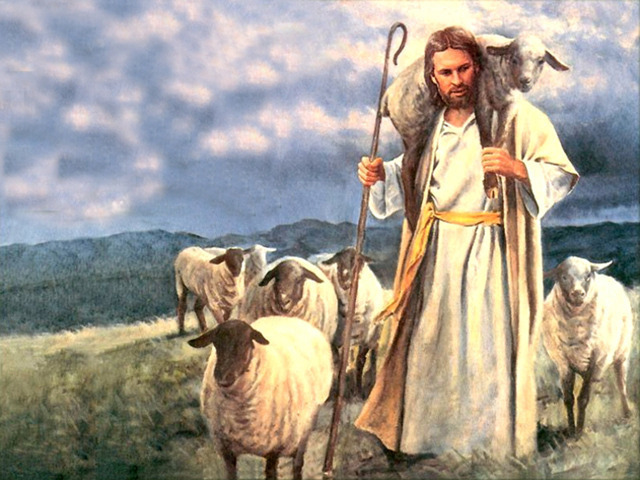
The Shepherd

John 10:11 I am the good shepherd. The good shepherd lays down his life for the sheep.

Luke 15:3-7 So he told them this parable: (4) “What man of you, having a hundred sheep, if he has lost one of them, does not leave the ninety-nine in the open country, and go after the one that is lost, until he finds it? (5) And when he has found it, he lays it on his shoulders, rejoicing. (6) And when he comes home, he calls together his friends and his neighbors, saying to them, ‘Rejoice with me, for I have found my sheep that was lost.’ (7) Just so, I tell you, there will be more joy in heaven over one sinner who repents than over ninety-nine righteous persons who need no repentance.

THEN a shepherd has at last overtaken his poor, silly, wandering sheep, he does not straightway fall to scolding or beating it for having cost him so much toil and trouble. No; but he observes that it is very weary, that it has torn itself among thorns, and cut itself among jagged rocks, and therefore he first tenderly sees to its wounds, and then bears it back to the fold in his own arms. Poor trembling sinner, the gospel has at length laid hold upon you; you cannot longer run into the paths of sin, grace has stopped your mad career, and made you tremble at the guilt of sin. Continue reading

Remembering Biblical Principles For Christian Women in the Digital World

Young Women and Discretion

by Walter E. Isenhour

“The aged women likewise, that they be in behaviour as becometh holiness . . .  that they may teach the young women to be sober . . . to be discreet, chaste . . .  that the word of God be not blasphemed” —Titus 2:3-5.

In the fifth verse of the second chapter of Titus the aged women are to teach young women “to be discreet.” What does it mean to be discreet? It means to be prudent, judicious, cautious; wise in conduct and management, especially as to matters of propriety and self-control.

A young woman who measures up to these qualities in mind, heart, soul, spirit, and life certainly rises above the degrading principles of sin and wickedness. Her life is one of nobility, beauty, usefulness, and sublimity. She sets examples before her husband, children, and neighbors that areworthy of emulation. They know her life is hid with Christ in God. She possesses the Spirit of our Lord, and this enables her to discern between the evil and the good, and to avoid evil, error, and anything and all things that would mislead her. She likewise shields her husband and children from evils and errors, sins and wickedness, that they are environed with. At least she warns and cautions them against such, and shows them the higher, better, holier, and more beautiful and worthwhile things in life.

The discreet woman is possessed with the spirit and ability to adopt “means to an end,” and of course this means that which brings her and the family to a good end. She avoids the means that would injure her life, character, soul, and influence, and that would likewise injure her family and those about her. She must realize that what she takes into her life will have its effect, through the years—and will bring her to a good end, only as the means are good. She knows that the good will work out right, while the bad will work out wrong. She realizes that the good is a means to a good end, but the bad is a means to a bad end. Therefore she takes into her very soul the good and rejects the bad. She is discreet. Those who know her realize that she is a woman of great and commendable discretion. Continue reading

For Whom Did Christ Die? – The Children Of God

John 11:52 and not for the nation only, but also to gather into one the children of God who are scattered abroad.

By Don Fortner 

John11:52
Our great, sin-atoning Substitute laid down his life and died for the children of God. According to the prophecy of Caiaphas, Christ was to die, not for the nation of the Jews only, but to “gather together in one the children of God that were scattered abroad” throughout the Gentile world. Redemption and adoption belong to the same people. Those who are predestinated to adoption by Christ are said to have redemption in him through his blood (Eph 1:5,7). This blessing of adoption, in the full enjoyment of it, in the resurrection, is called “the redemption of the body”. The resurrection is called the redemption of our bodies because redemption, in so far as the application of it is concerned, will not be complete until our very bodies are redeemed from all the consequences of Adam’s fall (Rom 8:23Eph. 1:144:30). Continue reading

Who are you, O man, who answers back to God?

Predestination a loving doctrine (Romans 9)

Romans 9:9-24 is one of the most intriguing and thought provoking passages in the Bible. Yet, it is often not given the serious consideration that it needs when dealing with the issue of God’s sovereignty and our salvation. This short but powerful section asks some pointed questions often raised in the argument against predestination. . . and then answers them. In addition, there is a simple theological test that you can take. The test is not by my devising; rather, it is imbedded in the passage and is authored by God.

Let’s begin. (Note: all scripture quotations are from the NASB.)

For this is a word of promise: ‘At this time I will come, and Sarah shall have a son.’ 10And not only this, but there was Rebekah also, when she had conceived twins by one man, our father Isaac; 11for though the twins were not yet born, and had not done anything good or bad, in order that God’s purpose according to His choice might stand, not because of works, but because of Him who calls,12it was said to her, ‘The older will serve the younger.’ 13Just as it is written, ‘Jacob I loved, but Esau I hated.'” (NASB) Continue reading

Rain and Grace: A Comparison.

Job 38:28 “Has the rain a father, or who has begotten the drops of dew?

Sermon Notes From Charles Spurgeon 

These Notes from Spurgeon, famed for his expository preaching in England at Park St.
and Metropolitan Tabernacle Pulpit, are well worth studying, adapting, and making
your own, for any sound preacher of the Gospel. He is deservedly known
to this day as “the Prince of Preachers,” and is arguably the greatest
preacher who has lived since New Testament days!

Who hath divided a watercourse for the overflowing of waters, or a way for the lightning of thunder; To cause it to rain on the earth, where no man is; on the wilderness, wherein there is no man; To satisfy the desolate and waste ground; and to cause the bud of the tender herb to spring forth? Job 38:25-27

God challengeth man to compare with his Maker even in the one matter of the rain. Can he create it? Can he send a shower upon the desert, to water the lone herbs which else would perish in the burning heat? No, he would not even think of doing such a thing. That generous act cometh of the Lord alone.

We shall work out a parallel between grace and rain. Continue reading

Against the World – Calvinism is Satanic

Join host Jerry Johnson for this week’s edition of Against the World, as he discusses a website which declared without any equivocation that Calvinism is Satanism.

HL : http://againsttheworld.tv/?p=734

How We Got The Bible

John F. MacArthur, Jr.

Ever since Eve encountered Satan’s barrage of doubt and denial (Gen. 3:1-7), mankind has continued to question God’s Word. Unfortunately, Eve had little or no help in sorting through her intellectual obstacles to full faith in God’s self-disclosure (Gen. 2:16,17).

Now the Scripture certainly has more than enough content to be interrogated, considering that it’s comprised of 66 books, 1,189 chapters, 31,173 verses, and 774,746 words. When you open your English translation to read or study, you might have asked in the past or are currently asking, “How can I be sure this is the pure and true Word of God?”

A question of this kind is not altogether bad, especially when one seeks to learn with a teachable mind (Acts 17:11). The Scripture invites the kinds of queries that a sincere student asks. Continue reading

If You Love Jesus Christ, You Defend His Doctrine Regardless

Updated 28/03/2012

Also a Transcript done for our  reader who requested so, this was my first attempt to do a transcript and I hope it meets the readers approval.

If You Love Jesus Christ, You Defend His Doctrine Regardless

So if you want to get an idea of how sincere and genuine your love for Jesus Christ really is, then set aside for the moment the Christian cd’s and the walks in nature and the “what would Jesus do” bracelets, the fish symbols on your car and just ask yourself how much do I love the Scriptures , which bears Christ’s image upon them. Surely you can see that your answer testifies that either in favour a strong love for Christ or a heart that runs cold towards Christ. It either speaks of hypocrisy and merely the outward empty shallow of hypocritical religion, or it speaks of the fact that you have a true and genuine spiritually alive relationship with God.

Continue reading