Usurping Women have been the originators of many false Charismatic movements !

One of the trademarks of Pentecostalism is that women usurp their God ordained place of submission in the church! Pentecostalism: The only religion often founded by women who usurp their place! Dominated by emotionalism!

Teaching or exercising authority over a man in the church. This includes pulpit preaching and administration.

1 Tim 2:12 But I do not allow a woman to teach or exercise authority over a man, but to remain quiet. 13 For it was Adam who was first created, andthen Eve. 14 And it was not Adam who was deceived, but the woman being quite deceived, fell into transgression. 15 But women shall be preserved through the bearing of children if they continue in faith and love and sanctity with self-restraint.

Being a pastor/elder/overseer. 1 Tim 3 and Titus 1 explicitly identify that pastors MUST BE MEN.

1 Timothy 3:1 It is a trustworthy statement: if any man aspires to the office of overseer, it is a fine work he desires to do. 2 An overseer, then, must be above reproach, the husband of one wife, temperate, prudent, respectable, hospitable, able to teach, 3 not addicted to wine or pugnacious, but gentle, uncontentious, free from the love of money. 4 He must be one who manages his own household well, keeping his children under control with all dignity 5 (but if a man does not know how to manage his own household, how will he take care of the church of God?); 6 and not a new convert, lest he become conceited and fall into the condemnation incurred by the devil. 7 And he must have a good reputation with those outside the church, so that he may not fall into reproach and the snare of the devil.

Notice that the prohibition against women teaching or exercising authority over men in the church is IMMEDIATELY FOLLOWED BY THE CLEAR STATEMENT THAT ONLY MEN CAN BE OVERSEERS/PASTORS! One continuous text!

Miram ~ 1500 BC Continue reading

“Truth Is of Necessity Intolerant of Falsehood” — Charles Spurgeon

“Casting down arguments and every high thing that exalts itself against the knowledge of God, bringing every thought into captivity to the obedience of Christ” – 2 Corinthians 10:5

“Faith is a supernatural work wherever it is found and if we think that we can beget faith in ourselves or others by the use of the fleshy weapons of philosophy, we shall certainly be foiled! The Scriptures pressed home by the Holy Spirit are God’s power unto salvation—not men’s cogitations and imaginations! There is the Revealed Gospel—reject it at your own peril! There is Jehovah’s Revelation of Himself to men—receive it or be damned! This is the ground to go upon if we would speak as the oracles of God. God grant that proud thinkers may come upon this ground and become Believers.

Here we are boldly met by some who say, ‘We do not need this doctrine which you call the ‘knowledge of God.’ We already know of something better. We tell you that your Gospel, about which you make such a fuss, is outworn and done with.’ Treat it so, Sirs, and perish, if you will, but as for us, we will mourn day and night over your unbelief. You will surely destroy your souls in rejecting the Divine Testimony, but in so doing you will prove that Word to be true which says that the Gospel is a savor of death unto death as well as of life unto life. . .

. . .Christ’s gospel has not come into the world to be co-equal with other faiths and share a divided kingdom with differing creeds. False gods may stand face to face to each other in one Pantheon, and be at peace, for they are all false together, but when Christ comes, Dagon must go down, not even the stump of him must stand. Truth is of necessity intolerant of falsehood, love wars with hate, and justice battles with wrong.”

– Charles Spurgeon (1834-1892)
taken from: Forts Demolished and Prisoners Taken, Sermon No. 1473, May 11,


Wise as Serpents—Harmless as Doves

by Thomas Watson

“Be wise as serpents—and harmless as doves.” Matthew 10:16

The Apostle says, “All Scripture is given by inspiration,” 2 Timothy 3:16. God’s Word is compared to a lamp for its enlightening quality, Psalm 119:105, and to refined silver for its enriching quality, Psalm 12:6. Among other parts of Sacred Writ, this text is not the least: “Be wise as serpents—and harmless as doves.” This is the speech of our blessed Savior. His lips were a tree of life which fed many. His works were miracles. His words were oracles—and deserve to be engraved upon our hearts as with the point of a diamond. This is a golden sentence, “Be wise as serpents—and harmless as doves.” Our Lord Jesus, in this chapter:

first, gives His Apostles their commission;

second, He foretells their danger;

third, He gives them several instructions.

I. Christ gives His Apostles their COMMISSION. Before they went abroad to preach, Christ ordained them, verse 5, “These twelve, Jesus sent forth.” Those who exercise in the ministerial function must have a lawful call. Hebrews 5:4, “No one takes this honor upon himself; he must be called by God.” Christ gave not only the Apostles and Prophets a call to their office (who wereextraordinary ministers)—but even pastors and teachers, (who are ordinary ministers) Ephesians 4:11.

QUESTION. But if one has gifts, is this not sufficient to the ministerial office? Continue reading

Three Things Which Will Not Be Found In Heaven – Revelation 21:4

Revelation 21:4 He will wipe away every tear from their eyes, and death shall be no more, neither shall there be mourning, nor crying, nor pain anymore, for the former things have passed away.”

Don Fortner

I cannot begin to describe the bliss and glory of our heavenly inheritance. Much that awaits us is yet unknown. And that which is revealed is seen here “through a glass darkly.” But here are three things, with which all who live upon the earth are very familiar, which shall not be found in heaven.

THERE WILL BE NO TEARS IN HEAVEN – “God shall wipe away all tears from their eyes; and there shall be no more death, neither sorrow, nor crying, neither shall there be any more pain: for the former things are passed away” (Rev. 21:4). Here we see much death, experience much sorrow, and feel much pain. And these things cause our eyes to swell and our cheeks to burn. But our God shall soon dry our eyes.In heaven, all that causes us to weep now, shall cease to be. Once we have left this world of sorrow, we shall never weep again! Continue reading

Doctrines Of Grace – Categorized Scripture List

By Monergism

God has recently given us the opportunity to discuss some theological issues with other Christians who believe differently than we do on a number of points, most notably the doctrines of grace. In such a circumstance, given the overwhelming supply of scriptural evidence that comes to bear on the topic, it seemed to me that the best approach would be a simple categorized scripture list: the fact that the entire paper would be scriptures, with the exception of a few brief explanatory notes, would underscore the truth that this is God’s own word and teaching; and the fact that it would be categorized would facilitate the ready comparison of scripture with scripture so as to lead one to a full-orbed understanding of the biblical teaching. Although I found a few good scripture lists of that nature available online, none of them was laid out in quite the progression that I was looking for, and so I developed my own. I’m posting it here with just the scripture references. Below, for your convenience I have provided a condensed version and a full version of the study. Continue reading

Critique of Claimed Visits to Heaven and Hell

The Bible contains the whole counsel of God— everything that will be revealed before the second coming of Christ. People have written books about Heaven and Hell in the past. It used to be that they were at least in the form of fiction, like Dante’s Inferno. The books we have reviewed claim to impart new revelations to the church. As such, these books ought to be rejected. They not only teach extra biblical ideas, they teach unbiblical ideas, some worse than others. Thus they lead people astray no matter how noble the ostensible reason for writing, such as to get people to believe in the second coming or to get them to repent. They do far more harm than good. It is the Scriptures that make us wise unto salvation: “and that from childhood you have known the sacred writings which are able to give you the wisdom that leads to salvation through faith which is in Christ Jesus. All Scripture is inspired by God and profitable for teaching, for reproof, for correction, for training in righteousness”
(2 Timothy 3:15-16).  (http://so4j.com/)

The latest claim of  an alleged visit to heaven is one which was made by  a neurosurgeon,  Dr Eben Alexander , who, after falling into a coma,  said that he had experienced things he never thought possible—a journey to the afterlife. Continue reading

The History of Dispensationalism

“My brother, I am a constant reader of my Bible, and I soon found that what I was taught to believe did not always agree with what my Bible said. I came to see that I must either part company with John Darby, or my precious Bible, and I chose to cling to my Bible and part from Mr. Darby.” George Müeller (1805–1898)

I am quite convinced that all the promises to Israél are found, are finding and will find their perfect fulfilment in the Church. It is true that in time past, in my expositions, I gave a definite place to Israél in the purposes of God. I have now come to the conviction, as I have just said, that it is, the new and spiritual Israél that is intended. G. Campbell Morgan (1863-1945)

Dispensationalism is a device of the enemy, designed to rob the children of no small part of that bread which their heavenly Father has provided for their souls; a device wherein the wily serpent appears as an angel of light, feigning to “make the Bible a new book” by simplifying much in it which perplexes the spiritually unlearned. It is sad to see how widely successful the devil has been by means of this subtle innovation. A. W. Pink(1886-1952)

It is mortifying to remember that I not only held and taught these novelties myself, but that I even enjoyed a complacent sense of superiority because thereof, and regarded with feelings of pity and contempt those who had not received the “new light” and were unacquainted with this up-to-date method of “rightly dividing the word of truth.” For I fully believed what an advertising circular says in presenting “Twelve Reasons why you should use THE SCOFIELD REFERENCE BIBLE,” namely, that: “First, the Scofield Bible outlines the Scriptures from the standpoint of DISPENSATIONAL TRUTH, and there can be no adequate understanding or rightly dividing of the Word of God except from the standpoint of dispensational truth.”

What a slur is this upon the spiritual understanding of the ten thousands of men, “mighty in the Scriptures,” whom God gave as teachers to His people during all the Christian centuries before “dispensational truth” (or dispensational error), was discovered! And what an affront to the thousands of men of God of our own day, workmen that need not to be ashamed, who have never accepted the newly invented system! Yet I was among those who eagerly embraced it (upon human authority solely, for there is none other) and who earnestly pressed it upon my fellow Christians. I am deeply thankful, however, that the time came (it was just ten years ago) when the inconsistencies and self contradictions of the system itself, and above all, the impossibility of reconciling its main positions with the plain statements of the Word of God, became so glaringly evident that I could not do otherwise than renounce it. Philip Mauro (1859-1952) Continue reading

The Sovereignty Of God In Salvation

John 10:28 I give them eternal life, and they will never perish, and no one will snatch them out of my hand.

A.W. PINK’S

THE
SOVEREIGNTY
OF GOD

CHAPTER FOUR

THE SOVEREIGNTY OF GOD IN SALVATION


“O the depths of the riches both of the wisdom and knowledge of God! how unsearchable are His judgments, and His ways past finding out” (Rom. 11:33).

“Salvation is of the LORD” (Jonah 2:9); but the Lord does not save all. Why not? He does save some; then if He saves some, why not others? Is it because they are too sinful and depraved? No; for the Apostle wrote, “This is a faithful saying, and worthy of all acceptation, that Christ Jesus came into the world to save sinners; of whom I am chief” (1 Tim. 1:15). Therefore, if God saved the “chief” of sinners, none are excluded because of their depravity. Why then does not God save all? Is it because some are too stony-hearted to be won? No; because it is written, that God will “take the stony heart out of their flesh, and will give them a heart of flesh” (Ezek. 11:19). Then is it because some are so stubborn, so intractable, so defiant that God is unable to woo them to Himself? Before we answer this question let us ask another; let us appeal to the experience of the Christian reader. Continue reading

His Number is 666

“His Number is 666”
By Kim Riddlebarger ~ Sermons on the Book of Revelation # 20
Texts: Revelation 13:11-18; Daniel 8:15-26

There is no subject–with the possible exception of the unpardonable sin–which has caused as much consternation for the people of God as has the so-called “mark of the beast.” John pointedly warns his hearers against taking such a mark on the back of the hand or the forehead. He also tells us that anyone who takes such a mark swears allegiance to the beast. This has given Christians throughout the ages a healthy suspicion of any government which persecutes the church or hinders the preaching of the gospel. It has lead to a number of questions in our own day about advancing technology and increasing government control over many areas of our personal lives. Such a warning from an apostle creates a climate in which sensational predictions and warnings about political events and technology are the norm. So we must do our best to bring clarity to this most difficult and controversial of subjects.

In past sermons, we have been working our way through Revelation 12-14 in which John introduces his reader to seven of the main characters in the great drama of redemption. Like the seal judgments of Revelation 6-8:1 and the trumpet judgments of Revelation 8-11, the vision recorded in Revelation 12-14 describes the entire period of time between the first advent and the second coming of Christ from a distinct theological perspective (or “camera” angle as we have been calling it). In this section of Revelation, John gives us a vivid description of the struggle between the people of God and our great adversary, Satan, who has been cast down from heaven to earth where he now seeks to wage war upon the church of Jesus Christ through the agency of his henchmen, the beast and the false prophet. Continue reading

Entertainment and Style of Music Do Not Convert People

John MacArthur,

“It’s not the style of our music that gets people converted. It’s not because of the entertainment level that they enjoy that gets them converted. Sooner or later you’ve got to get down to confronting them with the message and my judgment is sooner is better than later. So what are we waiting for? Let’s just get them to hear the message, that’s how they’re going to be saved. Take out the preaching of sin, take out the preaching of hell, take out repentance, take out the cross, and then people will feel comfortable. That’s the new trend. Build an image of love, care, being nice and if everybody is nice, they like us, they might like Jesus. That is tragically not the case. Continue reading

BRIAN MCLAREN CROSSED THE ROAD…

Matthew 7:13 “Enter by the narrow gate. For the gate is wide and the way is easy that leads to destruction, and those who enter by it are many.

By Amy Spreeman

Post-modern liberalism in the Body of Christ is what gives the Emergent Church theology its wings. It helps you toss along the waves of uncertainty; question what God said is Truth.  A few weeks ago we reported the many ways in which the Church is emerging into a New kind of Spirituality, one that brings together people of all faiths.

Yesterday on 9-11, a brand new book was released by Brian McLaren: Why did Jesus, Moses, the Buddha, and Mohammed cross the road?  Is it a bad joke? Here’s Brian McLaren’s punchline:

My answer to the question Why did Jesus, Moses, the Buddha, and Mohammed cross the road is simply, this: To get to “the other.”

In other words, everything we know about Jesus, Moses, the Buddha, and Mohammad, tells us that—if they were here today—they would be trying to lead us into an encounter with the other where, instead of killing one another, and hating one another, we would discover one another.

As all God’s children… Continue reading

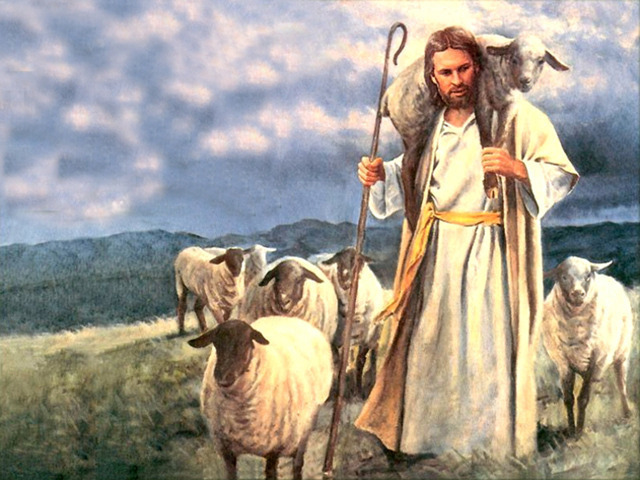
The Shepherd

John 10:11 I am the good shepherd. The good shepherd lays down his life for the sheep.

Luke 15:3-7 So he told them this parable: (4) “What man of you, having a hundred sheep, if he has lost one of them, does not leave the ninety-nine in the open country, and go after the one that is lost, until he finds it? (5) And when he has found it, he lays it on his shoulders, rejoicing. (6) And when he comes home, he calls together his friends and his neighbors, saying to them, ‘Rejoice with me, for I have found my sheep that was lost.’ (7) Just so, I tell you, there will be more joy in heaven over one sinner who repents than over ninety-nine righteous persons who need no repentance.

THEN a shepherd has at last overtaken his poor, silly, wandering sheep, he does not straightway fall to scolding or beating it for having cost him so much toil and trouble. No; but he observes that it is very weary, that it has torn itself among thorns, and cut itself among jagged rocks, and therefore he first tenderly sees to its wounds, and then bears it back to the fold in his own arms. Poor trembling sinner, the gospel has at length laid hold upon you; you cannot longer run into the paths of sin, grace has stopped your mad career, and made you tremble at the guilt of sin. Continue reading

How to Discern : Who’s Who? (Part 5/6)

Acts 17:11 Now these Jews were more noble than those in Thessalonica; they received the word with all eagerness, examining the Scriptures daily to see if these things were so.

By Pastor Anton Bosch 

Who’s Who?  (Part  5/6)

It is important that we check every word we hear or read against the plumbline of the Bible. In addition, we need to check the source of the information as well. We must check two things: The message and the man.

Many times we will hear messages that sound spot-on, and may even be doctrinally correct, but the speaker is a deceiver. Remember, the Devil will present truth in order to get you on his hook. No Mormon or Jehovah’s Witness will knock on your door and begin the conversation by saying that they have come to present another Gospel and another Jesus. They all begin by affirming that they believe exactly what you believe. The problem is that by the time they get around to the lie it is often too late. Our only defense is not to listen to a single word from someone we have not checked out thoroughly first. Mormons and JWs are easy to recognize by their outward appearance. But how do we recognize someone who appears to be an evangelical, Bible believing preacher? Here are a few hints:

First, who is he and where does he come from? In other words who does he relate to and who has influenced his thinking? This can easily be established from his bio, personal history or curriculum vitae. Where did he train? Where does he fellowship? Who is he in relationship with? Who does he quote? Who quotes him? If he has a website, look at the other sites he provides links to. These questions will often reveal a lot about the messenger. Obviously, he may have had bad connections in the past and may have repented. If he has repented from former evil associations, has he publicly repudiated those links and doctrines and broken fellowship with them? If he has, his past should not be held against him; but, at the same time, some of those influences may continue to taint his thinking and one should be on the alert for signs thereof. “Evil company corrupts good habits” (1Corinthians 15:33) and a man can be known by the friends he keeps. Continue reading

How to Discern : Orthodoxy ( Part 3/6)

By Pastor Anton Bosch 

Orthodoxy ( Part 3/6)

The Roman church has for a long time believed that only the “clergy” may interpret the Bible. In fact, until recently, they did not even allow translations of the Bible into the common language of the people because they did not believe that ordinary people were equipped to read the Bible, let alone interpret it.

Since the Reformation, the Bible has been made available to ordinary people and now anyone in the free world is able to read, study and own Bibles. But the pendulum has swung to the other extreme so that today every Tom, Dick and Harry feels he has the right to interpret the Bible as he feels fit. This is an equal but opposite error to that of the Roman clerical system.

It is therefore important that we understand that while each of us has the privilege of reading the Bible for ourselves, no individual has the right to interpret the Scriptures as he wishes. We can all understand the Bible, and the Spirit will lead us into all Truth, but it is not up to us to formulate our own “new” doctrine. There is a body of truth that is not open for reinterpretation. We refer to this as “orthodox” teaching. “Orthodox” means “conforming to established and traditional doctrine”. (Not to be confused with Eastern Orthodox churches.) Continue reading

How to Discern : Understanding the Bible (Part 2/6)

By Pastor Anton Bosch 

Understanding the Bible

Many people will agree that the Bible is the authoritative Word of God. The problem however is often how it is interpreted. How can we be sure that our understanding is the right one?

In discerning truth from error, we must begin by understanding Truth for ourselves. Many people try to discover the Truth by analyzing and dissecting error. You simply cannot do that. It is like someone trying to drive a car by looking only in the rearview mirror while trying to move forward. You cannot see where you are going by looking where others have gone wrong. So before we try to judge error or someone else’s doctrine, we need to be sure about what we believe. I agree, that many are prompted by the rise of some error to study truth. But, if you want to learn the truth on some matter, you will only learn it by studying the Bible, not by studying the mistakes of others. So what must I do to understand?

First I must ask God for wisdom. “If any of you lacks wisdom, let him ask of God, who gives to all liberally and without reproach, and it will be given to him” (James 1:5). The same Spirit Who inspired the men to write the Bible (2Timothy 3:16, 2Peter 1:21), is available to help us understand what is written. The Bible is not an academic book which can be studied in an intellectual way only. Yes, the Bible is logically sound and intellectually deep, but it is primarily a spiritual book in which God speaks to His people. And His Spirit will lead, guide and counsel us so we may come “into all truth” (John 16:13). Studying the Bible is both an academic and spiritual exercise. Read it in a “spiritual” way without applying sound reasoning and you will not discover the Truth. But study it as academic literature without the Spirit’s help and you will most certainly end in error. Pray David’s prayer every time you approach the Word: “Open thou mine eyes, that I may behold wondrous things out of thy law” (Psalm 119:18). Continue reading