Needful Exhortations and Warnings

one-more-joint

By Don Fortner  (Selected Commentary on selected books, Chapter 16) 

Needful Exhortations and Warnings

Therefore all things whatsoever ye would that men should do to you, do ye even so to them: for this is the law and the prophets.”

           (Mat_7:1-29)

In this chapter, our Lord Jesus concludes his Sermon on the Mount. Throughout this sermon (Matthew 5-7), our Savior draws a clear, unmistakable distinction between true and false religion, between outward ceremonialism and inward godliness, between religious hypocrisy and true spirituality. In chapter 5 he showed us the character of his people and the necessity of holiness. In chapter 6 he showed us the character of true worship and the necessity of faith. Here in chapter 7 he brings his sermon home to all who heard him (and to all who read his words today) by making general, but pointed, exhortations and warnings, that we all need to be reminded of continually. May God the Holy Spirit, who has preserved these exhortations and warnings for us upon the pages of Holy Scripture, graciously apply them to our hearts.

Kindness

This chapter opens with a gracious exhortation to kindness (Mat_7:1-5).

“Judge not, that ye be not judged. For with what judgment ye judge, ye shall be judged: and with what measure ye mete, it shall be measured to you again. And why beholdest thou the mote that is in thy brother’s eye, but considerest not the beam that is in thine own eye? Or how wilt thou say to thy brother, Let me pull out the mote out of thine eye; and, behold, a beam is in thine own eye? Thou hypocrite, first cast out the beam out of thine own eye; and then shalt thou see clearly to cast out the mote out of thy brother’s eye.”

I do not know of any text in all the Bible that has been more twisted, abused, and misapplied by men than Mat_7:1. Those who despise absolute values, absolute standards of right and wrong, absolute doctrinal truths and dogmatism, even if they cannot quote any other text in the Bible, recite these words to condemn as divisive bigots all who press upon them the doctrinal and spiritual demands of Holy Scripture. With sweet sounding piety and complete seriousness they will look you right in the eye and say, “Judge not, that ye be not judged.” Continue reading


The Holy Spirit and the Hearing of Faith

945589_10151498341359865_810922571_n

Don Fortner 

This only would I learn of you, Received ye the Spirit by the works of the law, or by the hearing of faith?”                                                                                                                   (Galatians 3:2)

This only would I learn of you.” ― Here Paul strikes at the heart of the Galatians’ great error, and demonstrates that the gift of the Holy Spirit, that is to say grace, salvation, eternal life, and all the blessings of the covenant of grace of which the gift of the Spirit is the seal and assurance (Gal. 3:13-14; Eph. 1:13-14), come to chosen, redeemed sinners only by the hearing of faith, not by the works of the law.

Received ye the Spirit by the works of the law, or by the hearing of faith?” ― John Gill asserts, “This question supposes they had received the Spirit; that is, the Spirit of God, as a spirit of wisdom and knowledge in the revelation of Christ; as a spirit of regeneration and sanctification; as a spirit of faith and adoption; and as the earnest, seal, and pledge of their future glory.”

True Believers Continue reading

The Treachery of False Religious Leaders

Treachery 4

spy-vs-spy-courtesy-of-Mad-Magazine

Don Fortner 

Listen here (click on player) :

Treachery

Text:          Mal_2:1-17

      Subject:     The Treachery of False Prophets

      Date:         Sunday Evening — August 23, 2009

Introduction:

My subject is TREACHERY. The 2nd chapter of Malachi’s prophecy is a scathing denunciation of treachery. Here the Lord God denounces the treacherous deeds of men and emphatically declares that he will turn their treachery upon their own heads. The treachery spoken of in these 17 verses, that are boiling with the anger of God, is far worse than…

  • The civil treachery of a traitor,
  • The political treachery of self-serving politicians,
  • Or the domestic treachery of a husband or wife who destroys the lives of their family to gratify their own lusts.

The treachery here denounced by our God is treachery in the pulpit, the treachery of religious leaders, the treachery of that man who is supposed to be “the messenger of the Lord of hosts,” but is instead the minister of Satan.

(Zep_3:4) “Her prophets are light and treacherous persons: her priests have polluted the sanctuary, they have done violence to the law.”

(Hos_5:7) “They have dealt treacherously against the LORD: for they have begotten strange children: now shall a month devour them with their portions.”

(Hos_6:7) “But they like men have transgressed the covenant: there have they dealt treacherously against me.”

The Lord God has promised that he will give his church pastors after his own heart, pastors who will feed his people with knowledge and understanding (Jer_3:15). But Satan constantly seeks to fill the pulpits of churches with treacherous men.

TREACHEROUS PREACHERS Continue reading

What about Praying For the Dead? What does the Bible say

praying for the dead

For to him that is joined to all the living there is hope: for a living dog is better than a dead lion. For the living know that they shall die: but the dead know not any thing, neither have they any more a reward; for the memory of them is forgotten.
(Ecclesiastes 9:4-5 KJV)

by Tony Warren 

What about Praying For the Dead? 

There are few doctrines so couched in man made tradition and superstition, as the Roman catholic belief that by praying for the dead, it will benefit these souls, or that they can also intercede for us is some way. Should Christians pray for the dead? Absolutely not! This is not only a totally unchristian idea, but it is in some ways downright Pagan. Is God’s loving kindness declared after men are in the grave that the dead receive blessings, and our prayers for them are answered? Man says yes, but God says no!

Psalms 88:10-12

  • “Wilt thou shew wonders to the dead? shall the dead arise and praise thee? Selah.
  • Shall thy lovingkindness be declared in the grave? or thy faithfulness in destruction?
  • Shall thy wonders be known in the dark? and thy righteousness in the land of forgetfulness? ” Continue reading

False faith

Sea of Fog

By Don Fortner 

Joh_2:23-24

Read Mat_7:13-27

A false faith can do many things and produce many things, which make it hard to detect. A false faith can experience deep conviction for sin like Judas. It can tremble at the Word of God like Felix. It can repent like Esau. It can obtain high office in the church like Judas, Diotrephes and Demas. A false faith can speak well of Christ: ‘Never a man spake like this man.’ It can experience deep religious emotions like the stony-ground hearers. It can diligently perform religious works like the Pharisees. A false faith can even preach the gospel, perform miracles, cast out demons and persevere to the end (Mat_7:22-23). But, as I read the Word of God, I see that there are three things that a false faith can never do.

1. A false faith can never produce a heart broken over sin (Psalms 51). It can offer sacrifices to try to appease God for sin. It can do good works to try to make up for sin. It can even confess sin. But, ‘The sacrifices of God are a broken spirit: a broken and contrite heart, O God, thou wilt not despise.’ Such brokenness and humility, because of inbred sin, a false faith cannot produce. Continue reading

Testing the Spirits

 By Prof. Johan Malan

Christians should be able to test all doctrine in creeds, sermons, books, articles, as well as statements made during discussions, to determine if they are a true reflection of Scriptural truth: “Beloved, do not believe every spirit, but test the spirits, whether they are of God; because many false prophets have gone out into the world” (1 John 4:1).

Every religious message has a spiritual dimension to it – either the Spirit of truth who wants to guide us into all truth (John 16:13), or Satan’s spirit of error who is intent on deceiving as many people as possible, also within churches (1 John 4:6; 2 Pet. 2:1-2).
Continue reading

The Ministry of The Holy Spirit

John MacArthur – Strength for today (Devotionals)

“By this we know that we abide in Him and He in us, because He has given us of His Spirit.” – 1 John 4:13
Experiencing the ministry of the Holy Spirit is evidence of genuine saving faith.

In John 14:26, Jesus described the Holy Spirit as “the Helper.” One of the most important ways He helps us is by assuring us that we belong to God. Several works of the Holy Spirit, if present in our lives, give evidence of the genuineness of our salvation. In 1 Corinthians 12:3 Paul writes, “No one can say, ‘Jesus is Lord,’ except by the Holy Spirit.” Apart from the convicting work of the Holy Spirit, you would not know who Christ was, nor would you confess Him as Savior and Lord. If you have experienced that work of the Holy Spirit, that is evidence you are a true child of God.

Continue reading

Why I Am a Calvinist, Part 5 – 8 of 8

by Phil Johnson – Grace to You

Why I Am a Calvinist, Part 5

. . . and why every Christian is a Calvinist of sorts.

Part V: Why this issue is really a lot simpler than most people think

At the end of the previous post, I described how even in my Arminian days, I affirmed an awful lot of truth about the sovereignty of God: I would have affirmed with no reservation whatsoever that God is God; that He does all His good pleasure; that no one can make Him do otherwise; that He is in control and in charge no matter how much noise evildoers try to make; and not only is He in charge, He is working all things out for my good and His glory. As a matter of fact, my confidence in the promise of Romans 8:28 was what motivated my prayer life.

That’s Calvinism. If you believe those things, you have affirmed the heart of Calvinism, even if you call yourself an Arminian. Those are the basic truths of Calvinism, and if you already believe those things, you are functioning with Calvinist presuppositions.

In fact, the truths of Calvinism so much permeate the heart of the gospel message, that even if you think you are a committed and consistent proponent of Arminianism, if you truly affirm the gospel you have already conceded the principle points of Calvinism anyway.

Continue reading

Why I Am a Calvinist, Part 1-4 of 8

by Phil Johnson – Grace to You

Why I Am a Calvinist, Part 1

. . and why every Christian is a Calvinist of sorts.  


Part I: Is Arminianism damnable heresy?

I love the doctrines of grace and don’t shy away from the label “Calvinist.” I believe in the sovereignty of God. I’m convinced Scripture teaches that God is completely sovereign not only in salvation (effectually calling and granting faith to those whom He chooses); but also in every detail of the outworking of Providence. “Whom He predestined, these He also called; whom He called, these He also justified; and whom He justified, these He also glorified” (Romans 8:30). And He makes “all things work together for good to those who love God, [i.e.,] to those who are the called according to His purpose” (Romans 8:28). Quite simply, He “works all things according to the counsel of His will” (Ephesians 1:11).

That’s what people commonly mean when they speak of “Calvinism.” When I accept that label, I am not pledging allegiance to the man John Calvin. I am not affirming everything he taught, and I’m not condoning everything he did. I’m convinced Calvin was a godly man and one of the finest biblical expositors and theological minds ever, but he wasn’t always right. As a matter of fact, my own convictions are baptistic, so I am by no means one of Calvin’s devoted followers. In other words, when I accept the label “Calvinist,” it’s only for convenience’s sake. I’m not saying “I am of Calvin” in the Corinthian sense.

Continue reading

Let us not only think of ourselves

J.C. Ryle

Expository Thoughts on the Gospels: Luke volume 1,

[Carlisle, PA: Banner of Truth, 1986], 257. {Luke 8:16-21}

Let us not only think of ourselves. Let us also think of others. There are millions in the world who have no spiritual light at all. They are without God, without Christ, and without hope. (Eph. 2:12) Can we do nothing for them? There are thousands around us who are unconverted and dead in sins, seeing nothing and knowing nothing right. Can we do nothing for them?

Continue reading

Faith in the Storm

From a sermon by Charles Haddon Spurgeon entitled “Wrecked But Not Reckless,”

delivered June 9, 1872.

There are many young believers who get into such a squall, and do not know what to make of it. They say, “Why, had I been a child of God I could not have drifted into this frightful tempest.” How sayest thou so? Did not David go through it? He said, “All thy waves and thy billows have gone over me.” You must be very little acquainted with the history of the people of God if you think that they are strangers to these conflicts.

Continue reading

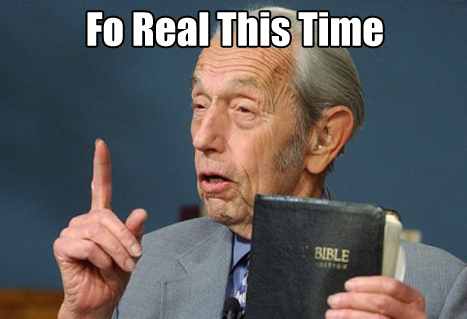
Harold Camping & May 21 Judgment Day – Update!

By Ken Silva pastor-teacher on May 20, 2011

But understand this, that in the last days there will come times of difficulty.

For people will be lovers of self, lovers of money, proud, arrogant, abusive, disobedient to their parents, ungrateful, unholy, heartless, unappeasable, slanderous, without self-control, brutal, not loving good, treacherous, reckless, swollen with conceit, lovers of pleasure rather than lovers of God, having the appearance of godliness, but denying its power.

Avoid such people. For among them are those who creep into households and capture weak women, burdened with sins and led astray by various passions, always learning and never able to arrive at a knowledge of the truth. (2 Timothy 3:1-7)

Continue reading

The Doctrines of Grace (Part 10 of 10)

John MacArthur – Grace to You

The Doctrine of God’s Effectual Call

We have a wonderful subject to talk about tonight and I took up a little more time than I ought to have, in one sense, but wanted to share with you what I did, so we’re going to try to squeeze it in the time we have. I want you to open your Bible to Romans 8…Romans chapter 8 and let’s begin in Romans 8 with some very familiar revelation from God.

Verse 28 which is familiar to all of us is a good starting point. Romans 8:28, “And we know that God causes all things to work together for good to those who love God, to those who are called according to His purpose, for whom He foreknew He also predestined to become conformed to the image of His Son that He might be the firstborn among many brethren, and whom He predestined these He also called and whom He called these He also justified and whom He justified, these He also glorified.”

Continue reading

The Doctrines of Grace (Part 9 of 10)

John MacArthur – Grace to You

The Doctrine of Actual Atonement, Part 2

Those of you who have been with us know we are tackling some of the more challenging and profound and difficult doctrines in the Scripture. And I trust we’re having a wonderful time digging deeply into God’s precious truth.

Last Sunday night we began to look at the subject, “For whom did Christ die?” Or, “The Nature of the Atonement.” Or as I chose to call it, “The Doctrine of Actual Atonement.” And I want to go back to that. If you weren’t here last week, it really would be helpful for you to get the tape or the CD, whatever is best for you, and to listen to what I said and pair it up with what we’re going to say tonight because you’re going to get just a very abbreviated review of that important foundation.

Continue reading

The Doctrines of Grace (Part 8 of 10)

John MacArthur – Grace to You

The Doctrine of Actual Atonement, Part 1

Well, how many of you have always wanted to go to seminary?  You’re about to go tonight.  I’m going to challenge your thinking a little bit as we talk about this issue of the question, “For whom did Christ die?”  We have been looking over the last number of weeks at some very important doctrines, the doctrine of perseverance, or the preservation of the saints; the doctrine of sovereign election in salvation.  We have looked at the doctrine of total or absolute inability, that is the depravity of the sinner which renders it impossible for him to respond to the gospel.  And tonight I want to talk to you about what I’ve chosen to call, trying to give it a more accurate name, the doctrine of actual atonement…the doctrine of actual atonement.

Continue reading