Reprobation Asserted

John 10

But ye believe not, because ye are not of my sheep, as I said unto you.
(John 10:26 KJV)

Listent to sermon

There was a division therefore again among the Jews for these sayings. And many of them said, He hath a devil, and is mad; why hear ye him? Others said, These are not the words of him that hath a devil. Can a devil open the eyes of the blind? And it was at Jerusalem the feast of the dedication, and it was winter. And Jesus walked in the temple in Solomon’s porch. Then came the Jews round about him, and said unto him, How long dost thou make us to doubt? If thou be the Christ, tell us plainly. Jesus answered them, I told you, and ye believed not: the works that I do in my Father’s name, they bear witness of me. But ye believe not, because ye are not of my sheep, as I said unto you. My sheep hear my voice, and I know them, and they follow me: And I give unto them eternal life; and they shall never perish, neither shall any man pluck them out of my hand. My Father, which gave them me, is greater than all; and no man is able to pluck them out of my Father’s hand.
(John 10:19-29 KJV) Continue reading

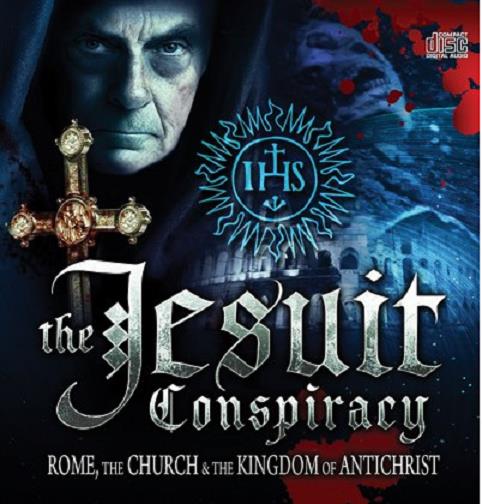
The Ultimate Conspiracy – Dave Hunt and the Jesuit Attempt to Hijack the Christian Faith

Jesuit conspiracy

The Jesuit Conspiracy
Adullam Films & Noise of Thunder Radio
Presented by Christian J. Pinto
Audio CD (MP3)

The Ultimate Conspiracy – Dave Hunt and the Jesuit Attempt to Hijack the Christian Faith
By Michael Bunker

“But God, who is rich in mercy, for his great love wherewith he loved us, Even when we were dead in sins, hath quickened us together with Christ, (by grace ye are saved;) And hath raised us up together, and made us sit together in heavenly places in Christ Jesus: That in the ages to come he might shew the exceeding riches of his grace in his kindness toward us through Christ Jesus.” — Ephesians 2:4-7

June 22, 2002 — Too often we are not willing to ask the questions that cut to the root of the issues of the day. Our attentions are seized by shiny rocks and relics, by petty debates and well concocted mysteries — so that, in the end, the greatest of all deceptions slides under the door unnoticed.

In the grand debate over whether homosexual, pedophilic priests should be demoted or defrocked, we are loathe to ask the deeper question: Do Catholics go to heaven? Or deeper still, Are YOU Catholic?

While Protestants silently chortle over the convulsions within the world’s largest cult, few are willing to recognize that Catholic doctrine has so overwhelmed the “protestant” religion, that there is not a dimes worth of difference between the two. Why should we be shocked that the priests of the papacy are fondling boys behind closed doors, when they have boldly molested Protestant Church doctrine for the last several hundred years?

Excuse me Bishop Pedofili, can we see BOTH of your hands?

Behold, the Ultimate Conspiracy. While “remnant” Christians and patriots pour through the voluminous documentations of a wicked “New World Order”, a far more heinous conspiracy marches forward unnoticed. In the confusion caused by the frantic attempt to expose the growing menace of fascistic globalism, the opponents of that antichrist system have willingly embraced the very theology of Antichrist.

We must start with some history, and there we will find the fingerprints of the last days Great Deception. Gather around and we will unveil the web of mystery and deceit that has ensnared the churches of the world.

JESUITS Continue reading

Discerning the Time

approaching-rain-storm-utah-images

Don Fortner

“And he said also to the people, When ye see a cloud rise out of the west, straightway ye say, There cometh a shower; and so it is. And when [ye see] the south wind blow, ye say, There will be heat; and it cometh to pass. [Ye] hypocrites, ye can discern the face of the sky and of the earth; but how is it that ye do not discern this time? Yea, and why even of yourselves judge ye not what is right? When thou goest with thine adversary to the magistrate, [as thou art] in the way, give diligence that thou mayest be delivered from him; lest he hale thee to the judge, and the judge deliver thee to the officer, and the officer cast thee into prison. I tell thee, thou shalt not depart thence, till thou hast paid the very last mite.” (Luke 12:54-59)

In these verses our Lord Jesus spoke specifically to the common people, the people who heard his doctrine and saw his miracles, those men and women who claimed to believe God, who claimed to be the people of God. Yet, he denounces them in exactly the same way as he had denounced the scribes, the Sadducees and the Pharisees, as hypocrites. Their teachers and preachers were blind men, but willfully blind as well. Both the religious leaders and the people who followed them, our Lord here denounces and rebukes as hypocrites. Continue reading

Eschatology by Ethos: Why the “Optimism” vs. “Pessimism” Paradigm Doesn’t Work

Pessimism-or-optimism-small

Why the “Optimism” vs. “Pessimism” Paradigm Doesn’t Work

Kim Riddlebarger

Anyone familiar with the in-house feud between Reformed postmillenarians and Reformed amillenarians knows that the debate between these two positions is often framed in terms of “optimistic” postmillenarians vs. “pessimistic” amillenarians. Despite the widespread use and apparent utility of these labels, I remain unconvinced that one can formulate a proper and biblical eschatology merely by identifying a position’s distinctive ethos and then choosing the most “optimistic” of the various options.

To avoid being labeled an “eschatological pessimist”—a negative label that postmillenarians have successfully pinned on dispensationalists—a number of Reformed amillenarians self-consciously identify themselves as “optimistic” amillenarians. In making this identification, the optimistic amillenarian attempts to co-opt the attractive rhetoric of cultural progress and transformation used by postmillenarians, while at the same time avoiding the serious exegetical problem associated with postmillennialism—a rather embarrassing shortage of biblical passages in the New Testament that teach such a view.

While I am “optimistic” about the kingdom of God and the progress it will make during the interadvental age (and would likely qualify to be an “optimistic” amillenarian), I’m not so sure an unqualified affirmation of “optimism” is the best way for Reformed amillenarians to respond to those who determine the soundness of one’s eschatological position using the optimism/pessimism paradigm. Here’s why.

No Christian who truly believes that the resurrection of Jesus Christ inaugurates the new creation and guarantees the final victory over Satan and his kingdom at the end of the age wants to be identified as a “pessimist.” No doubt, the New Testament is crystal clear about who wins in the end. God will save his elect, usher in the age to come, consummate his kingdom, raise the dead, judge the world, and make all things new. These truths are certainly reason enough to be optimistic about the eventual outcome of the present course of world history, especially when one considers what Jesus Christ did to secure our redemption from sin’s power and consequence. Through his death and resurrection, Jesus Christ removes the curse and defeats our greatest enemy, which is death. No small thing and a very good reason to be optimistic. Continue reading

The Antichrist

Man of sin anti christs

By Kim Riddlebarger

Perhaps no subject broached by contemporary Bible prophecy teachers engenders more speculation and less sound Biblical exegesis than does the subject of Antichrist. This is certainly due to the mysterious nature of the subject itself, as well as to the fact that no other aspect of Bible prophecy lends itself so nicely to speculation regarding the identification of one specific individual who will become the very personification of evil and the archenemy of Jesus Christ and his gospel.

“Pin the tail” on the Antichrist is not merely an evangelical fascination. Indeed, such speculation has gone on almost from the beginning of Christianity. Irenaeus (130-200) argued that Antichrist would be a Jewish born, satanically inspired, usurper of God’s true glory, who would appear in the Jerusalem temple in connection with an end-times great apostasy. (1) The Protestant Reformers, of course, universally identified the papacy with the Antichrist, the Apology of the Augsburg Confession (1540) stating that “the papacy will also be a part of the kingdom of Antichrist if it maintains that human rites justify (XV.18).” The Westminster Confession (1647) contends that the Pope is “that antichrist, that man of sin, and son of perdition, that exalteth himself in the church against Christ, and all that is called God (XXV.6).” Rome, not to be outdone, has returned the favor, contending that antichristic Protestant “heresies have swept down from the North, where Calvin, Wycliffe, Luther and legions of Protestants are ravaging the flock of Christ.” (2)

But there is no doubt that much of contemporary speculation has taken the concept of identifying the Antichrist to new extremes. One of my favorite possessions is a booklet passed on to me by my grandmother, entitled The Time of Jacob’s Trouble (1939), wherein the author attempts to demonstrate that the revived Germany under Hitler in the pre-World War II years is the supposed last-days ten-nation confederacy predicted in Revelation 13. Of course, the author very deftly demonstrates how Mussolini is the false prophet and how Italian imperialism in Ethiopia is proof that Rome is the great harlot of Revelation 18 and compatriot of the German beast. I can still remember the fear instilled in me as a child, when I heard, one preacher declare that Antichrist was then living somewhere in the Middle East, probably still a child playing stickball in some crowded dusty street, awaiting the day when he would be possessed by the devil and allowed to wreck havoc on the world after the rapture. Continue reading

Dispensationalism: Focusing eschatology on assumption and human politics, and reducing Christ’s role in Bible prophecy

Grant Swart

1.

Dispensational Premillenialism sharply focuses the events surrounding the end times, on the so-called “secret” rapture and a perceived forthcoming millennium. At the center of this focus is national Israel, daily events which take place in the Middle-East and in the realm of international politics and, of course, the increasing popularization of any number of future personalities representing the Antichrist. Sensational speculation and enthusiastic debate, motivated mainly by geo-political human affairs and major natural events, are designed to divert attention away from biblical prophecy regarding the end times. The end time is thereby reduced to a small window of time in the future and fragmented and isolated events in recent human history, rather than an ongoing eschatological understanding of biblical prophecy which stretches from Genesis to Revelation.

Some of the most commercially successful books, television shows and even certain reference Bibles, have been remarkably innovative and convincingly sincere in finding ways to support the false assumptions which are necessary to support the  “concept” of dispensational premillenialism in its various forms. Continue reading

His Number is 666

“His Number is 666”
By Kim Riddlebarger ~ Sermons on the Book of Revelation # 20
Texts: Revelation 13:11-18; Daniel 8:15-26

There is no subject–with the possible exception of the unpardonable sin–which has caused as much consternation for the people of God as has the so-called “mark of the beast.” John pointedly warns his hearers against taking such a mark on the back of the hand or the forehead. He also tells us that anyone who takes such a mark swears allegiance to the beast. This has given Christians throughout the ages a healthy suspicion of any government which persecutes the church or hinders the preaching of the gospel. It has lead to a number of questions in our own day about advancing technology and increasing government control over many areas of our personal lives. Such a warning from an apostle creates a climate in which sensational predictions and warnings about political events and technology are the norm. So we must do our best to bring clarity to this most difficult and controversial of subjects.

In past sermons, we have been working our way through Revelation 12-14 in which John introduces his reader to seven of the main characters in the great drama of redemption. Like the seal judgments of Revelation 6-8:1 and the trumpet judgments of Revelation 8-11, the vision recorded in Revelation 12-14 describes the entire period of time between the first advent and the second coming of Christ from a distinct theological perspective (or “camera” angle as we have been calling it). In this section of Revelation, John gives us a vivid description of the struggle between the people of God and our great adversary, Satan, who has been cast down from heaven to earth where he now seeks to wage war upon the church of Jesus Christ through the agency of his henchmen, the beast and the false prophet. Continue reading

Testing the Spirits

 By Prof. Johan Malan

Christians should be able to test all doctrine in creeds, sermons, books, articles, as well as statements made during discussions, to determine if they are a true reflection of Scriptural truth: “Beloved, do not believe every spirit, but test the spirits, whether they are of God; because many false prophets have gone out into the world” (1 John 4:1).

Every religious message has a spiritual dimension to it – either the Spirit of truth who wants to guide us into all truth (John 16:13), or Satan’s spirit of error who is intent on deceiving as many people as possible, also within churches (1 John 4:6; 2 Pet. 2:1-2).
Continue reading