Hirelings and the Shepherd

Jer 3 v 15

Don Fortner 

“This parable spake Jesus unto them: but they understood not what things they were which he spake unto them. Then said Jesus unto them again, Verily, verily, I say unto you, I am the door of the sheep. All that ever came before me are thieves and robbers: but the sheep did not hear them. I am the door: by me if any man enter in, he shall be saved, and shall go in and out, and find pasture. The thief cometh not, but for to steal, and to kill, and to destroy: I am come that they might have life, and that they might have it more abundantly. I am the good shepherd: the good shepherd giveth his life for the sheep. But he that is an hireling, and not the shepherd, whose own the sheep are not, seeth the wolf coming, and leaveth the sheep, and fleeth: and the wolf catcheth them, and scattereth the sheep. The hireling fleeth, because he is an hireling, and careth not for the sheep. I am the good shepherd, and know my sheep, and am known of mine. As the Father knoweth me, even so know I the Father: and I lay down my life for the sheep. And other sheep I have, which are not of this fold: them also I must bring, and they shall hear my voice; and there shall be one fold, and one shepherd. Therefore doth my Father love me, because I lay down my life, that I might take it again. No man taketh it from me, but I lay it down of myself. I have power to lay it down, and I have power to take it again. This commandment have I received of my Father. There was a division therefore again among the Jews for these sayings. And many of them said, He hath a devil, and is mad; why hear ye him? Others said, These are not the words of him that hath a devil. Can a devil open the eyes of the blind?” (John 10:6-21)
George Whitefield once declared, “As God can send a nation or people no greater blessing than to give them faithful, sincere, and upright ministers, so the greatest curse that God can possibly send upon a people in this world, is to give them over to blind, unregenerate, carnal, lukewarm, and unskilled guides. And yet, in all ages, we find that there have been many wolves in sheep’s clothing, many that daubed with untempered mortar, that prophesied smoother things than God did allow.”

Wolves in sheep’s clothing were prevalent in the days of Isaiah, Jeremiah, and Ezekiel. Continue reading

“A Just God and a Saviour”

182914_10151649219609865_270462064_n

Nevertheless he saved them for his name’s sake, that he might make his mighty power to be known.
(Psalms 106:8 KJV)

“A Just God and a Saviour”

Isaiah 45:21

The Lord our God, the one true and living God of heaven and earth, is a God who freely and abundantly forgives sin through the blood of his Son, the Lord Jesus Christ. This is what God himself says, “I, even I, am he that blotteth out thy transgressions for mine own sake, and will not remember thy sins.


The People Forgiven

Who are the people to whom God will be merciful? They are not good, righteous, and morally upright men and women. So long as a man thinks that he is good and righteous, he will never obtain mercy from God. The characters to whom God says he will be merciful are sinners. The grace and lovingkindness of Jehovah is reserved for sinners. Until you see that your supposed righteousness is an abomination to God, you will never obtain the righteousness of God in Christ (Romans 10:1-4). Every promise of the gospel is made to sinners. — “The Son of man came not to call the righteous, but sinners to repentance (Matthew 11:28-30; Isaiah 1:4-6, 18; 55:6-7). The grace and mercy of God is for Continue reading

Reprobation Asserted

John 10

But ye believe not, because ye are not of my sheep, as I said unto you.
(John 10:26 KJV)

Listent to sermon

There was a division therefore again among the Jews for these sayings. And many of them said, He hath a devil, and is mad; why hear ye him? Others said, These are not the words of him that hath a devil. Can a devil open the eyes of the blind? And it was at Jerusalem the feast of the dedication, and it was winter. And Jesus walked in the temple in Solomon’s porch. Then came the Jews round about him, and said unto him, How long dost thou make us to doubt? If thou be the Christ, tell us plainly. Jesus answered them, I told you, and ye believed not: the works that I do in my Father’s name, they bear witness of me. But ye believe not, because ye are not of my sheep, as I said unto you. My sheep hear my voice, and I know them, and they follow me: And I give unto them eternal life; and they shall never perish, neither shall any man pluck them out of my hand. My Father, which gave them me, is greater than all; and no man is able to pluck them out of my Father’s hand.
(John 10:19-29 KJV) Continue reading

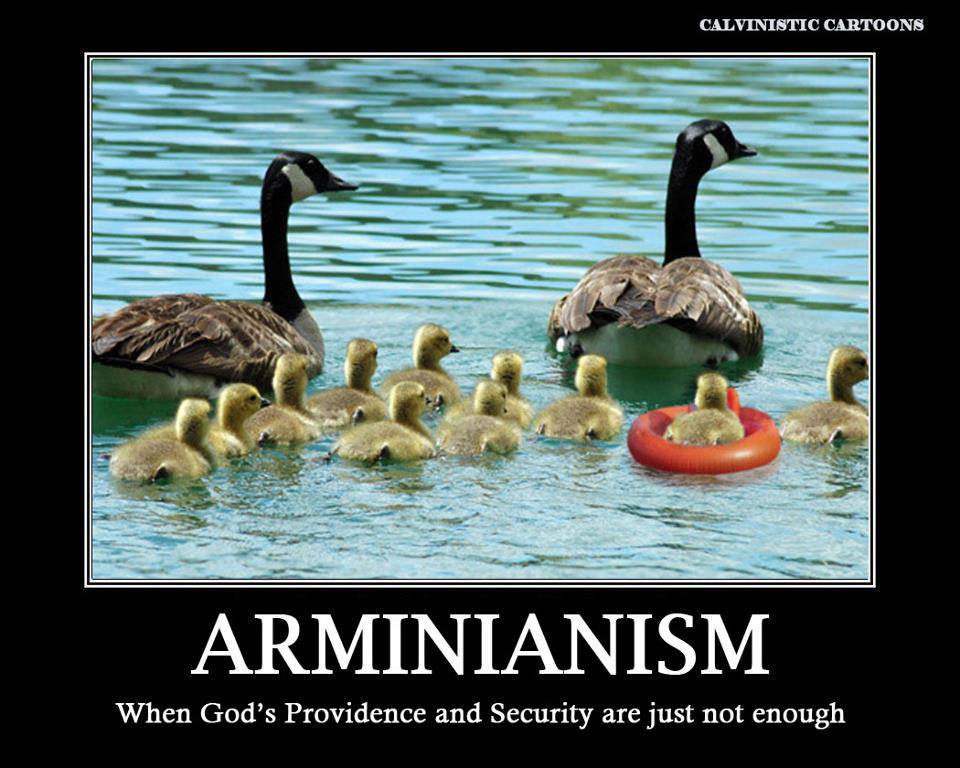
When God’s Providence And Security Are Just Not Enough

1005440_519814371419692_180198057_n

ARMINIANISM wrests Scripture to teach that it is possible for the true believer to fall from the grace of salvation (Gal. 5:4); and that each believer is provided with sufficient ability to persevere and preserve himself, if only he will: (“And ye will not come to Me, that ye might have life.” John 5:40). It all depends on the choice of man’s will, whether he will persevere or not. (This denies everything thus far so irrefutably declared!) The error continues: Continue reading

The First Twelve Preachers

mission

The First Twelve Preachers

“And he goeth up into a mountain, and calleth unto him whom he would: and they came unto him. And he ordained twelve, that they should be with him, and that he might send them forth to preach, And to have power to heal sicknesses, and to cast out devils: And Simon he surnamed Peter; And James the son of Zebedee, and John the brother of James; and he surnamed them Boanerges, which is, The sons of thunder: And Andrew, and Philip, and Bartholomew, and Matthew, and Thomas, and James the son of Alphaeus, and Thaddaeus, and Simon the Canaanite, And Judas Iscariot, which also betrayed him: and they went into an house. And the multitude cometh together again, so that they could not so much as eat bread. And when his friends heard of it, they went out to lay hold on him: for they said, He is beside himself.” (Mark 3:13-21)

Here the Holy Spirit describes the calling of the twelve Apostles by our Lord Jesus Christ. This is an event, which ought to always be remembered and studied with deep gratitude. No twelve men in history have been so important as these twelve. None have done so much good. None have been of such benefit to us. J.C. Ryle wrote…

“What a vast amount of benefit these few men have conferred upon the world! The names of a few Jewish fishermen are known and lived by millions all over the globe, while the names of many kings and rich men are lost and forgotten.”

These apostles were a special order of men. The apostolic office was in existence for only a very brief period of time, during which the canon of Holy Scripture was completed. They had distinct gifts of healing, tongues, and inspiration, which no one has possessed since the Apostolic Era. They were men specifically chosen, gifted, and ordained by our Lord Jesus Christ to preach the gospel during the earliest days of Christianity and to write the New Testament, explaining by divine inspiration the teachings of our Lord Jesus Christ. They had no successors. When they died, their office died. And when the Apostles died, all the gifts and signs accompanying apostleship died as well.

Twelve Men Continue reading

Discerning Between the Righteous and the Wicked

Malachi 3 v 13 to  18

“Our Lord tells us to let the tares grow with the wheat. We are never to attempt to separate them. Why? Because we do not have the ability to know the one from the other. If the task of separating them were ours, we would pull up the wheat and keep the tares every time. None of us knows who is saved and who is lost. Those who pretend to have such knowledge are as arrogant as they are ignorant.”

DISCERNING BETWEEN THE RIGHTEOUS AND THE WICKED

Don Fortner 

My subject tonight is Discerning Between the Righteous and the Wicked. — Our Lord Jesus tells us plainly that in every age, wherever the righteous are found the wicked will be found among them. In every field of wheat, there tares grow and thrive. Wherever sheep find pasture, goats will be found grazing beside them. He also tells us to let the tares grow together with the wheat and let the goats graze with the sheep. We are never to try to separate them. That is the Lord’s work, and he will do it by the gospel.


We must never try to separate the tares from the wheat; and we must never try to separate the wicked from the righteous. But that does not mean that they be discerned and will not be separated. In Malachi 3, the Lord God makes a very clear discernment and assures us that, when he has finished all things, we shall with him — “discern between the righteous and the wicked, between him that serveth God and him that serveth him not.” Continue reading

Lessons for Troublesome Times

end-of-the-world-2


“And he looked up, and saw the rich men casting their gifts into the treasury. And he saw also a certain poor widow casting in thither two mites. And he said, Of a truth I say unto you, that this poor widow hath cast in more than they all: For all these have of their abundance cast in unto the offerings of God: but she of her penury hath cast in all the living that she had. And as some spake of the temple, how it was adorned with goodly stones and gifts, he said, As for these things which ye behold, the days will come, in the which there shall not be left one stone upon another, that shall not be thrown down. And they asked him, saying, Master, but when shall these things be? and what signwill there be when these things shall come to pass? And he said, Take heed that ye be not deceived: for many shall come in my name, saying, I am Christ; and the time draweth near: go ye not therefore after them. But when ye shall hear of wars and commotions, be not terrified: for these things must first come to pass; but the end is not by and by. Then said he unto them, Nation shall rise against nation, and kingdom against kingdom: And great earthquakes shall be in divers places, and famines, and pestilences; and fearful sights and great signs shall there be from heaven. But before all these, they shall lay their hands on you, and persecute you, delivering you up to the synagogues, and into prisons, being brought before kings and rulers for my name’s sake. And it shall turn to you for a testimony. Settle it therefore in your hearts, not to meditate before what ye shall answer: For I will give you a mouth and wisdom, which all your adversaries shall not be able to gainsay nor resist. And ye shall be betrayed both by parents, and brethren, and kinsfolks, and friends; and some of you shall they cause to be put to death. And ye shall be hated of all men for my name’s sake. But there shall not an hair of your head perish. In your patience possess ye your souls. And when ye shall see Jerusalem compassed with armies, then know that the desolation thereof is nigh. Then let them which are in Judaea flee to the mountains; and let them which are in the midst of it depart out; and let not them that are in the countries enter thereinto. For these be the days of vengeance, that all things which are written may be fulfilled. But woe unto them that are with child, and to them that give suck, in those days! for there shall be great distress in the land, and wrath upon this people. And they shall fall by the edge of the sword, and shall be led away captive into all nations: and Jerusalem shall be trodden down of the Gentiles, until the times of the Gentiles be fulfilled.” (Luke 21:1-24)

We are living in troublesome times. These are perilous days. These are difficult days for everyone. But they are particularly difficult for people who believe God and seek, in all things and above all things, to honor Him. I know that your minds are constantly full of questions, for which there seems to be no answer. Moral decadence, fornication, adultery, homosexuality, and the pedophilia that it spawns are not just tolerated, but actively promoted in our public schools and by law. The brutal slaughter of unborn babies is as common as the removal of warts. By some perverse logic, the same people who want to protect rattle snakes from extinction and weep over the misuse of laboratory rats tell us that the murder of a baby is a matter of choice! Domestic violence is epidemic. War is an everyday activity. And the religion of the day is nothing short of men worshipping themselves. When I think about these things, three passages of Scripture come to my mind (Deuteronomy 31:17; Psalm 10:4; Galatians 6:7). Continue reading

Discerning the Time

approaching-rain-storm-utah-images

Don Fortner

“And he said also to the people, When ye see a cloud rise out of the west, straightway ye say, There cometh a shower; and so it is. And when [ye see] the south wind blow, ye say, There will be heat; and it cometh to pass. [Ye] hypocrites, ye can discern the face of the sky and of the earth; but how is it that ye do not discern this time? Yea, and why even of yourselves judge ye not what is right? When thou goest with thine adversary to the magistrate, [as thou art] in the way, give diligence that thou mayest be delivered from him; lest he hale thee to the judge, and the judge deliver thee to the officer, and the officer cast thee into prison. I tell thee, thou shalt not depart thence, till thou hast paid the very last mite.” (Luke 12:54-59)

In these verses our Lord Jesus spoke specifically to the common people, the people who heard his doctrine and saw his miracles, those men and women who claimed to believe God, who claimed to be the people of God. Yet, he denounces them in exactly the same way as he had denounced the scribes, the Sadducees and the Pharisees, as hypocrites. Their teachers and preachers were blind men, but willfully blind as well. Both the religious leaders and the people who followed them, our Lord here denounces and rebukes as hypocrites. Continue reading

Eschatology by Ethos: Why the “Optimism” vs. “Pessimism” Paradigm Doesn’t Work

Pessimism-or-optimism-small

Why the “Optimism” vs. “Pessimism” Paradigm Doesn’t Work

Kim Riddlebarger

Anyone familiar with the in-house feud between Reformed postmillenarians and Reformed amillenarians knows that the debate between these two positions is often framed in terms of “optimistic” postmillenarians vs. “pessimistic” amillenarians. Despite the widespread use and apparent utility of these labels, I remain unconvinced that one can formulate a proper and biblical eschatology merely by identifying a position’s distinctive ethos and then choosing the most “optimistic” of the various options.

To avoid being labeled an “eschatological pessimist”—a negative label that postmillenarians have successfully pinned on dispensationalists—a number of Reformed amillenarians self-consciously identify themselves as “optimistic” amillenarians. In making this identification, the optimistic amillenarian attempts to co-opt the attractive rhetoric of cultural progress and transformation used by postmillenarians, while at the same time avoiding the serious exegetical problem associated with postmillennialism—a rather embarrassing shortage of biblical passages in the New Testament that teach such a view.

While I am “optimistic” about the kingdom of God and the progress it will make during the interadvental age (and would likely qualify to be an “optimistic” amillenarian), I’m not so sure an unqualified affirmation of “optimism” is the best way for Reformed amillenarians to respond to those who determine the soundness of one’s eschatological position using the optimism/pessimism paradigm. Here’s why.

No Christian who truly believes that the resurrection of Jesus Christ inaugurates the new creation and guarantees the final victory over Satan and his kingdom at the end of the age wants to be identified as a “pessimist.” No doubt, the New Testament is crystal clear about who wins in the end. God will save his elect, usher in the age to come, consummate his kingdom, raise the dead, judge the world, and make all things new. These truths are certainly reason enough to be optimistic about the eventual outcome of the present course of world history, especially when one considers what Jesus Christ did to secure our redemption from sin’s power and consequence. Through his death and resurrection, Jesus Christ removes the curse and defeats our greatest enemy, which is death. No small thing and a very good reason to be optimistic. Continue reading

Arminianism Agrees With Roman Catholicism, Calvinism Agrees With The Bible

road to rome

Arminianism at Home in Rome

But, however frivolous his cavils, the principles for which he contends are of the most pernicious  nature and tendency. I must repeat, what already seems to have given him so much offence, that Arminianism “came from Rome, and leads thither again.” Julian, bishop of Eclana a  contemporary and disciple of Pelagius, was one of those who endeavoured, with much art, to gild the  doctrines of that heresiarch, in order to render them more sightly and palatable. The Pelagian system,  thus varnished and paliated, soon began to acquire the softer name of Semipelagianism. Let us take a  view of it, as drawn to our hands by the celebrated Mr. Bower, who himself, in the main, a professed  Pelagian, and therefore less likely to present us with an unfavourable portrait of the system he  generally approved. Among the principles of that sect, this learned writer enumerates the following:

“The notion of election and reprobation, independent of our merits or demerits, is  maintaining a fatal necessity, is the bane of all virtue, and serves only to render good  men remiss in working out their salvation, and to drive sinners to despair.

“The decrees of election and reprobation are posterior to, and in consequence of, our  good or evil works, as foreseen by God from all eternity.”

Is not this too the very language of modern Arminianism? Do not the partizans of that scheme argue on the same identical terms? Should it be said, “True, this proves that Arminianism is Pelagianism revived; but it does not prove, that the doctrines of Arminianism are originally Popish:” a moment’s cool attention will make it plain that they are. Let us again hear Mr. Bower, who, after the passage just quoted, immediately adds, “on these two last propositions, the Jesuits found their whole system of grace and free-will; agreeing therein with the Semipelagians, against the Jansenists and St. Augustine.” The Jesuits were moulded into a regular body, towards the middle of the sixteenth century: toward the close of the same century, Arminius began to infest the Protestant churches. It needs therefore no great penetration, to discern from what source he drew his poison. His journey to Rome (though Monsicur Bayle affects to make light of the inferences which were at that very time deduced from it) was not for nothing. If, however, any are disposed to believe, that  Arminius imbibed his doctrines from the Socinians in Poland, with whom, it is certain, he was on terms of intimate friendship, I have no objection to splitting the difference: he might import some of his tenets from the Racovian brethren, and yet be indebted, for others, to the disciples of Loyola. Continue reading

The Matter of Church Discipline

early-christians1


The Matter of Church Discipline

“Moreover if thy brother shall trespass against thee, go and tell him his fault between thee and him alone: if he shall hear thee, thou hast gained thy brother. But if he will not hear thee, then take with thee one or two more, that in the mouth of two or three witnesses every word may be established. And if he shall neglect to hear them, tell it unto the church: but if he neglect to hear the church, let him be unto thee as an heathen man and a publican. Verily I say unto you, Whatsoever ye shall bind on earth shall be bound in heaven: and whatsoever ye shall loose on earth shall be loosed in heaven. Again I say unto you, That if two of you shall agree on earth as touching any thing that they shall ask, it shall be done for them of my Father which is in heaven. For where two or three are gathered together in my name, there am I in the midst of them. Then came Peter to him, and said, Lord, how oft shall my brother sin against me, and I forgive him? till seven times? Jesus saith unto him, I say not unto thee, Until seven times: but, Until seventy times seven. Therefore is the kingdom of heaven likened unto a certain king, which would take account of his servants. And when he had begun to reckon, one was brought unto him, which owed him ten thousand talents. But forasmuch as he had not to pay, his lord commanded him to be sold, and his wife, and children, and all that he had, and payment to be made. The servant therefore fell down, and worshipped him, saying, Lord, have patience with me, and I will pay thee all. Then the lord of that servant was moved with compassion, and loosed him, and forgave him the debt. But the same servant went out, and found one of his fellowservants, which owed him an hundred pence: and he laid hands on him, and took him by the throat, saying, Pay me that thou owest. And his fellowservant fell down at his feet, and besought him, saying, Have patience with me, and I will pay thee all. And he would not: but went and cast him into prison, till he should pay the debt. So when his fellowservants saw what was done, they were very sorry, and came and told unto their lord all that was done. Then his lord, after that he had called him, said unto him, O thou wicked servant, I forgave thee all that debt, because thou desiredst me: Shouldest not thou also have had compassion on thy fellowservant, even as I had pity on thee? And his lord was wroth, and delivered him to the tormentors, till he should pay all that was due unto him. So likewise shall my heavenly Father do also unto you, if ye from your hearts forgive not every one his brother their trespasses. (Mat_18:15-35)

In this passage our Lord and Savior anticipates two things. First, he anticipates the fact that differences would arise among his disciples, causing offenses. It is a sad fact, but a fact nonetheless, that God’s people in this world are sinners still. We love one another; but those who are the objects of our most ardent love are the very people we are most apt to offend. The offenses are excuseless. We ought to exercise great care not to offend. But offend we do. What husband, wife, son, or daughter has not wept bitterly after needlessly offending one in the family dearly loved? Paul and Barnabas were both brethren, faithful servants of God. But they had a falling out over John Mark. Yes, God’s people, true believers, often trespass against one another. Continue reading

Why Don’t All People Come To Christ?

Turning away

Don Fortner

“Search the scriptures; for in them ye think ye have eternal life: and they are they which testify of me. And ye will not come to me, that ye might have life.” (John 5:39-40)

Faith in Christ is set before us in many different ways in Scripture. Faith is looking to Christ. — “Look unto me, and be ye saved, all the ends of the earth: for I am God, and there is none else” (Isaiah 45:22). — “Behold, as the eyes of servants look unto the hand of their masters, and as the eyes of a maiden unto the hand of her mistress; so our eyes wait upon the LORD our God, until that he have mercy upon us” (Psalms 123:2). Faith is trusting Christ, as a son trusts his father. — “O LORD of hosts, blessed is the man that trusteth in thee” (Psalms 84:12). Faith is seeking Christ, as a man seeks something he has lost. Faith is laying hold of Christ, as a drowning man lays hold of a life-line. And saving faith is described in Scripture as coming to Christ. The Lord Jesus is able to save to the uttermost all them that come to God by him. Believers are described by Peter as a people coming to the Savior. — “To whom coming, as unto a living stone, disallowed indeed of men, but chosen of God, andprecious” (1 Peter 2:4).

How often poor, needy sinners came to Christ, or were brought to him in desperate need, while he walked on the earth. And as often as a needy soul came to our omnipotent, ever-gracious, all-merciful Savior, he obtained the healing power and saving mercy he needed (Matthew 8:1-3; 9:1-8, 20-22, 18-26, 27-31). Salvation is obtained by coming to Christ. The Lord Jesus is able to save all who come to God by him. The Lord Jesus has promised that he will save all who come to him. (Matthew 11:28; John 6:37; John 7:37-38). And in the Gospel narratives every poor sinner who came to Christ obtained the salvation he sought.

In John 5:39-40 our Lord Jesus is talking to religious people, people who went to church every week, people who read and studied the Bible. He says, “Search the scriptures; for in them ye think ye have eternal life: and they are they which testify of me. And ye will not come to me, that ye might have life.” These were Bible thumping, conservative, religious, church going people, people who read, memorized, and studied the Word of God. Yet, our Savior said to these religious people, — “Search the scriptures; for in them ye think ye have eternal life: and they are they which testify of me. And ye will not come to me, that ye might have life.” Continue reading

Blinded By Satan

iStock_000021267657Medium

INTENDED FOR READING ON LORD’S-DAY, APRIL 16, 1893. DELIVERED BY C. H. SPURGEON,

AT THE METROPOLITAN TABERNACLE, NEWINGTON, ON LORD’S-DAY EVENING, MARCH 31, 1889.

“The god of this world has blinded the minds of them which believe not.” 2 Corinthians 4:4.

THE practice of blinding men is a horrible process, too horrible for us to say another word about it, but there is also a spiritual blindness which comes upon some men. These are, to begin with, unbelievers. The god of this world does not blind Believers—but he blinds the minds of them which believe not. It is, therefore, a very dangerous thing not to believe on the Son of God. The penalty of unbelief is death and condemnation—and that penalty begins to fall on men when, in consequence of their unbelief, their foolish heart is darkened, their intellect loses the power to perceive spiritual ob-jects—and the god of this world blinds their mental vision. Ah, my Hearers, how anxious Satan is to secure your destruc-tion, since, rather than that you should see the saving Light of God, he takes the trouble to blind your eyes! God grant that no man here may die under this dreadful deprivation of Light which is caused by Satanic influence upon the minds of men who have not believed in Jesus!

Remember that this blindness to spiritual things is quite consistent with much sharpness as to natural things. A man may be a very keen politician. He may be a first-rate man of business. He may be an eminent scientist, a profound thinker and, yet, he may be blinded as to spiritual Truths of God. How often is it true, “You have hid these things from the wise and prudent, and have revealed them unto babes”! As an old writer says, “Poor, ignorant men often find the door to Heaven and enter in, while the learned are looking for the latch.” Yes, a man may have clear eyes for worldly things. He may be very keen as to his insight into the problems of life and, yet, the god of this world may have blinded his eyes! Continue reading

Evil Came Down From The Lord

article-2179504-143EA986000005DC-698_964x640

Don Fortner

Evil Came Down From The Lord Audio sermon:

Sermon notes :

Let’s begin tonight by reading the 1st chapter of Micah’s prophecy together.

Micah 1:1-16 

The word of the LORD that came to Micah the Morasthite in the days of Jotham, Ahaz, and Hezekiah, kings of Judah, which he saw concerning Samaria and Jerusalem. Hear, all ye people; hearken, O earth, and all that therein is: and let the Lord GOD be witness against you, the Lord from his holy temple. For, behold, the LORD cometh forth out of his place, and will come down, and tread upon the high places of the earth. And the mountains shall be molten under him, and the valleys shall be cleft, as wax before the fire, and as the waters that are poured down a steep place. For the transgression of Jacob is all this, and for the sins of the house of Israel. What is the transgression of Jacob? is it not Samaria? and what are the high places of Judah? are they not Jerusalem? Therefore I will make Samaria as an heap of the field, and as plantings of a vineyard: and I will pour down the stones thereof into the valley, and I will discover the foundations thereof. And all the graven images thereof shall be beaten to pieces, and all the hires thereof shall be burned with the fire, and all the idols thereof will I lay desolate: for she gathered it of the hire of an harlot, and they shall return to the hire of an harlot. Therefore I will wail and howl, I will go stripped and naked: I will make a wailing like the dragons, and mourning as the owls. For her wound is incurable; for it is come unto Judah; he is come unto the gate of my people, even to Jerusalem. Declare ye it not at Gath, weep ye not at all: in the house of Aphrah roll thyself in the dust. Pass ye away, thou inhabitant of Saphir, having thy shame naked: the inhabitant of Zaanan came not forth in the mourning of Bethezel; he shall receive of you his standing. For the inhabitant of Maroth waited carefully for good: but evil came down from the LORD unto the gate of Jerusalem. O thou inhabitant of Lachish, bind the chariot to the swift beast: she is the beginning of the sin to the daughter of Zion: for the transgressions of Israel were found in thee. Therefore shalt thou give presents to Moreshethgath: the houses of Achzib shall be a lie to the kings of Israel. Yet will I bring an heir unto thee, O inhabitant of Mareshah: he shall come unto Adullam the glory of Israel. Make thee bald, and poll thee for thy delicate children; enlarge thy baldness as the eagle; for they are gone into captivity from thee.
(Micah 1:1-16 KJV)

UNIVERSAL MESSAGE

The singular object of Micah and of all prophecy was to prepare the way of the Lord. By the writings of His prophets the Lord God prepared His Church for the coming of Christ. Continue reading

Holding Fast The Faithful Word

preach-the-word

Don Fortner 

It is very easy and a very common thing to teach false, damning, heretical doctrine using only Bible terms. God’s servants faithfully expound the sense the Scriptures, giving out the message of God the Holy Spirit conveyed in the text from which they preach.

“Preach the Word!”

2 Timothy 4:2

Those who piously insist that we say exactly what God says in the Bible, no more and no less, prove themselves terribly hypocritical by the fact that they never follow the practice. Like heretical Campbellites, they refer us to a word, phrase, or statement in the Bible, and then explain their meaning in words totally contrary to that which God the Holy Spirit has stated in Holy Scripture.

Words are vehicles of communication. They express ideas. The ideas expressed by any use of words can only be determined by the context in which they are used. In preaching the gospel we interpret the ideas (the doctrine) conveyed in a passage in the light of its immediate context and in the light of the whole Volume of Divine Inspiration, and declare that doctrine honestly in the language of the people we address. When a man takes refuge in a pretense of using only the very words of Scripture, it is because he is either uncertain of the meaning of those words, or those words convey something he wishes to hide.

     “Holding fast the faithful Word,” as we have been taught by God the Holy Spirit, let every faithful gospel preacher boldly and confidently expound exactly what God says in the Bible, no more and no less,by sound doctrine,” “for there are many unruly and vain talkers and deceivers, specially they of the circumcision: Whose mouths must be stopped, who subvert whole houses, teaching things which they ought not, for filthy lucre’s sake.” I say with Paul, to all who are responsible to proclaim the gospel of Christ, “speak thou the things which become sound doctrine,” for the time has come when men “will not endure sound doctrine; but after their own lusts they heap to themselves teachers, having itching ears.” — Brethren, “PREACH THE WORD!

How Continue reading