Why People Find the Bible Difficult

by A. W. Tozer

Chapter 6 from Man: The Dwelling Place of God (Camp Hill, Penn: Christian Publications, 1966).

That many persons find the Bible hard to understand will not be denied by those acquainted with the facts. Testimony to the difficulties encountered in Bible reading is too full and too widespread to be dismissed lightly.

In human experience there is usually a complex of causes rather than but one cause for everything, and so it is with the difficulty we run into with the Bible. To the question, Why is the Bible hard to understand? no snap answer can be given; the pert answer is sure to be the wrong one. The problem is multiple instead of singular, and for this reason the effort to find a single solution to it will be disappointing.

Continue reading

Why would someone hate the word Exegesis? part 2

John MacArthur – Grace to You

Preaching the Book God Wrote, Part 3

5. How did the preacher’s message begin?

The message began as a true word from God and was given as truth because God’s purpose was to transmit truth. It was ordered by God as truth and was delivered by God’s Spirit in cooperation with holy men who received it with exactly the pure quality that God intended (2 Pet. 1:20-21). It was received as Scriptura inerrantis by the prophets and apostles, i.e., without wandering from Scripture’s original formulation in the mind of God.

Inerrancy then expresses the quality with which the writers of our canon received the text we call Scripture.

Continue reading

Happiness Is . . .

John MacArthur – Grace to You – Drawing Near

“Blessed are the poor in spirit . . . those who mourn . . .the gentle . . . those who hunger and thirst for righteousness . . . the merciful . . . the pure in heart . . . the peacemakers . . . [and] those who have been persecuted for the sake of righteousness” (Matt. 5:3-10).

A quiz in a popular magazine characterized happy people as those who enjoy other people but aren’t self-sacrificing, who refuse to participate in negative feelings or emotions, and who have a sense of accomplishment based on their own self-sufficiency.

But Jesus described happy people quite differently. In fact, He characterized them as spiritual beggars who realize they have no resources in themselves. He said they are meek rather than proud, mournful over their sin, self- sacrificing, and willing to endure persecution to reconcile men to God.

Continue reading

Who’s Afraid of the Big, Bad Heretic?

Evangelical Apathy and the Danger of False Teaching
by John MacArthur

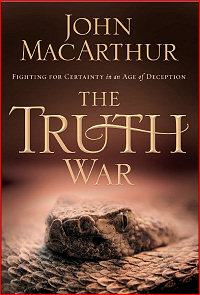
The following is excerpted from The Truth War (Nelson, 2007, pp. 165-68)

Why do so many evangelicals act as if false teachers in the church could never be a serious problem in this generation? Vast numbers seem convinced that they are “rich, have become wealthy, and have need of nothing’; and do not know that [they] are wretched, miserable, poor, blind, and naked” (Revelation 3:17).

In reality, the church today is quite possibly more susceptible to false teachers, doctrinal saboteurs, and spiritual terrorism than any other generation in church history. Biblical ignorance within the church may well be deeper and more widespread than at any other time since the Protestant Reformation. If you doubt that, compare the typical sermon of today with a randomly-chosen published sermon from any leading evangelical preacher prior to 1850. Also compare today’s Christian literature with almost anything published by evangelical publishing houses a hundred years ago or more.

Continue reading

Rejoicing in the Lord

By Arthur W Pink

“Rejoice in the Lord always: and again I say, Rejoice” (Phil. 4:4). How many there are today who make an entirely wrong use of this Divine exhortation. Let any servant of God faithfully trace out the inward experiences of a Christian, let him describe the painful discoveries of “the plague of his own heart” (1 Kings 8:38), and his daily conflict with his corruptions and the corresponding effect this produces in the dampening of his spirits. Let him point out how well-suited to his case is the humiliating lament of Romans 7:24, and the light-hearted and empty-headed religionists of the day will promptly (we do not say “quote,” but) hurl at his head these words—“rejoice in the Lord always.” Those who thus misuse our text suppose that its happy strains condemn all gloominess in a Christian, and that it goes to show that one who is groaning is living far below his privileges.

Continue reading

Metamorphosis, Part 3 (questioning everything)

John MacArthur – Grace to You

I have examined and critiqued postmodernism elsewhere (see The Truth War, 2007). It should be sufficient for our purposes in this context to summarize the postmodern mind-set by describing it as dubiousness about practically everything. As we noted, the starting point for modernity was a rejection of biblical authority (setting aside belief in the supernatural as an untenable or merely irrelevant opinion). Instead, science and human reason were foolishly treated as reliable and authoritative. In the end, the disastrous failure of so many modern ideologies utterly debunked modern rationalism and delivered a deathblow to modern certitude. Postmodernism therefore subjects every idea and every authority to endless skepticism.

Modernity’s most basic assumption was that the way to achieve unshakable certainty is through a rigorous application of the scientific method. (Whatever could be tested and proved in the laboratory—or logically deduced from scientific “facts”—was deemed true; everything else was written off as mere superstition.) Moderns were convinced that a basic foundation of settled scientific knowledge would easily provide a trustworthy authority by which all truth claims could be tested. That process in turn would eventually bring about a uniform consensus regarding all the fundamental realities of life and human existence.

Continue reading

Metamorphosis, Part 2 (proliferating ignorance)


John MacArthur – Grace to You


The World Wide Web had quietly been implemented less than a year after the Soviet Union broke up. Still, by 1993, when the first edition of Ashamed of the Gospel hit the shelves, no one but the earliest Internet insiders had even heard about the Web—much less seen it. Most people had no clue how quickly or how drastically the Web would alter the world as we knew it.

I remember being told at a strategic planning retreat in 1996 that the World Wide Web would eventually become the primary vehicle for the dissemination of our radio broadcast and recorded sermons. (At the time, radio and cassette tapes were still the only media we were using for audio content.) When the men at Grace to You who stay abreast of new technologies predicted that within twenty years or so cassette tapes would be a totally dead technology, I thought they were exaggerating. “You can’t access the Internet in a car,” I pointed out. “Even if you could, who wants to carry a computer on the car seat, when it’s so much more convenient to pop in a cassette tape?”

Continue reading

Test yourselves to see if you are in the faith 2 Corinthians 13

John MacArthur – Grace to You – Bible Q & A

Test yourselves to see if you are in the faith; examine yourselves! (2 Corinthians 13:5)

The Corinthians, prompted by the evil insinuations of the false apostles, had demanded proof of Paul’s apostleship. He reluctantly defended himself, not for his own sake, but for the Lord’s, and so the Corinthians would not be cut off from the truth he preached to them. But in this passage, he turned the tables on his accusers and challenged them to test and examine themselves. The Greek text places the pronouns before the verbs for emphasis and literally reads, “Yourselves test to see if you are in the faith; yourselves examine.” Instead of arrogantly and foolishly challenging the genuineness of Paul’s relationship to the Lord, the Corinthians needed to examine the genuineness of their own salvation. The familiar New Testament terms peirazo (test) and dokimazo (examine) are used here as synonyms. They convey the idea of putting something to the test to determine its genuineness. The test was to see if the Corinthians were in the faith. Pistis (faith) refers here not to the subjective element of belief but to the objective body of Christian truth —the Christian faith.

Continue reading

Faith and the Gospel (Part 3)

Horatius Bonar (The prince of Scottish hymn writers)

For ease of reading, I have divided this article into 3 parts. Please see further on this blog Parts 1 and 2. – Grant Swart

FAITH AND THE GOSPEL (PART 3)

“Shall we tell men that unless they are holy they must not believe on Jesus Christ; that they must not venture on Christ for salvation until they are qualified and fit to be received and welcomed by Him? This would be a forbearing to preach the gospel at all, or to forbid all men to come to Christ. He is well qualified to come to us, but a sinner out of Christ has no qualifications for Christ but sin and misery…. Shall we tell people that they should not believe on Christ too soon? It is impossible that they should do it too soon. Can a man obey the command of the gospel too soon or do the work of God too soon?… Continue reading

Forgiving as You Are Forgiven

John MacArthur – Grace to you

“Forgive us our debts, as we also have forgiven our debtors. . . . For if you forgive men for their transgressions, your heavenly Father will also forgive you. But if you do not forgive men, then your Father will not forgive your transgressions” (Matt. 6:12, 14-15).

It’s possible to confess your sins and still not know the joy of forgiveness. How? Failure to forgive others! Christian educator J. Oswald Sanders observed that Jesus measures us by the yardstick we use on others. He didn’t say, “Forgive us because we forgive others,” but “Forgive us even as we have forgiven others.”

Continue reading

Enemies of Humility: Partisanship

John MacArthur – Grace to You

“. . . That no one of you might become arrogant in behalf of one against the other.”
1 Corinthians 4:6

Genuine humility among Christians will leave no room for arrogant partisanship.

The Corinthian church was a notorious illustration of the sin of partisanship among believers. Its partisanship—some members claimed allegiance to Paul, some to Apollos, and some to Cephas (Peter)—was essentially caused by pride. Paul, as author of 1 Corinthians, vigorously opposed such pride of divisions, as Apollos and Peter would have.

Continue reading

The Tragedy of Rejecting Salvation

John MacArthur – Grace to You

Hebrews 5:10–6:20

Spelling errors can be changed with an eraser or liquid paper. When you get lost trying to follow a map. you can ask for help. But there is one mistake that doesn’t give a second chance; rejecting salvation through Christ. Once a person comes face-to-face with God. his eternal destiny is established.

What can you say to someone who knows and understands how to become a Christian but doesn’t? And what does God have to say about those who fully know the gospel message but don’t take the final step of receiving Christ as their Lord and Savior?

These messages will spur your heart to have greater concern for unbelievers!

Continue reading

How do South African Christians relate to a government that is hard to live under?


Alan Lester – Grace Unlimited
From the sermon series Vanishing Beggar’s Gold 30Modern Truth to Ancient Rome

Mar 24, 2011

Romans 13:1-7; Acts 5:29

“Big Brother” has arrived. Security cameras everywhere – even on the freeways. Townhouse developments that look more like concentration camps have sprung up everywhere. Office complexes and even some clinics and hospitals now require your thumb-print for entry. Police stop and search vehicles arbitrarily, without warrants, and often expect a bribe in order to let you go. The banks decide how, when and where you will use your credit card, with new “security” measures in some establishments that prevent you from buying at the same place within a certain time frame. The media inundates us with bad news – encouraging a constant state of fear and desperation amongst the general populace and furthering racial tension. Governmental control of major media is more pronounced. Politicians are so arrogantly assured of their power that they do not always even try to hide their corrupt activities. — Oh, and we have a Presidential candidate with no education, a penchant for women (LOTS of women), reckons a shower will cure AIDS, keeps asking for a machine gun and thinks he’s Jesus.
Continue reading

Why Biblical Christianity Is Intolerable in an Age of “Tolerance”

John MacArthur – Grace to You

Psalm 119:160, John 17:17, 2 Timothy 1:14, Acts 4:12

In these postmodern times, tolerance is the supreme virtue of the public square.  Tolerant people can be broad thinkers, open-minded, and charitable to every worldview—every worldview, that is, except biblical Christianity.  The authoritative demands of Jesus Christ are beyond the threshold of postmodern tolerance.

In this postmodern era, one virtue is esteemed above all others:  tolerance. As a matter of fact, tolerance may soon be the only virtue secular society will embrace. Many traditional virtues (including humility, self-control, and chastity) have already fallen out of public favor and in some quarters are openly scorned or even regarded as transgressions.

Instead, with the beatification of tolerance, what was once forbidden is now encouraged. What was once universally deemed immoral is now celebrated. Marital infidelity and divorce have been normalized. Profanity is commonplace. Abortion, homosexuality, and moral perversions of all kinds are championed by large advocacy groups and tacitly encouraged by the popular media. The modern notion of “tolerance” is systematically turning morality on its head.

Continue reading

The Passing of the Saints

From a sermon by Charles Haddon Spurgeon entitled “Precious Deaths,” delivered February 18, 1872.

Let us be persuaded of this, that no believer dies an untimely death. In every consistent Christian’s case that promise is true, “With long life also will I satisfy him, and show him my salvation;” for long life is not to be reckoned by years as men count them. He lives longest who lives best. Many a man has crowded half a century into a single year. God gives his people life, not as the clock ticks, but as he helps them to serve him; and he can make them to live much in a short space of time. There are no untimely figs gathered into God’s basket; the great Master of the vineyard plucks the grapes when they are ripe and ready to be taken, and not before. Saintly deaths are precious in his sight.

Continue reading