Amazed by the Amazing

Alan Lester – Grace Unlimited website

Sermon done by Dr. Joshua Mack

One way to fill a stadium these days is to claim that a real miracle is about to take place. Imagine the impact on a crowd if a dead man, exumed from the cemetery, was actually raised to vibrant life before their eyes! Yet, greater miracles are taking place every day, and no stadium is filled as a result. God is exerting the same power He exerted in Christ when He raised Him from the dead, in trapped, helpless, ruined, dead rebels, raising them to eternal, overwhelming life!

Continue reading

The Doctrines of Grace (Part 1 of 10)

John MacArthur – Grace to You

The Doctrines of Grace sermon series

At some time in your Christian life, you may have struggled with questions like, When a sinner is saved, who chooses whom—does God choose the sinner, or the sinner choose God? Did Christ die for the sins of everyone, or just the people He saves?

The vast majority of those kinds of thorny, persistent, mind-boggling questions are directly related to the sovereignty of God, election, predestination, perseverance, and the question of “free will.” Those, of course, are doctrines associated with Calvinism. All are vital to a sound, biblical understanding of the gospel, but they are not without difficulty.

In The Doctrines of Grace, John MacArthur takes you to God’s Word and walks you through challenging truth that’s often neglected, maligned, or mischaracterized, but critical for every Christian to understand. This series will help you come to grips with what you believe about God, the gospel, and the nature of man.

Continue reading

Against Compromise

John MacArthur – Grace to You

It was Martin Luther who said:

“The world at the present time is sagaciously discussing how to quell the controversy and strife over doctrine and faith, and how to effect a compromise between the Church and the Papacy. Let the learned, the wise, it is said, bishops, emperor and princes, arbitrate. Each side can easily yield something, and it is better to concede some things which can be construed according to individual interpretation, than that so much persecution, bloodshed, war, and terrible, endless dissension and destruction be permitted.

Here is lack of understanding, for understanding proves by the Word that such patchwork is not according to God’s will, but that doctrine, faith and worship must be preserved pure and unadulterated; there must be no mingling with human nonsense, human opinions or wisdom.

The Scriptures give us this rule: ‘We must obey God rather than men’ (Acts 5:29).”

Continue reading

Why People Find the Bible Difficult

by A. W. Tozer

Chapter 6 from Man: The Dwelling Place of God (Camp Hill, Penn: Christian Publications, 1966).

That many persons find the Bible hard to understand will not be denied by those acquainted with the facts. Testimony to the difficulties encountered in Bible reading is too full and too widespread to be dismissed lightly.

In human experience there is usually a complex of causes rather than but one cause for everything, and so it is with the difficulty we run into with the Bible. To the question, Why is the Bible hard to understand? no snap answer can be given; the pert answer is sure to be the wrong one. The problem is multiple instead of singular, and for this reason the effort to find a single solution to it will be disappointing.

Continue reading

Why would someone hate the word Exegesis? part 1

Someone said : I am really beginning to hate the word exegesis. What’s wrong with the word summary? It’s simple, easy to understand!

It made me think. Why would the word Exegesis be an issue for someone if they are christian? If one is a believer I believe it is important to understand the meaning of Exegesis before we study the Word of God. there is a big difference between the word summary and the word exegesis. Should Bible teachers now change using the word exegesis to summary?

Summary = Presenting the substance in a condensed form; concise: a summary review.

Exegesis = This is a Latin term relating to correct Biblical understanding. It means literally ‘to lead out’. In the context of studying the Bible it means to get out of the text what the text is saying. This may include a number of things to aid the process such as reading the context in the chapter, in the particular book as a whole eg. Jeremiah or Matthew and even where it fits within the whole Bible. It may also include cultural awareness, the timing of the writing, and identifying the author and even the target audience.

Continue reading

Happiness Is . . .

John MacArthur – Grace to You – Drawing Near

“Blessed are the poor in spirit . . . those who mourn . . .the gentle . . . those who hunger and thirst for righteousness . . . the merciful . . . the pure in heart . . . the peacemakers . . . [and] those who have been persecuted for the sake of righteousness” (Matt. 5:3-10).

A quiz in a popular magazine characterized happy people as those who enjoy other people but aren’t self-sacrificing, who refuse to participate in negative feelings or emotions, and who have a sense of accomplishment based on their own self-sufficiency.

But Jesus described happy people quite differently. In fact, He characterized them as spiritual beggars who realize they have no resources in themselves. He said they are meek rather than proud, mournful over their sin, self- sacrificing, and willing to endure persecution to reconcile men to God.

Continue reading

Every blossoming flower warns

C H Spurgeon – Devotional

“It is time to seek the Lord.”
– Hos_10:12

This month of April is said to derive its name from the Latin verb aperio, which signifies to open, because all the buds and blossoms are now opening, and we have arrived at the gates of the flowery year. Reader, if you are yet unsaved, may your heart, in accord with the universal awakening of nature, be opened to receive the Lord. Every blossoming flower warns you that it is time to seek the Lord; be not out of tune with nature, but let your heart bud and bloom with holy desires. Do you tell me that the warm blood of youth leaps in your veins? then, I entreat you, give your vigour to the Lord. It was my unspeakable happiness to be called in early youth, and I could fain praise the Lord every day for it.

Continue reading

Who’s Afraid of the Big, Bad Heretic?

Evangelical Apathy and the Danger of False Teaching
by John MacArthur

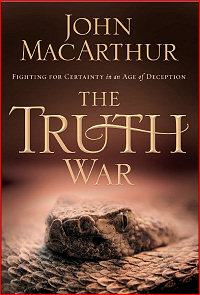
The following is excerpted from The Truth War (Nelson, 2007, pp. 165-68)

Why do so many evangelicals act as if false teachers in the church could never be a serious problem in this generation? Vast numbers seem convinced that they are “rich, have become wealthy, and have need of nothing’; and do not know that [they] are wretched, miserable, poor, blind, and naked” (Revelation 3:17).

In reality, the church today is quite possibly more susceptible to false teachers, doctrinal saboteurs, and spiritual terrorism than any other generation in church history. Biblical ignorance within the church may well be deeper and more widespread than at any other time since the Protestant Reformation. If you doubt that, compare the typical sermon of today with a randomly-chosen published sermon from any leading evangelical preacher prior to 1850. Also compare today’s Christian literature with almost anything published by evangelical publishing houses a hundred years ago or more.

Continue reading

Rejoicing in the Lord

By Arthur W Pink

“Rejoice in the Lord always: and again I say, Rejoice” (Phil. 4:4). How many there are today who make an entirely wrong use of this Divine exhortation. Let any servant of God faithfully trace out the inward experiences of a Christian, let him describe the painful discoveries of “the plague of his own heart” (1 Kings 8:38), and his daily conflict with his corruptions and the corresponding effect this produces in the dampening of his spirits. Let him point out how well-suited to his case is the humiliating lament of Romans 7:24, and the light-hearted and empty-headed religionists of the day will promptly (we do not say “quote,” but) hurl at his head these words—“rejoice in the Lord always.” Those who thus misuse our text suppose that its happy strains condemn all gloominess in a Christian, and that it goes to show that one who is groaning is living far below his privileges.

Continue reading

Metamorphosis, Part 3 (questioning everything)

John MacArthur – Grace to You

I have examined and critiqued postmodernism elsewhere (see The Truth War, 2007). It should be sufficient for our purposes in this context to summarize the postmodern mind-set by describing it as dubiousness about practically everything. As we noted, the starting point for modernity was a rejection of biblical authority (setting aside belief in the supernatural as an untenable or merely irrelevant opinion). Instead, science and human reason were foolishly treated as reliable and authoritative. In the end, the disastrous failure of so many modern ideologies utterly debunked modern rationalism and delivered a deathblow to modern certitude. Postmodernism therefore subjects every idea and every authority to endless skepticism.

Modernity’s most basic assumption was that the way to achieve unshakable certainty is through a rigorous application of the scientific method. (Whatever could be tested and proved in the laboratory—or logically deduced from scientific “facts”—was deemed true; everything else was written off as mere superstition.) Moderns were convinced that a basic foundation of settled scientific knowledge would easily provide a trustworthy authority by which all truth claims could be tested. That process in turn would eventually bring about a uniform consensus regarding all the fundamental realities of life and human existence.

Continue reading

Metamorphosis, Part 1 (end of the cold war)

John MacArthur – Grace to You

The world of 1993 was another time in many significant ways. That was a unique year, strikingly different from the rest of the 20th century—but also nothing at all like the Internet era, which was just about to begin.

History will no doubt always remember the early 1990s as a pivotal time in human history. In 1992, conservative op-ed commentator George Will published a compilation of his newspaper columns written over the prior three years. He titled the anthology Suddenly, which perfectly captured the spirit of the day. Suddenly, confusingly, everything was in flux. Worldly fads and philosophies were changing faster than ever. The changes were global and profound, affecting everything from art to zoology. Ideological changes, societal changes, political changes, and moral changes were the order of the day. The shifting of so many opinions and boundaries all at once was both drastic and disorienting.

Continue reading

Test yourselves to see if you are in the faith 2 Corinthians 13

John MacArthur – Grace to You – Bible Q & A

Test yourselves to see if you are in the faith; examine yourselves! (2 Corinthians 13:5)

The Corinthians, prompted by the evil insinuations of the false apostles, had demanded proof of Paul’s apostleship. He reluctantly defended himself, not for his own sake, but for the Lord’s, and so the Corinthians would not be cut off from the truth he preached to them. But in this passage, he turned the tables on his accusers and challenged them to test and examine themselves. The Greek text places the pronouns before the verbs for emphasis and literally reads, “Yourselves test to see if you are in the faith; yourselves examine.” Instead of arrogantly and foolishly challenging the genuineness of Paul’s relationship to the Lord, the Corinthians needed to examine the genuineness of their own salvation. The familiar New Testament terms peirazo (test) and dokimazo (examine) are used here as synonyms. They convey the idea of putting something to the test to determine its genuineness. The test was to see if the Corinthians were in the faith. Pistis (faith) refers here not to the subjective element of belief but to the objective body of Christian truth —the Christian faith.

Continue reading

Faith and the Gospel (Part 3)

Horatius Bonar (The prince of Scottish hymn writers)

For ease of reading, I have divided this article into 3 parts. Please see further on this blog Parts 1 and 2. – Grant Swart

FAITH AND THE GOSPEL (PART 3)

“Shall we tell men that unless they are holy they must not believe on Jesus Christ; that they must not venture on Christ for salvation until they are qualified and fit to be received and welcomed by Him? This would be a forbearing to preach the gospel at all, or to forbid all men to come to Christ. He is well qualified to come to us, but a sinner out of Christ has no qualifications for Christ but sin and misery…. Shall we tell people that they should not believe on Christ too soon? It is impossible that they should do it too soon. Can a man obey the command of the gospel too soon or do the work of God too soon?… Continue reading

Faith and the Gospel (Part 2)

Horatius Bonar (The prince of Scottish hymn writers)

For ease of reading, I have divided this article into 3 parts. Please see further on this blog Parts 1 and 3. – Grant Swart

FAITH AND THE GOSPEL (PART 2)

But whatever view of faith we take, one thing is obvious; that it is from first to last “the gift of God.” Make it as simple as you please, still it is the result of the Holy Spirit’s direct, immediate, all-quickening power. Never attempt to make faith simple, with the view of getting rid of the Spirit to produce it. This is one of the most wretched devices of Satan in the present evil day. By all means correct every mistake in regard to faith, by which hindrances are thrown in the sinners way, or darkness thrown around the soul. Show him that it is the object of faith, even with Christ and His cross, that he has to do, not with his own actions of faith; that it is not the virtue of merit that is in his faith that saved him, but the virtue and merit that are in Christ Jesus alone. Tell him to look outward, not inward for his peace. Beat him off from his self-righteous efforts to get up a particular kind of faith or particular acts of faith in order to obtain something for himself — something short of Christ to rest upon. Simplify, explain and illustrate faith to such an one, but never imagine that you are going to make the Spirit’s help less absolutely necessary.

Continue reading

Faith and the Gospel (Part 1)

Horatius Bonar (The prince of Scottish hymn writers)

For ease of reading, I have divided this article into 3 parts. Please see further on this blog Parts 2 and 3. – Grant Swart

FAITH AND THE GOSPEL (PART 1)

For by grace are ye saved through faith, and that not of yourselves, it is the gift of God” (Eph. 2:8).
Being justified by faith, we have peace with God” (Rom. 5:1).

Scripture presents faith to us in more aspects than one. It is sometimes called hearing, sometimes knowing, sometimes believing, or receiving, or trusting. Strictly speaking, it is simply the belief of the truth, yet it is referred to throughout Scripture under these different names. These may be said to be its different stages, and it is useful oftentimes to lay hold of it at each of these and contemplate it under each of these views. They are not in reality the same thing, yet they illustrate the same thing, they point to one object. The things we hear, the truth we know, the tidings we believe, the gift we receive, the Being we trust may be different in one sense — yet in another they are the same.

Continue reading