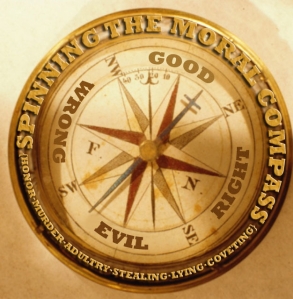
In the world, but not of the world, but which world is that, really?

by Grant Swart

The things of this world, wars, famine, suffering, poverty, etc., impact Christians and non-Christians alike. By remembering that we, as Christians, are “not of this world,” remembering that these things are just for a little while, we can see them in a different light. We are still in this world but we are no longer of it (John 17:14).

Believers are no longer of the world—we are no longer ruled by sin, nor are we bound by the principles of the world. In addition, we are being changed into the image of Christ, causing our interest in the things of the world to become less and less as we mature in Christ. Believers in Jesus Christ are simply in the world—physically present—but not of it, not part of its values. As believers, we should be set apart from the world, we often hear this, even refer to this and remind each other of it, but do we know what that world entails?   Continue reading

The (Im)Morality of Tattoos

Grant Swart

(with sincere appreciation to Lorne Zelyck)

The (Im)Morality of Tattoos was originally an assignment for a Contemporary Moral Issues class offered at Phoenix Seminary. After the original writing, it was modified to also address the ethicality of body piercings. The modified version was published as “Under the Needle: An Ethical Evaluation of Tattoos and Body Piercings” in The Christian Research Journal (Vol. 28/ No. 06/ 2005) available at http://www.equip.org. The author (Lorne Zelyck) reserves all editorial rights and privileges of this paper.

The (Im)Morality of Tattoos


I. A Brief Historical Timeline of Tattoos

In October 1991, a five thousand year old corpse was found frozen in a glacier between Italy and Austria. The body of this man (later called Otzi) is considered the best preserved corpse of the Bronze Age every found, and dates to around 3300 B.C. The skin of Otzi has become of great interest because it bears several tattoos: a cross, six straight lines fifteen centimeters long, and numerous parallel lines.1 Continue reading

Should Christians have Christmas trees?

Christians and Christmas TreesJohn MacArthur

December 17, 2009

As the Christmas Season approaches, questions like this sometimes arise. Like everything in life, it is important to approach these issues with biblical discernment.

In this case, we see nothing wrong with the traditional Christmas tree. However, some have taught that it’s wrong for anyone to have a Christmas tree in their home. But are their reasons valid? We don’t think so. Let’s look at the two most common objections people make against having a Christmas tree.

First, some object on the basis that Christmas trees have pagan origins. It is believed that Boniface, English missionary to Germany in the eighth century, instituted the first Christmas tree. He supposedly replaced sacrifices to the god Odin’s sacred oak with a fir tree adorned in tribute to Christ. But certain other accounts claim that Martin Luther introduced the Christmas tree lighted with candles. Based on that information you could say the Christmas tree has a distinguished Christian pedigree.

However, even if a pagan background were clearly established, that wouldn’t necessarily mean we could not enjoy the use of a Christmas tree. Perhaps the following analogy will help.

Continue reading

Christian Duty in a Pagan Culture

John MacArthur – Grace to You

In an increasingly secular and ungodly culture, many Christians wonder about their role and duty. Should we lobby for rights that have traditionally belonged to us? Should we make every effort to implement a Christian agenda? Should we completely reform the government? The Bible speaks clearly about our duty, and it’s all about governingour character.

Over a quarter of a century ago the late apologist and Christian thinker Francis Schaeffer asked the question, “How should we then live?” in his landmark book of the same title. The relevance of that question has not changed. If anything, it has only become more urgent for believers at the dawn of a new century and millennium.

Society has taken a nosedive into greater and greater evil, debauchery, violence, and corruption, and outside the church, the landscape seems filled with “modern barbarians.” The temptation is strong for believers to jump into the cultural fray as self-righteous social/political reformers and condescending moralizers. All the while those self-styled Christian activists forget or ignore their true mission in the world and completely miss the answer to Schaeffer’s question–an answer that God’s Word spells out quite clearly.

Continue reading

Christians and Halloween

Travis Allen 

Grace to you website

Halloween. It’s a time of year when the air gets crisper, the days get shorter, and for many young Americans the excitement grows in anticipation of the darkest, spookiest holiday of the year. Retailers also rejoice as they warm up their cash registers to receive an average of $41.77 per household in decorations, costumes, candy, and greeting cards. Halloween will bring in approximately $3.3 billion this year.

It’s a good bet retailers won’t entertain high expectations of getting $41.77 per household from the Christian market. Many Christians refuse to participate in Halloween. Some are wary of its pagan origins; others of its dark, ghoulish imagery; still others are concerned for the safety of their children. But other Christians choose to partake of the festivities, whether participating in school activities, neighborhood trick-or-treating, or a Halloween alternative at their church.

The question is, How should Christians respond to Halloween? Is it irresponsible for parents to let their children trick-or-treat? What about Christians who refuse any kind of celebration during the season–are they overreacting?

Continue reading

Speaking in tongues today – is it Biblical ?

Grant Swart

This is a subject which has once again risen to the forefront of discussions between Christians and professing Christians today, particularly since the modern Charismatic Pentecostal movement has gained much international popularity. Speaking in tongues has become a powerful tool used by some televangelists and so-called preachers in mega-churches, those for whom I find the tag “rock star evangelists” particularly descriptive, to deceive those congregants who lack discernment.

I recently heard one of the charismatic preachers at the forefront of the movement in our country, accuse those in his congregation who do not speak in tongues, of being simply and willfully ignorant. Subsequently, he has instituted classes where those, who have not been able to overcome their ignorance of the spiritual gift of tongues, to learn the skill. This, of course, is an addition to the already existing and well attended schools of prophecy and healing at his church, where for a tidy sum, one can learn to channel the Holy Spirit and do the work expected by God of every devoted Christian. I suppose none of this is new or unexpected. I mention it simply to sketch part of the reason for placing this article.

It is important for the Christian to determine the truth regarding this matter, particularly those who do not necessarily consult Scripture to test what is being fed to them from the Charismatic pulpit. Often, for those who are being deceived by the over-dressed, eloquent and financially successful businessmen who moonlight as Charismatic preachers, it is unthinkable that what is being taught as Biblical truth by their heroes, can be perceived as a lie or not from God. Continue reading

Modern Spirituality and Your Mind

1Jn 4:1  Beloved, do not believe every spirit, but test the spirits to see whether they are from God, for many false prophets have gone out into the world.

Listen to the sermon here :

By Voddie Baucham

This whole idea about having a peace about something being from God is a totally pagan idea, will we have peace at times when we are in the will of God? yes, will we we have a peace at times when we aren’t in the will of God yep, how do you know which is from God

Voddie Baucham says it this way:

Continue reading

The Pelagian Captivity of the Church

By Vernelle Imaging

by R.C. Sproul

Shortly after the Reformation began, in the first few years after Martin Luther posted the Ninety-Five Theses on the church door at Wittenberg, he issued some short booklets on a variety of subjects. One of the most provocative was titled The Babylonian Captivity of the Church. In this book Luther was looking back to that period of Old Testament history when Jerusalem was destroyed by the invading armies of Babylon and the elite of the people were carried off into captivity. Luther in the sixteenth century took the image of the historic Babylonian captivity and reapplied it to his era and talked about the new Babylonian captivity of the Church. He was speaking of Rome as the modern Babylon that held the Gospel hostage with its rejection of the biblical understanding of justification. You can understand how fierce the controversy was, how polemical this title would be in that period by saying that the Church had not simply erred or strayed, but had fallen — that it’s actually now Babylonian; it is now in pagan captivity.

Continue reading