Spreading as a spiritual cancer throughout apostatizing evangelicalism, we even see that it’s slithered all the way into the New Calvinst neo-reformed camp e.g. as in Acts 29 Network And Reformed Counter Reformation Spirituality? One of the fruits of CSM is a blurring of doctrinal lines, which is particularly dangerous in this time of postmodernism and growing spiritual blindness.
It is with daily regularity that I encounter certain fellow Christians, although I suppose in some instances they are merely professing Christians, who practice or promote the errors of legalism. I’m sure that we all do, that is, cross paths with people who endorse and encourage some or other form of legalistic practice everyday. The heresy of legalism is rooted in an erroneous teaching or understanding which continually attempts to place the Christian under some or other system of law and thereby attempts to make salvation, or at the very least a few percentage points of our salvation, dependant on man’s own efforts.
Legalism promotes the belief that one can be saved by keeping, or to the best of one’s ability attempting to keep, God’s commandments. Very often adherence to additional rituals and rules are encouraged by the legalistic system in order to retain salvation. Certain aspects of human life are often considered taboo and are presented as being detrimental to the legalist’s success in ‘achieving’ salvation. Legalists believe that they can, through their own efforts at self-righteousness and legal obedience, impress God sufficiently so as to influence His attitude toward them, and therefore reward them with eternal salvation.
Legalism can be described as a false doctrinal position or worldview within certain Christian Continue reading →
There are diverse opinions concerning the thousand years of peace (Millennium) described in Revelation and the events associated with it. Some interpret a literal, future, thousand-year time period in which Christ will rule over the Earth, a time which will be characterized by peace and harmony. Others understand a literal age of peace, but think the “thousand years” is a figure of speech. Still others see the Millennium as symbolic of a spiritual ideal, with no corresponding earthly condition. All of these positions fall into the category of millennialism, a broad term which includes any and all ideas relating to the millennium of Biblical prophecy.
In a nutshell, here are some very basic definitions of the positions regarding the millennium.
Premillenialism:
There are three definitions, any one of which could describe the views of the premillenialist:
Pretribulationists believe that the second coming will be in two stages separated by a seven-year period of tribulation. At the beginning of the tribulation, true Christians will rise to meet the Lord in the air.
Midtribulationists believe that the Rapture will take place at the halfway point of the seven-year tribulation, i.e. after 3½ years. This event begins the second, most intense part of the tribulation.
Posttribulationists hold that Christ will not return until the end of the tribulation. Christians, rather than being raptured at the beginning of the tribulation, or halfway through, will live through it
Postmillenialism:
Postmillennialists do not believe in a premillennial appearance of Christ. The postmillennial position is that the millennium began at the inauguration of Christ’s kingdom reign when he ascended to his heavenly throne. Christ will appear at the end of the millennium to lead his people into the heavenly city, the New Jerusalem.
Amillenialism:
Amillennialists do not believe in a literal Millennium. The “thousand years” is an expression, a way of referring to the entire period from the first coming of Christ, two thousand years ago, until the future second coming. The Second Coming will be a natural culmination of the process of world evangelization, rather than a revolutionary event that brings sudden and dramatic change.
We will place more polls in the near future which will deal with other aspects of Christian eschatology (an understanding or study of the end times and the destiny of man according to Bible prophecy).
Christ Exalted
Or
JESUS CHRIST GLORIOUSLY EXALTED ABOVE ALL EVIL IN THE WORK OF REDEMPTION
Dated August 1738. Lecture.
1 Corinthians 15:25, 26 For he must reign, till he hath put all enemies under his feet. The last enemy that shall be destroyed, is death.
Subject: Our Lord Jesus Christ in the work of redemption gloriously appears above all evil.
THE apostle in this chapter particularly opposes some among the Christian Corinthians who denied the resurrection of the dead and infested the church with their doctrine. There were two sorts of persons in that age who were especially great opposers of the doctrine of the resurrection. One among the Jews were the Sadducees, of whom we read, Acts 23:8. For the Sadducees say that there is no resurrection, either angel or spirit. And we have the same account in other places. Among the heathen that were the chief opposers of this doctrine were their philosophers. The doctrine of the resurrection of the dead was not consistent with their philosophy, by the principles of which, it was impossible that one who was deprived of the habit of life, would ever receive it again. And therefore they ridiculed the doctrine when the apostle preached it among them at Athens. (Acts 17) Probably the church at Corinth received this corruption from the philosophers, and not the Sadducees. For Corinth was near to Athens, and the place of the chief resort of the philosophers of Greece.
The apostle, in opposing this error, first insists on Christ’s resurrection from the dead, and next on the resurrection of all the saints at the end of the world. And in the verses next before the text, shows how both are connected, or that one arises or follows from the other. And then adds, “then cometh the end, when he shall have delivered up the kingdom to God, even the Father; when he shall have put down all rule, and all authority, and power. For he must reign till he hath put all enemies under his feet. The last enemy that shall be destroyed is death.” Observe,
The largely pretending to be Protestant evangelical community continues its pilgrimage back to the legalistic spiritual bondage of apostate Roman Catholicism and its evil author the Church of Rome.
As an online apologetics and discernment work Apprising Ministries does what we can to document this woeful walk away from the truths recaptured during the Lord’s Reformation.
8For it is by free grace (God’s unmerited favor) that you are saved ([a]delivered from judgment and made partakers of Christ’s salvation) through [your] faith. And this [salvation] is not of yourselves [of your own doing, it came not through your own striving], but it is the gift of God; 9Not because of works [not the fulfillment of the Law’s demands], lest any man should boast. [It is not the result of what anyone can possibly do, so no one can pride himself in it or take glory to himself.]
_______________________________________
Note to our Valued Readers, Bothers and Sisters
As you can see we changed the look and we would love your valued opinions. Please feel free to tell us if you like the new look in the comments section 🙂
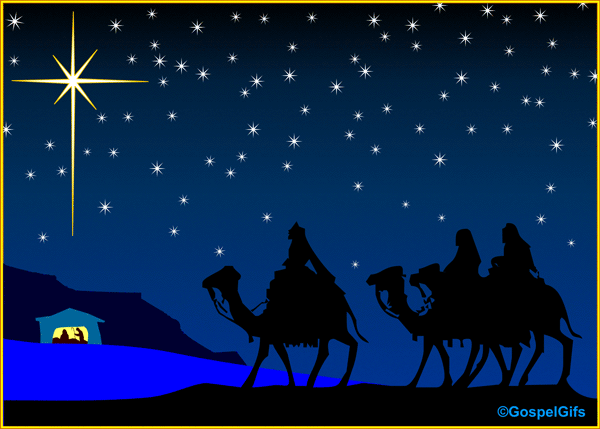
Few biblical stories are as well known, yet so clouded by myth and tradition, as that of the magi, or wise men, mentioned by Matthew. During the Middle Ages legend developed that they were kings, that they were three in number, and that their names were Casper, Balthazar, and Melchior. Because they were thought to represent the three sons of Noah, one of them is often pictured as an Ethiopian. A twelfth-century bishop of Cologne even claimed to have found their skulls.
The only legitimate facts we know about these particular magi are the few given by Matthew in the first twelve verses of chapter 2. We are not told their number, their names, their means of transportation to Palestine, or the specific country or countries from which they came. The fact that they came from the east would have been assumed by most people in New Testament times, because the magi were primarily known as the priestly-political class of the Parthians-who lived to the east of Palestine.
“If the word spoken through angels proved unalterable, and every transgression and disobedience received a just recompense, how shall we escape if we neglect so great a salvation?” (Heb. 2:2-3).
Today the majority believes that God is a God of love and grace, but not of justice. One brief look at Hebrews 2:2-3 ought to convince anyone otherwise. The writer’s point is this: Since the Old Testament makes it clear that transgression and disobedience met with severe and just punishment, how much more so will equal or greater punishment be rendered under the New Testament, which was revealed by the Lord Jesus Christ Himself?
The majority of people in the world will miss the next Christmas. But how can that be? How can anyone miss Christmas, given the amount of advertising, publicity, and promotion the holiday receives each year? Because although many celebrate Christmas every year, most don’t know what it’s about. In spite of all the media promotion of Christmas, the majority of people will miss it because it has become so obscured.
For those of us who know and love the Lord Jesus Christ, Christmas is a time to focus on His birth. But even we can get caught up in the swirl of activity around Christmastime and can miss it in a practical sense. Satan has so cluttered the Christian concept of Christmas with such needless paraphernalia that its true meaning is easily lost.
A Brief History of Christmas
Most scholars doubt that December 25 th is the true date of Christ’s birth. There is no biblical support for it, and some against it. That date was decided upon by the church in Rome in the fourth century. They had a specific reason for doing so.
Many people who profess to be Calvinists are surprised to learn that while John Calvin was opposed to the bad things that have sometimes come to be associated with Christmas, he wasn’t against keeping the holiday as a celebration of the birth of Christ and saw it as a matter of liberty for the churches and the individual.
We can gain insight into Calvin’s views by reading two letters, one written on January 2, 1551; the other in March of 1555. The relevant portions are below, followed by the full contents of both letters. One may observe that Calvin’s understanding of the Regulative Principle of Worship is not so much focused on the kind of uniform, narrowly limited kind of worship that came to be the legacy of Puritanism, but on protecting the liberty of local congregations and individuals. One must never forget that liberty of conscience, under the authority of the Lord Jesus Christ speaking in the Scripture, is a fundamental of fundamentals for John Calvin.
The story of the first Christmas is so beloved that singers and storytellers across the centuries have embellished and elaborated and mythologized the story in celebration. However, most people now don’t know which details are biblical and which are fabricated. People usually imagine the manger scene with snow, singing angels, many worshipers, and a little drummer boy. None of that is found in the biblical account.
Christmas has become the product of an odd mixture of pagan ideas, superstition, fanciful legends, and plain ignorance. Add to that the commercialization of Christmas by marketers and the politicization of Christmas in the culture wars, and you’re left with one big mess. Let’s try to sort it out. The place to begin is in God’s Word, the Bible. Here we find not only the source of the original account of Christmas, but also God’s commentary on it.
“Therefore also God highly exalted Him, and bestowed on Him the name which is above every name, that at the name of Jesus every knee should bow, of those who are in heaven, and on earth, and under the earth, and that every tongue should confess that Jesus Christ is Lord, to the glory of God the Father.” – Philippians 2:9-11
God will exalt the humble.
Having plumbed the depths of Christ’s humiliation (Phil. 2:5-8), Paul now soars to the heights of His exaltation (vv. 9-11). Like Paul, the apostle Peter affirmed that the great theme of Old Testament prophecy was the sufferings of Christ and the glory to follow (1 Peter 1:11). Regarding Christ, the writer of Hebrews says that “for the joy set before Him [He] endured the cross, despising the shame, and has sat down at the right hand of the throne of God” (Heb. 12:2). Christ understood His sufferings in light of His exaltation.
This creed arose out of the early Western church and should be thought of as a summary of the Apostles’ teaching rather than directly attributable to them. Originally it was essentially a baptismal confession and had several variations. The form in use today dates from the eighth century.
For the weapons of our warfare are not of the flesh, but divinely powerful for the destruction of fortresses. We are destroying speculations and every lofty thing raised up against the knowledge of God, and we are taking every thought captive to the obedience of Christ, (2 Corinthians 10:4–5)
To successfully fight the spiritual war requires weapons from the heavenly arsenal. Only those divinely powerful weapons are suited for the destruction of the enemies’ fortresses. That term would convey to the New Testament reader the thought of a formidable stronghold. Corinth, like most major cities in Greece, had an acropolis. Located on a mountain near the city, the acropolis was a fortified place into which the inhabitants could retreat when attacked. Ochuroma (fortresses) was also used in extrabiblical Greek to refer to a prison. People under siege in a fortress were imprisoned there by the attacking forces. The word was also used to refer to a tomb.


 Apprising Ministries has been warning for years concerning the evil effects of the neo-liberal in the Emerging Church aka the Emergent Church.









 For the Love of His Truth