Grow in Grace and Knowledge

sf_ntBooks_2Peter01


The apostle Peter wrote his first epistle to God’s saints who were suffering the horrible trial of persecution under the Roman Emperor, Nero. His second epistle was written shortly afterward, just before his death (2Pe_1:14), and is addressed to the same suffering saints. Their circumstances had not changed.

The first epistle dealt with the hard, hard trial of persecution, of suffering for Christ’s sake. In that epistle Peter urges us to persevere in the faith, assuring us of God’s great grace in Christ and urging us to follow the example our Savior set before us (1Pe_2:21-24).

In 2nd Peter the inspired apostle deals with a trial even more difficult to endure, and urges us to remain steadfast in faith in the face of the ever-increasing onslaught of false religion. In these three chapters Peter urges us to remain steadfast and persevere in the faith, assuring us again of God’s great grace to us in Christ, and urging us to “grow in grace, and in the knowledge of our Lord and Savior Jesus Christ” (2Pe_3:18). In 1st Peter we are taught to rejoice in hope in the face of great trials. Here, in 2nd Peter, we are taught to remain faithful to the truth in the midst of great falsehood.

Precious Things

In these two epistles the apostle Peter reminds us of the many blessings of grace our God has given us in Christ. In fact, he tells us that the Lord God has, according to his divine power, “given unto us all things that pertain unto life and godliness, through the knowledge of him that hath called us to glory and virtue” (2Pe_1:3). Among these many gifts of grace, Peter names six that he calls “precious.

  1. He tells us that the trial of our faith is more precious than gold that perishes, because the trials of our faith in this world will make heaven more glorious than it could otherwise have been (1Pe_1:7). Continue reading

Two Great Errors Of False Teachers

Well

But chiefly them that walk after the flesh in the lust of uncleanness, and despise government. Presumptuous are they, selfwilled, they are not afraid to speak evil of dignities. Whereas angels, which are greater in power and might, bring not railing accusation against them before the Lord. But these, as natural brute beasts, made to be taken and destroyed, speak evil of the things that they understand not; and shall utterly perish in their own corruption; And shall receive the reward of unrighteousness, as they that count it pleasure to riot in the day time. Spots they are and blemishes, sporting themselves with their own deceivings while they feast with you; Having eyes full of adultery, and that cannot cease from sin; beguiling unstable souls: an heart they have exercised with covetous practices; cursed children: Which have forsaken the right way, and are gone astray, following the way of Balaam the son of Bosor, who loved the wages of unrighteousness; But was rebuked for his iniquity: the dumb ass speaking with man’s voice forbad the madness of the prophet. These are wells without water, clouds that are carried with a tempest; to whom the mist of darkness is reserved for ever. For when they speak great swelling words of vanity, they allure through the lusts of the flesh, through much wantonness, those that were clean escaped from them who live in error. While they promise them liberty, they themselves are the servants of corruption: for of whom a man is overcome, of the same is he brought in bondage. For if after they have escaped the pollutions of the world through the knowledge of the Lord and Saviour Jesus Christ, they are again entangled therein, and overcome, the latter end is worse with them than the beginning. For it had been better for them not to have known the way of righteousness, than, after they have known it, to turn from the holy commandment delivered unto them. But it is happened unto them according to the true proverb, The dog is turned to his own vomit again; and the sow that was washed to her wallowing in the mire.
(2 Peter 2:10-22 KJV)

Two great errors of false teachers 
2Pe_2:10-22

There were and are false preachers and teachers in the Christian church, just as there were false teachers among the Jews. We are warned to mark them and beware of them (Mat_7:15-16; 2Ti_4:3-4).

2Pe_2:10. These false teachers and preachers (besides denying the true gospel of redemption through Christ alone—2Pe_2:1) are guilty of two great errors. Continue reading

Hirelings and the Shepherd

Jer 3 v 15

Don Fortner 

“This parable spake Jesus unto them: but they understood not what things they were which he spake unto them. Then said Jesus unto them again, Verily, verily, I say unto you, I am the door of the sheep. All that ever came before me are thieves and robbers: but the sheep did not hear them. I am the door: by me if any man enter in, he shall be saved, and shall go in and out, and find pasture. The thief cometh not, but for to steal, and to kill, and to destroy: I am come that they might have life, and that they might have it more abundantly. I am the good shepherd: the good shepherd giveth his life for the sheep. But he that is an hireling, and not the shepherd, whose own the sheep are not, seeth the wolf coming, and leaveth the sheep, and fleeth: and the wolf catcheth them, and scattereth the sheep. The hireling fleeth, because he is an hireling, and careth not for the sheep. I am the good shepherd, and know my sheep, and am known of mine. As the Father knoweth me, even so know I the Father: and I lay down my life for the sheep. And other sheep I have, which are not of this fold: them also I must bring, and they shall hear my voice; and there shall be one fold, and one shepherd. Therefore doth my Father love me, because I lay down my life, that I might take it again. No man taketh it from me, but I lay it down of myself. I have power to lay it down, and I have power to take it again. This commandment have I received of my Father. There was a division therefore again among the Jews for these sayings. And many of them said, He hath a devil, and is mad; why hear ye him? Others said, These are not the words of him that hath a devil. Can a devil open the eyes of the blind?” (John 10:6-21)

George Whitefield once declared, “As God can send a nation or people no greater blessing than to give them faithful, sincere, and upright ministers, so the greatest curse that God can possibly send upon a people in this world, is to give them over to blind, unregenerate, carnal, lukewarm, and unskilled guides. And yet, in all ages, we find that there have been many wolves in sheep’s clothing, many that daubed with untempered mortar, that prophesied smoother things than God did allow.”

Wolves in sheep’s clothing were prevalent in the days of Isaiah, Jeremiah, and Ezekiel. Continue reading

“A Just God and a Saviour”

182914_10151649219609865_270462064_n

Nevertheless he saved them for his name’s sake, that he might make his mighty power to be known.
(Psalms 106:8 KJV)

“A Just God and a Saviour”

Isaiah 45:21

The Lord our God, the one true and living God of heaven and earth, is a God who freely and abundantly forgives sin through the blood of his Son, the Lord Jesus Christ. This is what God himself says, “I, even I, am he that blotteth out thy transgressions for mine own sake, and will not remember thy sins.


The People Forgiven

Who are the people to whom God will be merciful? They are not good, righteous, and morally upright men and women. So long as a man thinks that he is good and righteous, he will never obtain mercy from God. The characters to whom God says he will be merciful are sinners. The grace and lovingkindness of Jehovah is reserved for sinners. Until you see that your supposed righteousness is an abomination to God, you will never obtain the righteousness of God in Christ (Romans 10:1-4). Every promise of the gospel is made to sinners. — “The Son of man came not to call the righteous, but sinners to repentance (Matthew 11:28-30; Isaiah 1:4-6, 18; 55:6-7). The grace and mercy of God is for Continue reading

Discovering Christ in All the Scriptures – FREE EBOOK DOWNLOAD BY Don Fortner

fortner-christ-in-all-scriptures

FREE EBOOK DOWNLOAD BY Don Fortner – Discovering Christ in All the Scriptures

Summary

This is a Bible Survey type of book, with 67 chapters, an introduction and one on each book of the Bible. The main focus of this work is to see Christ in each book of Scripture. Pastor Fortner  does a good work in this book.

Chapter 1
GENESIS
The Book of Beginnings (Exert)

I want to take you through the entire Volume of Holy Scripture, book by book, show you the message of each book and its
relation to the whole Word of God. That will be the easy part. Here’s the tough part—I plan to cover one entire book in each
of the succeeding chapters. We will begin, of course, with Genesis, the book of beginnings.

What I hope to do in these studies is to give you a zoomlens view of Holy Scripture. I trust the Lord will use them to help you see clearly that the message of this Book, from beginning to end is Jesus Christ and him crucified, and that you will be able to grasp more fully the whole truth of God, the whole of Divine Revelation.

We read in Genesis 1:1-3—”In the beginning God created the heaven and the earth. And the earth was without form, and void; and darkness was upon the face of the deep. And the Spirit of God moved upon the face of the waters. And God
said, Let there be light: and there was light.” Continue reading

Reprobation Asserted

John 10

But ye believe not, because ye are not of my sheep, as I said unto you.
(John 10:26 KJV)

Listent to sermon

There was a division therefore again among the Jews for these sayings. And many of them said, He hath a devil, and is mad; why hear ye him? Others said, These are not the words of him that hath a devil. Can a devil open the eyes of the blind? And it was at Jerusalem the feast of the dedication, and it was winter. And Jesus walked in the temple in Solomon’s porch. Then came the Jews round about him, and said unto him, How long dost thou make us to doubt? If thou be the Christ, tell us plainly. Jesus answered them, I told you, and ye believed not: the works that I do in my Father’s name, they bear witness of me. But ye believe not, because ye are not of my sheep, as I said unto you. My sheep hear my voice, and I know them, and they follow me: And I give unto them eternal life; and they shall never perish, neither shall any man pluck them out of my hand. My Father, which gave them me, is greater than all; and no man is able to pluck them out of my Father’s hand.
(John 10:19-29 KJV) Continue reading

BABYLON’S WOES

alas-babylon-babylon-will-perish

And he cried mightily with a strong voice, saying, Babylon the great is fallen, is fallen, and is become the habitation of devils, and the hold of every foul spirit, and a cage of every unclean and hateful bird.
(Revelation 18:2 KJV)

Don Fortner

Habakkuk 2:4-20

Listen to the sermon :

The title of my message is BABYLON’S WOES. In the 2nd chapter of Habakkuk the Prophet of God denounces four great woes upon Babylon. These are woes that were pronounced upon the ancient city of Babylon. Yet, a careful reading of the chapter makes it obvious that the mere destruction of that ancient city is not all that the passage asserts. By the Spirit of God, Habakkuk here speaks prophetically of Mystical Babylon, the great whore of the earth by which the truth of God is prostituted and immortal souls are damned.

Proposition: Babylon represents all false religion; and all false religion is under the curse of God.

FOUR WOES

Here are four woes denounced upon Babylon, four woes that fell from the very mouth of God, woes which shall be executed upon that wicked city.

1.     Woe to Babylon, woe to all false religion, woe to all free-will, works religion, God’s wrath shall destroy you because you spoil the nations of the world (vv. 6-8).

(Habakkuk 2:6-8) “Shall not all these take up a parable against him, and a taunting proverb against him, and say, Woe to him that increaseth [that which is] not his! how long? and to him that ladeth himself with thick clay! 7 Shall they not rise up suddenly that shall bite thee, and awake that shall vex thee, and thou shalt be for booties unto them? 8 Because thou hast spoiled many nations, all the remnant of the people shall spoil thee; because of men’s blood, and [for] the violence of the land, of the city, and of all that dwell therein.”

2.    Woe to Babylon, woe to all false religion, woe to all free-will, works religion, God’s wrath shall destroy you because you make men swell with pride (vv. 4-5, 9-11). Continue reading

Be Not Unequally Yoked Together

Be not unequally

2 Corinthians 6:11-18 KJV (11) O ye Corinthians, our mouth is open unto you, our heart is enlarged. (12) Ye are not straitened in us, but ye are straitened in your own bowels. (13) Now for a recompence in the same, (I speak as unto my children,) be ye also enlarged. (14) Be ye not unequally yoked together with unbelievers: for what fellowship hath righteousness with unrighteousness? and what communion hath light with darkness? (15) And what concord hath Christ with Belial? or what part hath he that believeth with an infidel? (16) And what agreement hath the temple of God with idols? for ye are the temple of the living God; as God hath said, I will dwell in them, and walk in them; and I will be their God, and they shall be my people. (17) Wherefore come out from among them, and be ye separate, saith the Lord, and touch not the unclean thing; and I will receive you, (18) And will be a Father unto you, and ye shall be my sons and daughters, saith the Lord Almighty.

Be not unequally yoked together Continue reading

Arminianism Agrees With Roman Catholicism, Calvinism Agrees With The Bible

road to rome

Arminianism at Home in Rome

But, however frivolous his cavils, the principles for which he contends are of the most pernicious  nature and tendency. I must repeat, what already seems to have given him so much offence, that Arminianism “came from Rome, and leads thither again.” Julian, bishop of Eclana a  contemporary and disciple of Pelagius, was one of those who endeavoured, with much art, to gild the  doctrines of that heresiarch, in order to render them more sightly and palatable. The Pelagian system,  thus varnished and paliated, soon began to acquire the softer name of Semipelagianism. Let us take a  view of it, as drawn to our hands by the celebrated Mr. Bower, who himself, in the main, a professed  Pelagian, and therefore less likely to present us with an unfavourable portrait of the system he  generally approved. Among the principles of that sect, this learned writer enumerates the following:

“The notion of election and reprobation, independent of our merits or demerits, is  maintaining a fatal necessity, is the bane of all virtue, and serves only to render good  men remiss in working out their salvation, and to drive sinners to despair.

“The decrees of election and reprobation are posterior to, and in consequence of, our  good or evil works, as foreseen by God from all eternity.”

Is not this too the very language of modern Arminianism? Do not the partizans of that scheme argue on the same identical terms? Should it be said, “True, this proves that Arminianism is Pelagianism revived; but it does not prove, that the doctrines of Arminianism are originally Popish:” a moment’s cool attention will make it plain that they are. Let us again hear Mr. Bower, who, after the passage just quoted, immediately adds, “on these two last propositions, the Jesuits found their whole system of grace and free-will; agreeing therein with the Semipelagians, against the Jansenists and St. Augustine.” The Jesuits were moulded into a regular body, towards the middle of the sixteenth century: toward the close of the same century, Arminius began to infest the Protestant churches. It needs therefore no great penetration, to discern from what source he drew his poison. His journey to Rome (though Monsicur Bayle affects to make light of the inferences which were at that very time deduced from it) was not for nothing. If, however, any are disposed to believe, that  Arminius imbibed his doctrines from the Socinians in Poland, with whom, it is certain, he was on terms of intimate friendship, I have no objection to splitting the difference: he might import some of his tenets from the Racovian brethren, and yet be indebted, for others, to the disciples of Loyola. Continue reading

The True Shepherd and the False

the-lord-is-my-shepherd-mike-ivey

Don Fortner

“Verily, verily, I say unto you, He that entereth not by the door into the sheepfold, but climbeth up some other way, the same is a thief and a robber. But he that entereth in by the door is the shepherd of the sheep. To him the porter openeth; and the sheep hear his voice: and he calleth his own sheep by name, and leadeth them out. And when he putteth forth his own sheep, he goeth before them, and the sheep follow him: for they know his voice. And a stranger will they not follow, but will flee from him: for they know not the voice of strangers. This parable spake Jesus unto them: but they understood not what things they were which he spake unto them.”

(John 10:1-6)

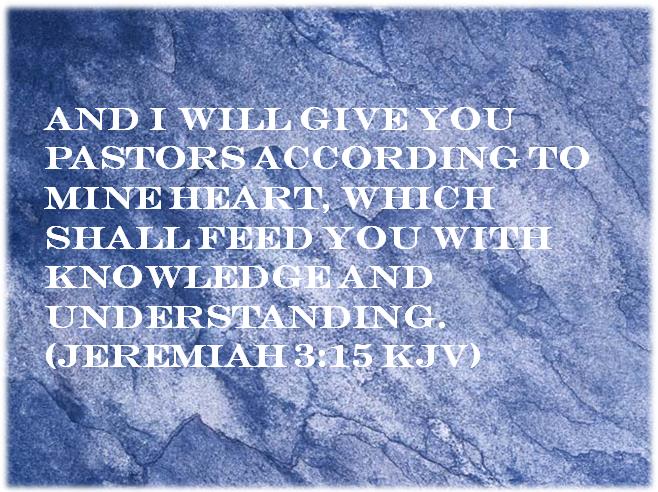
The Lord God made a promise to his church in Jeremiah 3:15. It is a promise made to those people to whom the God of heaven declares, “I am married unto you…I will bring you to Zion.” This is God’s promise to his people for all time. — “I will give you pastors according to mine heart, which shall feed you with knowledge and understanding.”

Those pastors who are the ascension gifts of Christ to his church, who are pastors after God’s own heart, feed the sheep with knowledge, gospel knowledge, Bible knowledge, the knowledge of God, of Christ, of grace, and knowledge of man in his fallen state and in his redeemed state. They constantly proclaim the Word of the Lord. They constantly call eternity bound sinners to Christ, and urge God’s people to “walk in the old paths, where is the good way” that you may “find rest for your souls.” They feed God’s people with understanding, too, understanding you, understanding the things of God, and understanding the times.

When the Lord God gives his church pastors after his own heart, who feed his sheep with knowledge and understanding, his sheep shall “fear no more, are no longer dismayed, neither shall they be lacking” (Jeremiah 23:4). Blessed are those people, blessed is that church to whom God gives such a pastor! Continue reading

TELL THE TRUTH ABOUT SALVATION

truth-is-still-truth

Grant Swart

I pray that it is my humble and heartfelt intent to write concerning an earnest directive which believers have been given, and that is, to truthfully pass on to those who do not know the Lord, the liberating and glorious facts concerning the means of salvation which the Gospel proclaims. When we consider all which constitutes the doctrine of salvation in the Gospel, it is impossible to disentangle it from the truth about God, the truth about men, the truth about sin, and the truth about Christ.

So often today the word “salvation” is used in very loose terms, ascribing to it many man-centered, phony ideas and fanciful doctrines which sound reasonable and very appealing to man’s conscience and which man readily accepts. Many of these are simply intended to soothe man’s guilty conscience, and leave him with a false comfort that man himself remains the ‘captain of his soul’ and in control of his eternal destiny. However, biblical truth about salvation is that man is not in any position to determine or secure his own salvation, by means of a decision or by applying his will or effort.

One is not likely to hear from the mouths of most preachers, that man is hopelessly unable to choose to follow God, or to decide to allow God into his life. Contrary to what many billboards around our country proclaim, man cannot, and indeed will never want to, turn back to God, unless he has been called to do so by God. Continue reading

Why Don’t All People Come To Christ?

Turning away

Don Fortner

“Search the scriptures; for in them ye think ye have eternal life: and they are they which testify of me. And ye will not come to me, that ye might have life.” (John 5:39-40)

Faith in Christ is set before us in many different ways in Scripture. Faith is looking to Christ. — “Look unto me, and be ye saved, all the ends of the earth: for I am God, and there is none else” (Isaiah 45:22). — “Behold, as the eyes of servants look unto the hand of their masters, and as the eyes of a maiden unto the hand of her mistress; so our eyes wait upon the LORD our God, until that he have mercy upon us” (Psalms 123:2). Faith is trusting Christ, as a son trusts his father. — “O LORD of hosts, blessed is the man that trusteth in thee” (Psalms 84:12). Faith is seeking Christ, as a man seeks something he has lost. Faith is laying hold of Christ, as a drowning man lays hold of a life-line. And saving faith is described in Scripture as coming to Christ. The Lord Jesus is able to save to the uttermost all them that come to God by him. Believers are described by Peter as a people coming to the Savior. — “To whom coming, as unto a living stone, disallowed indeed of men, but chosen of God, andprecious” (1 Peter 2:4).

How often poor, needy sinners came to Christ, or were brought to him in desperate need, while he walked on the earth. And as often as a needy soul came to our omnipotent, ever-gracious, all-merciful Savior, he obtained the healing power and saving mercy he needed (Matthew 8:1-3; 9:1-8, 20-22, 18-26, 27-31). Salvation is obtained by coming to Christ. The Lord Jesus is able to save all who come to God by him. The Lord Jesus has promised that he will save all who come to him. (Matthew 11:28; John 6:37; John 7:37-38). And in the Gospel narratives every poor sinner who came to Christ obtained the salvation he sought.

In John 5:39-40 our Lord Jesus is talking to religious people, people who went to church every week, people who read and studied the Bible. He says, “Search the scriptures; for in them ye think ye have eternal life: and they are they which testify of me. And ye will not come to me, that ye might have life.” These were Bible thumping, conservative, religious, church going people, people who read, memorized, and studied the Word of God. Yet, our Savior said to these religious people, — “Search the scriptures; for in them ye think ye have eternal life: and they are they which testify of me. And ye will not come to me, that ye might have life.” Continue reading

THE GOSPEL ACCORDING TO ISAIAH

Isaiah 53

“OUR CONFESSION OF FAITH”

Isaiah 53

 The Works of Henry Mahan, Volume 1 containing The Gospel According To Isaiah, Chapter 20

Someone asked an old minister of the gospel, “Is your creed in print?” He replied, “Yes, you will find it all in Isaiah, Chapter 53.” Here is the gospel of God’s grace in one chapter.

(Vs. 1) “Our report” is our message of the love, mercy, and grace of God in Christ Jesus. It is the testimony of Cod concerning Jesus Christ (Rom. 1:1-4). There has never lived a prophet who did not mourn the fact that men would not believe the good news of grace.

“The arm of the Lord” is Christ Jesus, the wisdom and POWER of God; for the gospel of Christ is the power of Cod unto salvation (Rom. 1:16). Natural men do not see, hear, nor understand how God can be just and justifier, righteous and merciful to sinners through the obedience and death of Christ, the substitute (I Cor. 2:8-14). He must be revealed to the heart by the Holy Spirit.

(Vs. 2) “A tender plant”signifies His lowly entrance into the world. He came not full grown in the pomp and glory of men but as a tiny, frail, helpless infant, born of a woman (Gal. 4:4-5).

“A root out of a dry ground” reveals the condition of David’s house and the nation of Israel at this time. There was nothing left of the glory of David’s kingdom, only dry ground, its king an unlikely son of a carpenter (John 6:42).

“No form … no comeliness … no beauty.” In sending our Redeemer into the world, the Lord God rejected and refused all fleshly, human attraction. Anything that would attract the eye of the flesh or support of the natural mind was refused. “My kingdom is not of this world” (John 1:10-11). Continue reading

Suffer Persecution

941912_640891752592273_122437478_n

The holy scriptures

Yea, and all that will live godly in Christ Jesus shall suffer persecution. But evil men and seducers shall wax worse and worse, deceiving, and being deceived. But continue thou in the things which thou hast learned and hast been assured of, knowing of whom thou hast learned them; And that from a child thou hast known the holy scriptures, which are able to make thee wise unto salvation through faith which is in Christ Jesus. All scripture is given by inspiration of God, and is profitable for doctrine, for reproof, for correction, for instruction in righteousness: That the man of God may be perfect, throughly furnished unto all good works.
(2 Timothy 3:12-17 KJV)

2Ti_3:12. In the preceding verse Paul speaks of the suffering, afflictions, and persecutions he had endured for preaching the gospel of Jesus Christ; and he adds, ‘All that will live godly in Christ Jesus shall suffer persecution.’ There are no exceptions.

Satan, the world, and especially unsaved religionists hate the gospel of free grace and justification by faith alone. Going about to establish a righteousness of their own, they are opposed to the imputed righteousness of Christ and count as their enemies all who preach and believe it. Those who wish to be exempt from persecution must necessarily denounce Christ (Joh_15:18-21). All believers shall not be martyrs; but it is absolutely unavoidable that as soon as a true knowledge of grace and a zeal for the person and work of Christ is manifested by a believer, it kindles the rage of Satan and ungodly men. By persecution, slander, murmuring, or some other method, trial will come! Continue reading

Needful Exhortations and Warnings

one-more-joint

By Don Fortner  (Selected Commentary on selected books, Chapter 16) 

Needful Exhortations and Warnings

Therefore all things whatsoever ye would that men should do to you, do ye even so to them: for this is the law and the prophets.”

           (Mat_7:1-29)

In this chapter, our Lord Jesus concludes his Sermon on the Mount. Throughout this sermon (Matthew 5-7), our Savior draws a clear, unmistakable distinction between true and false religion, between outward ceremonialism and inward godliness, between religious hypocrisy and true spirituality. In chapter 5 he showed us the character of his people and the necessity of holiness. In chapter 6 he showed us the character of true worship and the necessity of faith. Here in chapter 7 he brings his sermon home to all who heard him (and to all who read his words today) by making general, but pointed, exhortations and warnings, that we all need to be reminded of continually. May God the Holy Spirit, who has preserved these exhortations and warnings for us upon the pages of Holy Scripture, graciously apply them to our hearts.

Kindness

This chapter opens with a gracious exhortation to kindness (Mat_7:1-5).

“Judge not, that ye be not judged. For with what judgment ye judge, ye shall be judged: and with what measure ye mete, it shall be measured to you again. And why beholdest thou the mote that is in thy brother’s eye, but considerest not the beam that is in thine own eye? Or how wilt thou say to thy brother, Let me pull out the mote out of thine eye; and, behold, a beam is in thine own eye? Thou hypocrite, first cast out the beam out of thine own eye; and then shalt thou see clearly to cast out the mote out of thy brother’s eye.”

I do not know of any text in all the Bible that has been more twisted, abused, and misapplied by men than Mat_7:1. Those who despise absolute values, absolute standards of right and wrong, absolute doctrinal truths and dogmatism, even if they cannot quote any other text in the Bible, recite these words to condemn as divisive bigots all who press upon them the doctrinal and spiritual demands of Holy Scripture. With sweet sounding piety and complete seriousness they will look you right in the eye and say, “Judge not, that ye be not judged.” Continue reading