Five Slanderous Reports Confronted

Slander

By Don Fortner

Do you know what it is to be held in suspicion? Do you know what it is to be slandered, falsely accused, to have your name evil spoken of, to have your character assaulted? There are few of God’s children in this world who do not experience these things.

Noah’s son Ham sought to mar his father’s name among his own brothers. Moses was the object of much slander in Pharaoh’s house; but the slander in the house of Israel was more bitter; and the suspicions of Miriam and Aaron were even worse. Joseph’s brethren spoke evil of him. David was maligned by Saul, betrayed by Ahithophel, and cursed by Simeon. Jeremiah was falsely accused by those for whom he labored, to whom he carried the burden of the Word of the Lord. John the Baptist was praised as a great prophet one day and accused of being possessed of the devil the next. Our Lord himself was slandered, maligned, falsely accused, betrayed and looked upon by the multitudes, those who would not hear him, as a vile, reprehensible man, a glutton, a drunk, and the constant companion of sinners. The women who anointed the Savior had their motives suspected and were slandered, even by their fellow disciples. Paul was accused of being a self-serving false prophet, a promoter of licentiousness, and a wicked man. Continue reading

The Wisdom of Proverbs

540415_230600840407234_1278694670_n

Proverbs 13:1-25

A wise son hears his father’s instruction, but a scoffer does not listen to rebuke. (2) From the fruit of his mouth a man eats what is good, but the desire of the treacherous is for violence. (3) Whoever guards his mouth preserves his life; he who opens wide his lips comes to ruin. (4) The soul of the sluggard craves and gets nothing, while the soul of the diligent is richly supplied. (5) The righteous hates falsehood, but the wicked brings shame and disgrace. (6) Righteousness guards him whose way is blameless, but sin overthrows the wicked. (7) One pretends to be rich, yet has nothing; another pretends to be poor, yet has great wealth. (8) The ransom of a man’s life is his wealth, but a poor man hears no threat. (9) The light of the righteous rejoices, but the lamp of the wicked will be put out. (10) By insolence comes nothing but strife, but with those who take advice is wisdom. (11) Wealth gained hastily will dwindle, but whoever gathers little by little will increase it. (12) Hope deferred makes the heart sick, but a desire fulfilled is a tree of life. (13) Whoever despises the word brings destruction on himself, but he who reveres the commandment will be rewarded. (14) The teaching of the wise is a fountain of life, that one may turn away from the snares of death. (15) Good sense wins favor, but the way of the treacherous is their ruin. (16) In everything the prudent acts with knowledge, but a fool flaunts his folly. (17) A wicked messenger falls into trouble, but a faithful envoy brings healing. (18) Poverty and disgrace come to him who ignores instruction, but whoever heeds reproof is honored. (19) A desire fulfilled is sweet to the soul, but to turn away from evil is an abomination to fools. (20) Whoever walks with the wise becomes wise, but the companion of fools will suffer harm. (21) Disaster pursues sinners, but the righteous are rewarded with good. (22) A good man leaves an inheritance to his children’s children, but the sinner’s wealth is laid up for the righteous. (23) The fallow ground of the poor would yield much food, but it is swept away through injustice. (24) Whoever spares the rod hates his son, but he who loves him is diligent to discipline him. (25) The righteous has enough to satisfy his appetite, but the belly of the wicked suffers want.  (ESV)

John Gills commentary  on some verses :  Continue reading

The Purpose of Christian Ministry

France-DSC5968

Horatius Bonar 

“The object of the Christian ministry is to convert sinners and to edify the body of Christ. No faithful minister can possibly rest short of this. Applause, fame, popularity, honor, wealth-all these are vain. If souls are not won, if saints are not matured, our ministry itself is vain.

The question, therefore, which each of us has to answer to his own conscience is, ‘Has it been the end of my ministry, has it been the desire of my heart to save the lost and guide the saved? Is this my aim in every sermon I preach, in every visit I pay? Is it under the influence of this feeling that I continually live and walk and speak? Is it for this I pray and toil and fast and weep? Is it for this I spend and am spent, counting it, next to the salvation of my own soul, my chiefest joy to be the instrument of saving others? Is it for this that I exist? To accomplish this would I gladly die? Have I seen the

pleasure of the Lord prospering in my hand? Have I seen souls converted under my ministry? Have God’s people found refreshment from my lips, and gone upon their way rejoicing, or have I seen no fruit of my labors, and yet content to remain unblest? Am I satisfied to preach, and yet not know of one saving impression made, one sinner awakened ?’

Nothing short of positive success can satisfy a true minister of Christ. His plans may proceed smoothly and his external machinery may work steadily, but without actual fruit in the saving of souls he counts all these as nothing. His feeling is: ‘My little children, of whom I travail in birth again until Christ be formed in you’ (Galatians 4:19). And it is this feeling which makes him successful”
– Horatius Bonar (1808-1889)
taken from: Words to Winners of Souls.

If God is so powerful and so good, why do bad things happen?

 “SOVEREIGNTY OF GOD”

“Alleluia, for the Lord God omnipotent reigneth.”

There are basically two aspects in any definition of sovereignty. In order for anyone to be a king he must possess, (1) Absolute Authority, and, (2) All Power. A king must have the right to rule, and the ability to carry out his will. God said through Isaiah, “.. for I am God, and there is none else; I am God, and there is none like me .. My counsel shall stand, and I will do all my pleasure.” Isa. 46:9-10. Our God is a unique King in that his reign is eternal, “..the LORD sitteth King for ever.” Psa. 29:10.

A — DEFINITION OF SOVEREIGNTY:

“That the great God, blessed for ever, hath an absolute power and right dominion over his creatures, to dispose and determine of them as seemeth him good. Elisha Coles, God’s Sovereignty.” P 1.

B — PLACE OF SOVEREIGNTY:

We are not to think necessarily that sovereignty is an attribute of God. It is the conclusion of all His attributes. When we read that God is holy, just, love, gracious, merciful, all-wise, all-powerful, yea, all the works of God we see displayed, we reckon that He is sovereign! This is of extreme value to the child of God, to know there is no greater than his God.

“Although the sovereignty of God is universal and absolute, it is not the sovereignty of blind power. It is coupled with infinite wisdom, holiness, and love. And this doctrine, when properly understood, is a most comforting and reassuring one. Who would not prefer to have his affairs in the hands of a God of infinite power, wisdom, holiness and love, rather than to have them left to fate, or chance, or irrevocable natural law, or to short-sighted and perverted self? Those who reject God’s sovereignty should consider what alternatives they have left.” Loraine Boettner.

All of the works of God described in the Bible indicate that He is sovereign and that he has such authority and power, even as we are told in our text, “..the Lord God omnipotent reigneth.” When John, in the Revelation, saw inside heaven he saw, “the Lord God Almighty and the Lamb.” Rev.21:22 Continue reading

Wise as Serpents—Harmless as Doves

by Thomas Watson

“Be wise as serpents—and harmless as doves.” Matthew 10:16

The Apostle says, “All Scripture is given by inspiration,” 2 Timothy 3:16. God’s Word is compared to a lamp for its enlightening quality, Psalm 119:105, and to refined silver for its enriching quality, Psalm 12:6. Among other parts of Sacred Writ, this text is not the least: “Be wise as serpents—and harmless as doves.” This is the speech of our blessed Savior. His lips were a tree of life which fed many. His works were miracles. His words were oracles—and deserve to be engraved upon our hearts as with the point of a diamond. This is a golden sentence, “Be wise as serpents—and harmless as doves.” Our Lord Jesus, in this chapter:

first, gives His Apostles their commission;

second, He foretells their danger;

third, He gives them several instructions.

I. Christ gives His Apostles their COMMISSION. Before they went abroad to preach, Christ ordained them, verse 5, “These twelve, Jesus sent forth.” Those who exercise in the ministerial function must have a lawful call. Hebrews 5:4, “No one takes this honor upon himself; he must be called by God.” Christ gave not only the Apostles and Prophets a call to their office (who wereextraordinary ministers)—but even pastors and teachers, (who are ordinary ministers) Ephesians 4:11.

QUESTION. But if one has gifts, is this not sufficient to the ministerial office? Continue reading

The Sovereignty Of God In Salvation

John 10:28 I give them eternal life, and they will never perish, and no one will snatch them out of my hand.

A.W. PINK’S

THE
SOVEREIGNTY
OF GOD

CHAPTER FOUR

THE SOVEREIGNTY OF GOD IN SALVATION


“O the depths of the riches both of the wisdom and knowledge of God! how unsearchable are His judgments, and His ways past finding out” (Rom. 11:33).

“Salvation is of the LORD” (Jonah 2:9); but the Lord does not save all. Why not? He does save some; then if He saves some, why not others? Is it because they are too sinful and depraved? No; for the Apostle wrote, “This is a faithful saying, and worthy of all acceptation, that Christ Jesus came into the world to save sinners; of whom I am chief” (1 Tim. 1:15). Therefore, if God saved the “chief” of sinners, none are excluded because of their depravity. Why then does not God save all? Is it because some are too stony-hearted to be won? No; because it is written, that God will “take the stony heart out of their flesh, and will give them a heart of flesh” (Ezek. 11:19). Then is it because some are so stubborn, so intractable, so defiant that God is unable to woo them to Himself? Before we answer this question let us ask another; let us appeal to the experience of the Christian reader. Continue reading

The Shepherd

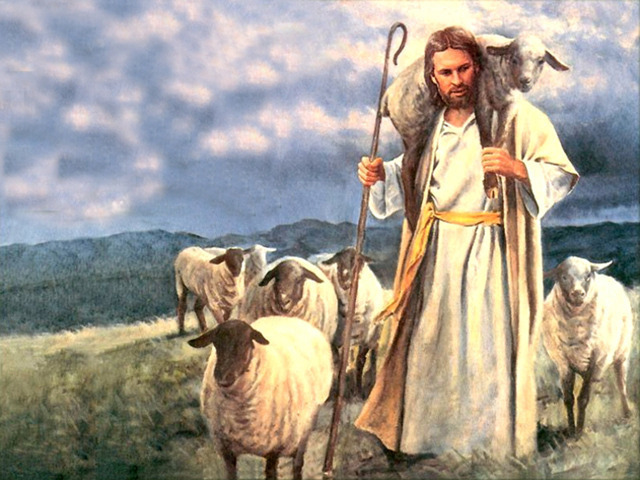
John 10:11 I am the good shepherd. The good shepherd lays down his life for the sheep.

Luke 15:3-7 So he told them this parable: (4) “What man of you, having a hundred sheep, if he has lost one of them, does not leave the ninety-nine in the open country, and go after the one that is lost, until he finds it? (5) And when he has found it, he lays it on his shoulders, rejoicing. (6) And when he comes home, he calls together his friends and his neighbors, saying to them, ‘Rejoice with me, for I have found my sheep that was lost.’ (7) Just so, I tell you, there will be more joy in heaven over one sinner who repents than over ninety-nine righteous persons who need no repentance.

THEN a shepherd has at last overtaken his poor, silly, wandering sheep, he does not straightway fall to scolding or beating it for having cost him so much toil and trouble. No; but he observes that it is very weary, that it has torn itself among thorns, and cut itself among jagged rocks, and therefore he first tenderly sees to its wounds, and then bears it back to the fold in his own arms. Poor trembling sinner, the gospel has at length laid hold upon you; you cannot longer run into the paths of sin, grace has stopped your mad career, and made you tremble at the guilt of sin. Continue reading

Beware False Prophets

Do not think it is the obvious that we can now who is a false teacher/prophet, it is those who profess to be believers who can lead you astray. Mat_7:15 “Beware of false prophets, who come to you in sheep’s clothing but inwardly are ravenous wolves.

This is an excellent sermon and exposition done by Pastor Vodie Baucham.

Please listen here :

OR DOWNLOAD SERMON HERE

Voddie Baucham 

Some sermon exert noted I jotted down :
Though the culture at large has a problem with judging, Christians are not only allowed to do so, we are commanded to do so. In this portion of the Sermon on the Mount, Jesus informs us that we must learn to discern and expose false teaching and false teachers.

False prophets are not always easy to spot.D A Carson ” Warnings against false prophets are necessarily based on the conviction that not all prophets are true, that truth can be violated and that the gospels enemies usually conceal their hostility and try to pass them selves of as fellow believers” (Quote used by Voddie) Continue reading

The Beatitudes and Christ

by Arthur Pink

The Beatitudes and Christ The Beatitudes and Christ Our meditations upon the Beatitudes would not be complete unless they turned our thoughts to the person of our blessed Lord. As we have endeavored to show, they describe the character and conduct of a Christian, and as Christian character is nothing more or less than being experimentally conformed to the image of God’s Son we must turn to Him for the perfect pattern. In the Lord Jesus Christ we find the brightest manifestations of the highest exemplifications of the different spiritual graces which are found, dimly reflected, in His followers. Not one or two but all of these perfections were displayed by Him, for Me is not only “lovely,” but “altogether lovely.” May the Holy Spirit who is here to glorify Him take now of the things of Christ and show them unto us.

First, “Blessed are the poor in spirit.” Most blessed is it to see how the Scriptures speak of Him who was rich becoming poor for our sakes, that we through His poverty might be rich. Great indeed was the poverty into which He entered. Born of parents who were poor in this world’s goods, He commenced His earthly life in a manger. During His youth and early manhood He toiled at the carpenter’s bench. After His public ministry had begun He declared that though the foxes had their holes and the birds of the air their nests, the Son of Man had not where to lay His head. If we trace out the Messianic utterances recorded in the Psalms by the Spirit of prophecy, we shall find that again and again He confessed to God His poverty of spirit: “I am poor and sorrowful” (Ps. 69:29); and, “Bow down thine ear, O Jehovah, for I am poor and needy” (Ps. 86:1); and again, “For I am poor and needy, and My heart is wounded within me” (Ps. 109:22). Continue reading

Bewitched

Acts 20:29-30 I know that after my departure fierce wolves will come in among you, not sparing the flock; (30) and from among your own selves will arise men speaking twisted things, to draw away the disciples after them.

John MacArthur – Grace to You

Galatians 3:1-5


Our study tonight takes us to the third chapter of the book of Galatians in our continuing look at this most exciting and helpful book. We will be considering verses 1-5. Galatians 3:1-5.

Defection is an ugly word. So is the word deserter. Certainly, there is nothing more bewildering, and few things more sorrowing, than to see a Christian who defects, or deserts, the purity of the Christian faith by which he has been born again and by which he has been nurtured, to settle for something less. But strange as it may seem, many Christians do. We find that they begin well. They receive the grace of Christ extended in salvation; they live in humble faith, but soon they fall into systems of legalism, systems of ritual, systems of works. I wonder how many Christians, for example, have come to a knowledge of Jesus Christ in a very personal way and have then fallen into a very liturgical church pattern, where they merely go through formalities and functions that have only external symbolism and no internal significance. I wonder how many people begin well, but then begin to substitute things like confirmation and communion and baptism and the Mass and any other kind of particular church rite for the realities of the Christian faith.

This is an issue that comes to full force in the book of Galatians, because this is the issue that confronts the heart of the Apostle Paul. He had been used as the mouthpiece of God to introduce the Galatians to the truth of the Gospel. He was the one who preached the gospel of grace; he was the one who exposed them to the magnificence of the Christian experience (which was by faith plus nothing) in the perfect and finished work of Jesus Christ. But since that time when he had begun with them, they had defected. They had deserted the simple purity of a grace gospel and substituted a form of religion, inferior and impotent.

This is not to say they had lost their salvation. It is to say, rather, that they substituted for the fullness of their life in Christ a form of religion that had no power and no joy. Furthermore, the unsaved world would get it’s doctrine of salvation from their lives and if they live legalistic lives, the world then is to conclude that salvation comes by legalism and nothing could be further from the truth. Continue reading

Should One Venerate a Dead Roman Catholic Nun?

Teresa of Calcutta may have followed another Jesus…..we must not exalt human beings like Teresa of Calcutta, and give to her a free pass to heaven because of a work done amongst the poor. She was a sinner who needed true shepherds to guide her to Jesus Christ as the sole and sufficient Saviour of the lost. I am told that John MacArthur had opportunity to present the glorious gospel of Jesus Christ to Teresa of Calcutta, and she rejected it. To accept Christ she would have had to renounce the whole Roman Catholic deception and the pride of her own spiritual works, and this she was unwilling to do.

For us the lessons are at least two: One: we need to ask ourselves whether we who know Christ as Lord and Saviour are as dedicated to his cause, and as sacrificial, as a Teresa of Calcutta who knew not the truth of God in Christ. And two: does not her sad ‘angst’ of soul cause us to see that we still have a work to do in witnessing to our Catholic neighbours? For clearly their bondage is great, and they need the light of Scripture to know God’s forgiveness and to have the assurance that their souls are safe in Christ.

Continue reading

Traditions of Men

Bible Q&A with John MacArthur from Grace to You 

See to it that no one takes you captive through philosophy and empty deception, according to the tradition of men, according to the elementary principles of the world, rather than according to Christ.  (Colossians 2: 2:8a)

Paul is concerned that those who have been transferred from Satan’s domain to Christ’s kingdom not become enslaved again. He voiced a similar concern in Galatians 5:1: “It was for freedom that Christ set us free; therefore keep standing firm and do not be subject again to a yoke of slavery.” He calls the Colossians to constant watchfulness because danger is near, as the present tense imperative form of blepo (see to it) indicates. The church constantly faces the danger of false teachers. Jesus says in Matthew 7:15, “Beware of the false prophets, who come to you in sheep’s clothing, but inwardly are ravenous wolves.” In Matthew 16:6 he warns, “Watch out and beware of the leaven of the Pharisees and Sadducees.”

The apostles also warned the church against false teachers. Paul cautioned the Ephesian elders that “after my departure savage wolves will come in among you, not sparing the flock; and from among your own selves men will arise, speaking perverse things, to draw away the disciples after them. Therefore be on the alert” (Acts 20:29–31). To the Philippians he wrote, “Beware of the dogs, beware of the evil workers, beware of the false circumcision” (Phil. 3:2). Peter also warns of the danger of false teachers. He writes in 2 Peter 3:1, “You therefore, beloved, knowing this beforehand, be on your guard lest, being carried away by the error of unprincipled men, you fall from your own steadfastness.” Continue reading

Does God So Love the World?

John 3:16 “For God so loved the world, that he gave his only Son, that whoever believes in him should not perish but have eternal life.

John MacArthur – Grace to You

Love is the best known but least understood of all God’s attributes. Almost everyone who believes in God these days sees Him as a God of love. I have even met agnostics who are quite certain that if God exists, He must be benevolent, compassionate, and loving.

All those things are infinitely true about God, of course, but not in the way most people think. Because of the influence of modern liberal theology, many suppose that God’s love and goodness ultimately nullify His righteousness, justice, and holy wrath. They envision God as a benign heavenly grandfather-tolerant, affable, lenient, permissive, devoid of any real displeasure over sin, who without consideration of His holiness will benignly pass over sin and accept people as they are.

Liberal thinking about God’s love also permeates much of evangelicalism today. We have lost the reality of God’s wrath. We have disregarded His hatred for sin. The God most evangelicals now describe is all-loving and not at all angry. We have forgotten that “It is a terrifying thing to fall into the hands of the living God” (Hebrews 10:31)We do not believe in that kind of God anymore. Continue reading

Hear This: A Pastor Who Protects His Sheep From Wolves


Act 20:29 I know that after my departure fierce wolves will come in among you, not sparing the flock;

By Amy Spreeman

Here is something we don’t come across very often: A pastor protecting his flock from the latest heresies and fads that are sweeping Christendom through popular books, teachings and teachers leading millions off the path of Truth. I first heard this preacher from  First Baptist Church of Johnson City, NY last weekend after several friends shared it with me.  I was personally touched and impacted by Pastor Jim Murphy’s gracious and humble but firm conviction to stand on God’s Word and nothing else.

He titled his message, The Subtlety of Satan. Continue reading

Bad Company Corrupts Good Character


John MacArthur – Grace to You

Do not be deceived: “Bad company corrupts good morals.” Become sober–minded as you ought, and stop sinning; for some have no knowledge of God. I speak this to your shame. (1 Corinthians15:33–34)

Paul warned the Corinthians that they should not be deceived about the danger of bad companyHomilia(company) basically means an association of people, but also can have the connotation of a lecture or sermon. It seems possible, therefore, that the Corinthians were both listening to some wrong teaching and associating with some evil people. Whether the teaching was in formal messages or not, it was bad and corrupting.

People who think wrongly invariably behave wrongly. Wrong behavior comes from wrong thinking, from wrong beliefs and wrong standards. It is impossible to associate regularly with wicked people without being contaminated both by their ideas and by their habits. The context implies that the bad company was teaching the heretical theology that there is no resurrection of the dead, and that bad theology had corrupted good morals. Continue reading