Useless Religion

Useless without Christ

Listen to sermon : 

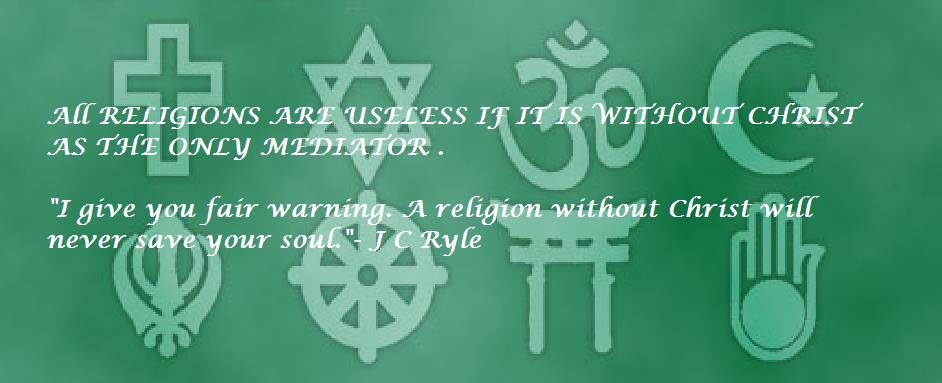
Many years ago J. C. Ryle wrote, “There are two ways a man may lose his own soul. [1] He may lose his soul by living and dying without any religion at all. He may live and die like a beast, prayerless, godless, graceless, and faithless. This is a sure way to hell. [2] He may lose his soul by taking up some useless kind of religion. He may live and die contenting himself with a false Christianity, resting on a baseless hope. This is the most common way to hell that there is.”

I want to talk to you about USELESS RELIGION. You may ask, “Pastor, What is useless religion. Surely, any religion is better than no religion.” Not so! — Useless religion is far worse than no religion, because useless religion convinces unregenerate men and women that all is well with their souls when nothing is well. In the practice of useless religion, men, women, and children eat and drink damnation to themselves, not discerning the Lord’s body, not knowing who Christ is, what He came into this world in human flesh to do, what He actually accomplished by His obedience unto death as the sinners’ Substitute (Most people do not know what He did or why He did it.), where He is now, or how He saves sinners by His grace and righteousness, through His blood.

  • All false religion is useless religion.
  • All useless religion is idolatry.

Open your Bible to Habakkuk 2:18-19, and you will see that God’s prophet Habakkuk, writing by Divine inspiration, denounced the useless religion of Babylon as soul-damning idolatry. Continue reading

“STRANGE FIRE”

Strange Fire

“STRANGE FIRE” 

And Nadab and Abihu, the sons of Aaron, took either of them his censer, and put fire therein, and put incense thereon, and offered strange fire before the LORD, which he commanded them not. And there went out fire from the LORD, and devoured them, and they died before the LORD. Then Moses said unto Aaron, This is it that the LORD spake, saying, I will be sanctified in them that come nigh me, and before all the people I will be glorified. And Aaron held his peace.
(Leviticus 10:1-3 KJV)

I want to talk to you today about the “STRANGE FIRE” these two sons of Aaron, Nadab and Abihu, offered before the Lord.

Divisions: I want to call your attention to three things in these three verses. Let be show you three things about Nadab and Abihu.
1. Their Sin
2. Their Judgment
3. Their Lesson

I. THEIR SIN (v. 1)

What was the failure of these two men? What was their crime? What was their sin? Were they spurious priests? Were they mere pretenders? Continue reading

Unfriend Yourself

Unfriendbook

Unfriend Yourself: Three Days to Detox, Discern, and Decide About Social Media 

The last time long ago when I posted a similar link, about the same subject , I got a lot of flack, from Social media Facebook friend.  Well come on give me flack again.  But this is a good read and gives one a lot to think about, our roles we play on Social media as believers. “While we would love to believe that social media can give us a place to “know and be known,” the question is whether that can happen through mediated communication. Sure, I can read about someone’s burdens and joys, but can I truly weep with those who weep when they are in their house and I am in mine? I don’t think so. I can weep for them but certainly not with them” (Kindle Locations 417-420)

Reblogged from The Reformed Reader 

I really enjoyed this short book on social media and the Christian life:Unfriend Yourself by Kyle Tennant.  It’s only 97 pages long so one can Continue reading

Nine Marks Of A False Prophet

Matt 7 v 15

Don Fortner 

Title: Nine Marks Of A False Prophet
Text: Matthew 7:15
Subject: Indictments Against False Prophets
Date: Sunday Morning – July 27, 1997
Tape # T-92
Reading: Ezekiel 13:1-16 and 22:25-31

Listen to sermon :

(We apologize for this message being incomplete. It was posted before the problem was discovered. We are making every effort to find a complete version for replacement.)

Ezekiel 13:1  And the word of the LORD came unto me, saying, 2  Son of man, prophesy against the prophets of Israel that prophesy, and say thou unto them that prophesy out of their own hearts, Hear ye the word of the LORD; 3  Thus saith the Lord GOD; Woe unto the foolish prophets, that follow their own spirit, and have seen nothing! 4  OIsrael, thy prophets are like the foxes in the deserts. 5  Ye have not gone up into the gaps, neither made up the hedge for the house of Israel to stand in the battle in the day of the LORD. 6  They have seen vanity and lying divination, saying, The LORD saith: and the LORD hath not sent them: and they have made others to hope that they would confirm the word. 7  Have ye not seen a vain vision, and have ye not spoken a lying divination, whereas ye say, The LORD saith it; albeit I have not spoken? 8  Therefore thus saith the Lord GOD; Because ye have spoken vanity, and seen lies, therefore, behold, I am against you, saith the Lord GOD. 9  And mine hand shall be upon the prophets that see vanity, and that divine lies: they shall not be in the assembly of my people, neither shall they be written in the writing of the house of Israel, neither shall they enter into the land of Israel; and ye shall know that I am the Lord GOD. 10 ¶ Because, even because they have seduced my people, saying, Peace; and there was no peace; and one built up a wall, and, lo, others daubed it with untempered morter: 11  Say unto them which daub it with untempered morter, that it shall fall: there shall be an overflowing shower; and ye, O great hailstones, shall fall; and a stormy wind shall rend it.

Ezekiel 22:25  There is a conspiracy of her prophets in the midst thereof, like a roaring lion ravening the prey; they have devoured souls; they have taken the treasure and precious things; they have made her many widows in the midst thereof. 26  Her priests have violated my law, and have profaned mine holy things: Continue reading

“Christ Is All!”

Bible  Image

Where there is neither Greek nor Jew, circumcision nor uncircumcision, Barbarian, Scythian, bond nor free: but Christ is all, and in all.
(Colossians 3:11 KJV)

“Christ Is All!”           

Colossians 3:11

     It is not possible for any mortal to comprehend the  full scope of those three words, but here are ten statements that might help to enlarge our understanding of them. After you have read this brief article, carefully study each statement, asking God the Holy Spirit to seal these words to your heart – “Christ is all!”

1. Christ is all to be known (John 17:3; Phil. 3:10). If you know Christ you know enough, even if you are ignorant of other things. If you do not know Christ it is nothing to have all other knowledge.

2. Christ is all to be chosen (Matt. 13:44-46) . There is no way to obtain this treasure and purchase this Pearl, but by selling all that you have. If you would save your life, you must lose it to Christ. Continue reading

Wicked Balances and Deceitful Weights

1380261_410347215731797_830237388_n

Shall I count them pure with the wicked balances, and with the bag of deceitful weights?” (Micah 6:11)

Listen to full sermon :

Jehovah’s question here is its own answer. The Lord God asserts in unequivocal terms that He abhors all injustice. If He saves, He will be “a just God and a Savior” (Isaiah 45:21). If He damns, it will be upon the grounds of strict justice. He will never use wicked balances or deceitful weights. He has named Himself a God that will by no means clear the guilty (Exodus 34:7). — “Behold, God will not cast away a perfect [man], neither will He help the evil doers” (Job 8:20). — “He that justifieth the wicked, and he that condemneth the just, even they both [are] abomination to the LORD” (Proverbs 17:15).

The Lord our God repeatedly avows His absolute, unbending justice in the exercise of His free, saving grace in Christ Jesus, and in the execution of His holy justice. — “A just weight and balance are the Lord’s” (Proverbs 16:11). — “Divers weights are an abomination unto the Lord; and a false balance is not good” (Proverbs 20:23). The God of all grace never uses wicked balances and deceitful weights to make sinners pure by His grace. Continue reading

The Great White Throne Judgment

revelation_title

And I saw a great white throne, and him that sat on it, from whose face the earth and the heaven fled away; and there was found no place for them. And I saw the dead, small and great, stand before God; and the books were opened: and another book was opened, which is the book of life: and the dead were judged out of those things which were written in the books, according to their works. And the sea gave up the dead which were in it; and death and hell delivered up the dead which were in them: and they were judged every man according to their works. And death and hell were cast into the lake of fire. This is the second death. And whosoever was not found written in the book of life was cast into the lake of fire.
(Revelation 20:11-15 KJV)

Revelation 20:11-15

This is the throne of judgment before which we all must appear in the last day. It is called “a great white throne“, to set forth the power, holiness, and sovereignty of the One who sits upon it. It is called “great” because it is the throne of the omnipotent God. It is called “white” because it is pure, spotless, righteous, and just. Nothing proceeds from this throne but justice and truth. It is called a “throne” because the Judge who sits upon it, before whom we all must stand, is the holy, sovereign Lord God.

In the last day, when time shall be no more, we all must appear before the august, great, white throne to be judged of God, to be judged according to the strict and exact righteousness and justice of the thrice holy God!

Yet, while the Word of God constantly warns the wicked of the terror of divine judgment and the everlasting wrath of God, the day of judgment is never described as a terror to the believer, or even a thing to be dreaded by us. Rather, for the believer the day of judgment is always set forth as a matter of anticipated joy and glory.

On this earth God’s saints are constantly misjudged. His servants are maligned and slandered by reprobate men. Continue reading

My Rock and my Salvation

954710_161146747405290_5210466_n

Psalms 62 
If (by the grace of God) I can learn a two-fold lesson, my attitude will so totally change that I can never be the same again. That lesson is found in verse one of this Psalm—‘My soul waiteth upon God’ and ‘From him cometh my salvation.’

1. What do I do? I wait as a disciple on my Lord’s command. I wait as a bondslave at my master’s feet. I wait as clay, submissive and surrendered in the potter’s hand (Rom_9:20-23).

2. On whom do I wait? I wait on the sovereign, all-wise Lord, who worketh all things after the counsel of his own will (Eph_1:9-12), on my heavenly Father, who loves me and works all things together for my good (Rom_8:28).

3. How do I wait? I wait ‘truly,’ or sincerely and silently. I wait only upon him. Note the repeated use of the word ‘only’ in Psa_62:2; Psa_62:5-6.

4. What are the results of my seeking, looking, and waiting upon God? ‘From him cometh my salvation’ from the law’s curse, from the judgment of sin, from the sting of death, and from all condemnation (Rom_8:1).

Psa_62:2; Psa_62:6. ‘He only is my rock and my salvation.’ This is the sum and substance of the Bible. I can find in the scripture no other doctrine than ‘salvation is of the Lord.’ The ‘salvation of the righteous is of the Lord’ (Jon_2:9; Psa_3:8; Psa_37:39; 2Th_2:13). Moses exhorted the people to ‘stand still (wait) and see the salvation of the Lord.’ It pleased the Lord to make us his people (1Sa_12:22); it pleased the Lord to bruise Christ in our stead (Isa_53:10); it pleased the Lord to reveal Christ in us (Gal_1:15); it pleased the Lord by the gospel to save those who believe (1Co_1:21). He only is our rock and refuge! That, rock (typically and literally) is Christ (1Co_10:4; Isa_28:16). Christ is our defense against all charges and condemnation (Rom_8:33-34), for he of God is made unto us all we need (1Co_1:30). Continue reading

BABYLON’S WOES

alas-babylon-babylon-will-perish

And he cried mightily with a strong voice, saying, Babylon the great is fallen, is fallen, and is become the habitation of devils, and the hold of every foul spirit, and a cage of every unclean and hateful bird.
(Revelation 18:2 KJV)

Don Fortner

Habakkuk 2:4-20

Listen to the sermon :

The title of my message is BABYLON’S WOES. In the 2nd chapter of Habakkuk the Prophet of God denounces four great woes upon Babylon. These are woes that were pronounced upon the ancient city of Babylon. Yet, a careful reading of the chapter makes it obvious that the mere destruction of that ancient city is not all that the passage asserts. By the Spirit of God, Habakkuk here speaks prophetically of Mystical Babylon, the great whore of the earth by which the truth of God is prostituted and immortal souls are damned.

Proposition: Babylon represents all false religion; and all false religion is under the curse of God.

FOUR WOES

Here are four woes denounced upon Babylon, four woes that fell from the very mouth of God, woes which shall be executed upon that wicked city.

1.     Woe to Babylon, woe to all false religion, woe to all free-will, works religion, God’s wrath shall destroy you because you spoil the nations of the world (vv. 6-8).

(Habakkuk 2:6-8) “Shall not all these take up a parable against him, and a taunting proverb against him, and say, Woe to him that increaseth [that which is] not his! how long? and to him that ladeth himself with thick clay! 7 Shall they not rise up suddenly that shall bite thee, and awake that shall vex thee, and thou shalt be for booties unto them? 8 Because thou hast spoiled many nations, all the remnant of the people shall spoil thee; because of men’s blood, and [for] the violence of the land, of the city, and of all that dwell therein.”

2.    Woe to Babylon, woe to all false religion, woe to all free-will, works religion, God’s wrath shall destroy you because you make men swell with pride (vv. 4-5, 9-11). Continue reading

Arminianism Agrees With Roman Catholicism, Calvinism Agrees With The Bible

road to rome

Arminianism at Home in Rome

But, however frivolous his cavils, the principles for which he contends are of the most pernicious  nature and tendency. I must repeat, what already seems to have given him so much offence, that Arminianism “came from Rome, and leads thither again.” Julian, bishop of Eclana a  contemporary and disciple of Pelagius, was one of those who endeavoured, with much art, to gild the  doctrines of that heresiarch, in order to render them more sightly and palatable. The Pelagian system,  thus varnished and paliated, soon began to acquire the softer name of Semipelagianism. Let us take a  view of it, as drawn to our hands by the celebrated Mr. Bower, who himself, in the main, a professed  Pelagian, and therefore less likely to present us with an unfavourable portrait of the system he  generally approved. Among the principles of that sect, this learned writer enumerates the following:

“The notion of election and reprobation, independent of our merits or demerits, is  maintaining a fatal necessity, is the bane of all virtue, and serves only to render good  men remiss in working out their salvation, and to drive sinners to despair.

“The decrees of election and reprobation are posterior to, and in consequence of, our  good or evil works, as foreseen by God from all eternity.”

Is not this too the very language of modern Arminianism? Do not the partizans of that scheme argue on the same identical terms? Should it be said, “True, this proves that Arminianism is Pelagianism revived; but it does not prove, that the doctrines of Arminianism are originally Popish:” a moment’s cool attention will make it plain that they are. Let us again hear Mr. Bower, who, after the passage just quoted, immediately adds, “on these two last propositions, the Jesuits found their whole system of grace and free-will; agreeing therein with the Semipelagians, against the Jansenists and St. Augustine.” The Jesuits were moulded into a regular body, towards the middle of the sixteenth century: toward the close of the same century, Arminius began to infest the Protestant churches. It needs therefore no great penetration, to discern from what source he drew his poison. His journey to Rome (though Monsicur Bayle affects to make light of the inferences which were at that very time deduced from it) was not for nothing. If, however, any are disposed to believe, that  Arminius imbibed his doctrines from the Socinians in Poland, with whom, it is certain, he was on terms of intimate friendship, I have no objection to splitting the difference: he might import some of his tenets from the Racovian brethren, and yet be indebted, for others, to the disciples of Loyola. Continue reading

The Matter of Church Discipline

early-christians1


The Matter of Church Discipline

“Moreover if thy brother shall trespass against thee, go and tell him his fault between thee and him alone: if he shall hear thee, thou hast gained thy brother. But if he will not hear thee, then take with thee one or two more, that in the mouth of two or three witnesses every word may be established. And if he shall neglect to hear them, tell it unto the church: but if he neglect to hear the church, let him be unto thee as an heathen man and a publican. Verily I say unto you, Whatsoever ye shall bind on earth shall be bound in heaven: and whatsoever ye shall loose on earth shall be loosed in heaven. Again I say unto you, That if two of you shall agree on earth as touching any thing that they shall ask, it shall be done for them of my Father which is in heaven. For where two or three are gathered together in my name, there am I in the midst of them. Then came Peter to him, and said, Lord, how oft shall my brother sin against me, and I forgive him? till seven times? Jesus saith unto him, I say not unto thee, Until seven times: but, Until seventy times seven. Therefore is the kingdom of heaven likened unto a certain king, which would take account of his servants. And when he had begun to reckon, one was brought unto him, which owed him ten thousand talents. But forasmuch as he had not to pay, his lord commanded him to be sold, and his wife, and children, and all that he had, and payment to be made. The servant therefore fell down, and worshipped him, saying, Lord, have patience with me, and I will pay thee all. Then the lord of that servant was moved with compassion, and loosed him, and forgave him the debt. But the same servant went out, and found one of his fellowservants, which owed him an hundred pence: and he laid hands on him, and took him by the throat, saying, Pay me that thou owest. And his fellowservant fell down at his feet, and besought him, saying, Have patience with me, and I will pay thee all. And he would not: but went and cast him into prison, till he should pay the debt. So when his fellowservants saw what was done, they were very sorry, and came and told unto their lord all that was done. Then his lord, after that he had called him, said unto him, O thou wicked servant, I forgave thee all that debt, because thou desiredst me: Shouldest not thou also have had compassion on thy fellowservant, even as I had pity on thee? And his lord was wroth, and delivered him to the tormentors, till he should pay all that was due unto him. So likewise shall my heavenly Father do also unto you, if ye from your hearts forgive not every one his brother their trespasses. (Mat_18:15-35)

In this passage our Lord and Savior anticipates two things. First, he anticipates the fact that differences would arise among his disciples, causing offenses. It is a sad fact, but a fact nonetheless, that God’s people in this world are sinners still. We love one another; but those who are the objects of our most ardent love are the very people we are most apt to offend. The offenses are excuseless. We ought to exercise great care not to offend. But offend we do. What husband, wife, son, or daughter has not wept bitterly after needlessly offending one in the family dearly loved? Paul and Barnabas were both brethren, faithful servants of God. But they had a falling out over John Mark. Yes, God’s people, true believers, often trespass against one another. Continue reading

The Doctrines of Grace

2 (73)

The Doctrines of Grace

TOTAL DEPRAVITY — We believe that all men since the fall of Adam are both guilty and helpless as sinners. All men are born with a sinful nature. All men are guilty of sin. All men are spiritually dead in sin. All men are helplessly lost by nature (Romans 3:9-19; 5:12; Ephesians 2:1-3).

UNCONDITIONAL ELECTION — God sovereignly chose the people whom He would save before the world began, not because of anything good which He foresaw in them, but simply according to His own good pleasure (John 15:16; Romans 9:11-13; Ephesians 1:3-4; 2 Thessalonians 2:13; 2 Timothy 1:9).

LIMITED ATONEMENT — We believe, according to the Scriptures that the Lord Jesus Christ died for and redeemed only His own elect, those who are actually saved by His grace. He did not die in vain, for those who perish under the justice of God; but He actually accomplished the redemption of His people. The benefits of Christ’s atonement are limited to the elect of God, according to God’s own purpose. Christ died for a particular people and effectually satisfied the justice of God for those people, guaranteeing their eternal salvation (Isaiah 53:8; John 10:11; Hebrews 9:12).

IRRESISTIBLE GRACE — God the Holy Spirit regenerates those sinners who were chosen by God and redeemed by Christ, and calls them to Christ, creating faith in their hearts by irresistible grace and power. All who are effectually called by the Holy Spirit, do come to Christ in faith (Psalm 65:4; 110:3; John 6:37-40; Romans 9:16).

PERSEVERANCE OF THE SAINTS — All true believers shall continue in the faith, persevere in grace, and inherit eternal glory, being preserved by the power and grace of God in Christ. Not one chosen, redeemed, regenerate sinner shall perish. Grace cannot allow it! (John 10:28-29; Romans 8:29-39; Philippians 1:6; 1 Peter 1:3-5).

These blessed truths of the Gospel we believe and preach to the glory of God and for the salvation of sinners through the grace of our Lord Jesus Christ.

 Don Fortner

HL : http://www.gracegems.org/D/doctrines_of_grace.htm

Why Don’t All People Come To Christ?

Turning away

Don Fortner

“Search the scriptures; for in them ye think ye have eternal life: and they are they which testify of me. And ye will not come to me, that ye might have life.” (John 5:39-40)

Faith in Christ is set before us in many different ways in Scripture. Faith is looking to Christ. — “Look unto me, and be ye saved, all the ends of the earth: for I am God, and there is none else” (Isaiah 45:22). — “Behold, as the eyes of servants look unto the hand of their masters, and as the eyes of a maiden unto the hand of her mistress; so our eyes wait upon the LORD our God, until that he have mercy upon us” (Psalms 123:2). Faith is trusting Christ, as a son trusts his father. — “O LORD of hosts, blessed is the man that trusteth in thee” (Psalms 84:12). Faith is seeking Christ, as a man seeks something he has lost. Faith is laying hold of Christ, as a drowning man lays hold of a life-line. And saving faith is described in Scripture as coming to Christ. The Lord Jesus is able to save to the uttermost all them that come to God by him. Believers are described by Peter as a people coming to the Savior. — “To whom coming, as unto a living stone, disallowed indeed of men, but chosen of God, andprecious” (1 Peter 2:4).

How often poor, needy sinners came to Christ, or were brought to him in desperate need, while he walked on the earth. And as often as a needy soul came to our omnipotent, ever-gracious, all-merciful Savior, he obtained the healing power and saving mercy he needed (Matthew 8:1-3; 9:1-8, 20-22, 18-26, 27-31). Salvation is obtained by coming to Christ. The Lord Jesus is able to save all who come to God by him. The Lord Jesus has promised that he will save all who come to him. (Matthew 11:28; John 6:37; John 7:37-38). And in the Gospel narratives every poor sinner who came to Christ obtained the salvation he sought.

In John 5:39-40 our Lord Jesus is talking to religious people, people who went to church every week, people who read and studied the Bible. He says, “Search the scriptures; for in them ye think ye have eternal life: and they are they which testify of me. And ye will not come to me, that ye might have life.” These were Bible thumping, conservative, religious, church going people, people who read, memorized, and studied the Word of God. Yet, our Savior said to these religious people, — “Search the scriptures; for in them ye think ye have eternal life: and they are they which testify of me. And ye will not come to me, that ye might have life.” Continue reading

Blinded By Satan

iStock_000021267657Medium

INTENDED FOR READING ON LORD’S-DAY, APRIL 16, 1893. DELIVERED BY C. H. SPURGEON,

AT THE METROPOLITAN TABERNACLE, NEWINGTON, ON LORD’S-DAY EVENING, MARCH 31, 1889.

“The god of this world has blinded the minds of them which believe not.” 2 Corinthians 4:4.

THE practice of blinding men is a horrible process, too horrible for us to say another word about it, but there is also a spiritual blindness which comes upon some men. These are, to begin with, unbelievers. The god of this world does not blind Believers—but he blinds the minds of them which believe not. It is, therefore, a very dangerous thing not to believe on the Son of God. The penalty of unbelief is death and condemnation—and that penalty begins to fall on men when, in consequence of their unbelief, their foolish heart is darkened, their intellect loses the power to perceive spiritual ob-jects—and the god of this world blinds their mental vision. Ah, my Hearers, how anxious Satan is to secure your destruc-tion, since, rather than that you should see the saving Light of God, he takes the trouble to blind your eyes! God grant that no man here may die under this dreadful deprivation of Light which is caused by Satanic influence upon the minds of men who have not believed in Jesus!

Remember that this blindness to spiritual things is quite consistent with much sharpness as to natural things. A man may be a very keen politician. He may be a first-rate man of business. He may be an eminent scientist, a profound thinker and, yet, he may be blinded as to spiritual Truths of God. How often is it true, “You have hid these things from the wise and prudent, and have revealed them unto babes”! As an old writer says, “Poor, ignorant men often find the door to Heaven and enter in, while the learned are looking for the latch.” Yes, a man may have clear eyes for worldly things. He may be very keen as to his insight into the problems of life and, yet, the god of this world may have blinded his eyes! Continue reading

Evil Came Down From The Lord

article-2179504-143EA986000005DC-698_964x640

Don Fortner

Evil Came Down From The Lord Audio sermon:

Sermon notes :

Let’s begin tonight by reading the 1st chapter of Micah’s prophecy together.

Micah 1:1-16 

The word of the LORD that came to Micah the Morasthite in the days of Jotham, Ahaz, and Hezekiah, kings of Judah, which he saw concerning Samaria and Jerusalem. Hear, all ye people; hearken, O earth, and all that therein is: and let the Lord GOD be witness against you, the Lord from his holy temple. For, behold, the LORD cometh forth out of his place, and will come down, and tread upon the high places of the earth. And the mountains shall be molten under him, and the valleys shall be cleft, as wax before the fire, and as the waters that are poured down a steep place. For the transgression of Jacob is all this, and for the sins of the house of Israel. What is the transgression of Jacob? is it not Samaria? and what are the high places of Judah? are they not Jerusalem? Therefore I will make Samaria as an heap of the field, and as plantings of a vineyard: and I will pour down the stones thereof into the valley, and I will discover the foundations thereof. And all the graven images thereof shall be beaten to pieces, and all the hires thereof shall be burned with the fire, and all the idols thereof will I lay desolate: for she gathered it of the hire of an harlot, and they shall return to the hire of an harlot. Therefore I will wail and howl, I will go stripped and naked: I will make a wailing like the dragons, and mourning as the owls. For her wound is incurable; for it is come unto Judah; he is come unto the gate of my people, even to Jerusalem. Declare ye it not at Gath, weep ye not at all: in the house of Aphrah roll thyself in the dust. Pass ye away, thou inhabitant of Saphir, having thy shame naked: the inhabitant of Zaanan came not forth in the mourning of Bethezel; he shall receive of you his standing. For the inhabitant of Maroth waited carefully for good: but evil came down from the LORD unto the gate of Jerusalem. O thou inhabitant of Lachish, bind the chariot to the swift beast: she is the beginning of the sin to the daughter of Zion: for the transgressions of Israel were found in thee. Therefore shalt thou give presents to Moreshethgath: the houses of Achzib shall be a lie to the kings of Israel. Yet will I bring an heir unto thee, O inhabitant of Mareshah: he shall come unto Adullam the glory of Israel. Make thee bald, and poll thee for thy delicate children; enlarge thy baldness as the eagle; for they are gone into captivity from thee.
(Micah 1:1-16 KJV)

UNIVERSAL MESSAGE

The singular object of Micah and of all prophecy was to prepare the way of the Lord. By the writings of His prophets the Lord God prepared His Church for the coming of Christ. Continue reading