He That Rolleth A Stone, It Will Return Upon Him….

he that roleth

″Whoso diggeth a pit shall fall therein: and he that rolleth a stone, it will return upon him. A lying tongue hateth those that are afflicted by it; and a flattering mouth worketh ruin. ″
(Proverbs 26:27-28 KJV)

Proverbs 26:27
Whoso diggeth a pit shall fall therein,…. That devises mischief against others, it shall come upon himself. The allusion is to the digging of pits for catching wild beasts, which are slightly covered with earth; and which sometimes the pursuers, through inadvertency, fall into themselves; the passage seems to be taken from Psa_7:15;

and he that rolleth a stone, it will return upon him; that rolls a stone up hill, if he does not take care, it will return back, and fall with great force upon himself; so the mischief which a wicked man labours hard at, as men do in digging a pit, or rolling a stone, in time rolls back upon themselves; the measure they mete out to others is measured to them. Jarchi makes mention of an “hagadah”, or exposition, which illustrates this passage, by the case of Abimelech; who slew threescore and ten persons on one stone, and was himself killed with a piece of a millstone cast upon him, Jdg_9:18; this may put in mind of the fable of Sisyphus (o), feigned in hell to roll a great stone to the top of a mountain, which presently falling down on his head, made his labour fruitless. Continue reading

Be Not Unequally Yoked Together

Be not unequally

2 Corinthians 6:11-18 KJV (11) O ye Corinthians, our mouth is open unto you, our heart is enlarged. (12) Ye are not straitened in us, but ye are straitened in your own bowels. (13) Now for a recompence in the same, (I speak as unto my children,) be ye also enlarged. (14) Be ye not unequally yoked together with unbelievers: for what fellowship hath righteousness with unrighteousness? and what communion hath light with darkness? (15) And what concord hath Christ with Belial? or what part hath he that believeth with an infidel? (16) And what agreement hath the temple of God with idols? for ye are the temple of the living God; as God hath said, I will dwell in them, and walk in them; and I will be their God, and they shall be my people. (17) Wherefore come out from among them, and be ye separate, saith the Lord, and touch not the unclean thing; and I will receive you, (18) And will be a Father unto you, and ye shall be my sons and daughters, saith the Lord Almighty.

Be not unequally yoked together Continue reading

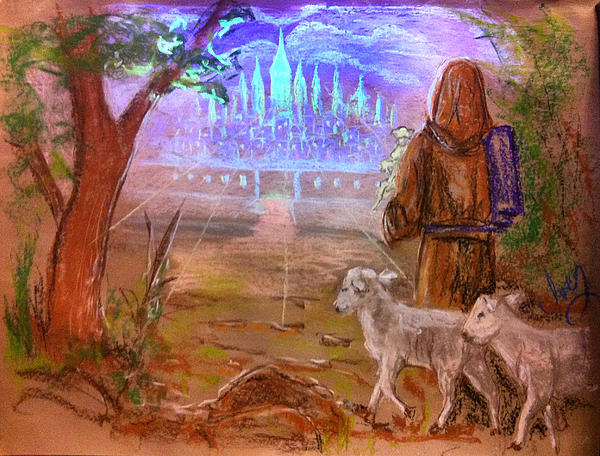
The True Shepherd and the False

the-lord-is-my-shepherd-mike-ivey

Don Fortner

“Verily, verily, I say unto you, He that entereth not by the door into the sheepfold, but climbeth up some other way, the same is a thief and a robber. But he that entereth in by the door is the shepherd of the sheep. To him the porter openeth; and the sheep hear his voice: and he calleth his own sheep by name, and leadeth them out. And when he putteth forth his own sheep, he goeth before them, and the sheep follow him: for they know his voice. And a stranger will they not follow, but will flee from him: for they know not the voice of strangers. This parable spake Jesus unto them: but they understood not what things they were which he spake unto them.”

(John 10:1-6)

The Lord God made a promise to his church in Jeremiah 3:15. It is a promise made to those people to whom the God of heaven declares, “I am married unto you…I will bring you to Zion.” This is God’s promise to his people for all time. — “I will give you pastors according to mine heart, which shall feed you with knowledge and understanding.”

Those pastors who are the ascension gifts of Christ to his church, who are pastors after God’s own heart, feed the sheep with knowledge, gospel knowledge, Bible knowledge, the knowledge of God, of Christ, of grace, and knowledge of man in his fallen state and in his redeemed state. They constantly proclaim the Word of the Lord. They constantly call eternity bound sinners to Christ, and urge God’s people to “walk in the old paths, where is the good way” that you may “find rest for your souls.” They feed God’s people with understanding, too, understanding you, understanding the things of God, and understanding the times.

When the Lord God gives his church pastors after his own heart, who feed his sheep with knowledge and understanding, his sheep shall “fear no more, are no longer dismayed, neither shall they be lacking” (Jeremiah 23:4). Blessed are those people, blessed is that church to whom God gives such a pastor! Continue reading

Needful Exhortations and Warnings

one-more-joint

By Don Fortner  (Selected Commentary on selected books, Chapter 16) 

Needful Exhortations and Warnings

Therefore all things whatsoever ye would that men should do to you, do ye even so to them: for this is the law and the prophets.”

           (Mat_7:1-29)

In this chapter, our Lord Jesus concludes his Sermon on the Mount. Throughout this sermon (Matthew 5-7), our Savior draws a clear, unmistakable distinction between true and false religion, between outward ceremonialism and inward godliness, between religious hypocrisy and true spirituality. In chapter 5 he showed us the character of his people and the necessity of holiness. In chapter 6 he showed us the character of true worship and the necessity of faith. Here in chapter 7 he brings his sermon home to all who heard him (and to all who read his words today) by making general, but pointed, exhortations and warnings, that we all need to be reminded of continually. May God the Holy Spirit, who has preserved these exhortations and warnings for us upon the pages of Holy Scripture, graciously apply them to our hearts.

Kindness

This chapter opens with a gracious exhortation to kindness (Mat_7:1-5).

“Judge not, that ye be not judged. For with what judgment ye judge, ye shall be judged: and with what measure ye mete, it shall be measured to you again. And why beholdest thou the mote that is in thy brother’s eye, but considerest not the beam that is in thine own eye? Or how wilt thou say to thy brother, Let me pull out the mote out of thine eye; and, behold, a beam is in thine own eye? Thou hypocrite, first cast out the beam out of thine own eye; and then shalt thou see clearly to cast out the mote out of thy brother’s eye.”

I do not know of any text in all the Bible that has been more twisted, abused, and misapplied by men than Mat_7:1. Those who despise absolute values, absolute standards of right and wrong, absolute doctrinal truths and dogmatism, even if they cannot quote any other text in the Bible, recite these words to condemn as divisive bigots all who press upon them the doctrinal and spiritual demands of Holy Scripture. With sweet sounding piety and complete seriousness they will look you right in the eye and say, “Judge not, that ye be not judged.” Continue reading

The Holy Spirit and the Hearing of Faith

945589_10151498341359865_810922571_n

Don Fortner 

This only would I learn of you, Received ye the Spirit by the works of the law, or by the hearing of faith?”                                                                                                                   (Galatians 3:2)

This only would I learn of you.” ― Here Paul strikes at the heart of the Galatians’ great error, and demonstrates that the gift of the Holy Spirit, that is to say grace, salvation, eternal life, and all the blessings of the covenant of grace of which the gift of the Spirit is the seal and assurance (Gal. 3:13-14; Eph. 1:13-14), come to chosen, redeemed sinners only by the hearing of faith, not by the works of the law.

Received ye the Spirit by the works of the law, or by the hearing of faith?” ― John Gill asserts, “This question supposes they had received the Spirit; that is, the Spirit of God, as a spirit of wisdom and knowledge in the revelation of Christ; as a spirit of regeneration and sanctification; as a spirit of faith and adoption; and as the earnest, seal, and pledge of their future glory.”

True Believers Continue reading

The Treachery of False Religious Leaders

Treachery 4

spy-vs-spy-courtesy-of-Mad-Magazine

Don Fortner 

Listen here (click on player) :

Treachery

Text:          Mal_2:1-17

      Subject:     The Treachery of False Prophets

      Date:         Sunday Evening — August 23, 2009

Introduction:

My subject is TREACHERY. The 2nd chapter of Malachi’s prophecy is a scathing denunciation of treachery. Here the Lord God denounces the treacherous deeds of men and emphatically declares that he will turn their treachery upon their own heads. The treachery spoken of in these 17 verses, that are boiling with the anger of God, is far worse than…

  • The civil treachery of a traitor,
  • The political treachery of self-serving politicians,
  • Or the domestic treachery of a husband or wife who destroys the lives of their family to gratify their own lusts.

The treachery here denounced by our God is treachery in the pulpit, the treachery of religious leaders, the treachery of that man who is supposed to be “the messenger of the Lord of hosts,” but is instead the minister of Satan.

(Zep_3:4) “Her prophets are light and treacherous persons: her priests have polluted the sanctuary, they have done violence to the law.”

(Hos_5:7) “They have dealt treacherously against the LORD: for they have begotten strange children: now shall a month devour them with their portions.”

(Hos_6:7) “But they like men have transgressed the covenant: there have they dealt treacherously against me.”

The Lord God has promised that he will give his church pastors after his own heart, pastors who will feed his people with knowledge and understanding (Jer_3:15). But Satan constantly seeks to fill the pulpits of churches with treacherous men.

TREACHEROUS PREACHERS Continue reading

What about Praying For the Dead? What does the Bible say

praying for the dead

For to him that is joined to all the living there is hope: for a living dog is better than a dead lion. For the living know that they shall die: but the dead know not any thing, neither have they any more a reward; for the memory of them is forgotten.
(Ecclesiastes 9:4-5 KJV)

by Tony Warren 

What about Praying For the Dead? 

There are few doctrines so couched in man made tradition and superstition, as the Roman catholic belief that by praying for the dead, it will benefit these souls, or that they can also intercede for us is some way. Should Christians pray for the dead? Absolutely not! This is not only a totally unchristian idea, but it is in some ways downright Pagan. Is God’s loving kindness declared after men are in the grave that the dead receive blessings, and our prayers for them are answered? Man says yes, but God says no!

Psalms 88:10-12

  • “Wilt thou shew wonders to the dead? shall the dead arise and praise thee? Selah.
  • Shall thy lovingkindness be declared in the grave? or thy faithfulness in destruction?
  • Shall thy wonders be known in the dark? and thy righteousness in the land of forgetfulness? ” Continue reading

False faith

Sea of Fog

By Don Fortner 

Joh_2:23-24

Read Mat_7:13-27

A false faith can do many things and produce many things, which make it hard to detect. A false faith can experience deep conviction for sin like Judas. It can tremble at the Word of God like Felix. It can repent like Esau. It can obtain high office in the church like Judas, Diotrephes and Demas. A false faith can speak well of Christ: ‘Never a man spake like this man.’ It can experience deep religious emotions like the stony-ground hearers. It can diligently perform religious works like the Pharisees. A false faith can even preach the gospel, perform miracles, cast out demons and persevere to the end (Mat_7:22-23). But, as I read the Word of God, I see that there are three things that a false faith can never do.

1. A false faith can never produce a heart broken over sin (Psalms 51). It can offer sacrifices to try to appease God for sin. It can do good works to try to make up for sin. It can even confess sin. But, ‘The sacrifices of God are a broken spirit: a broken and contrite heart, O God, thou wilt not despise.’ Such brokenness and humility, because of inbred sin, a false faith cannot produce. Continue reading

SANCTIFICATION: Why & how can God accept sinners into His Presence?

sanctification

Grant Swart

DEFINING A BIG WORD: SANCTIFICATION

Firstly, we should define what the word sanctification means. Put simply, sanctification is the act or process of being made or becoming holy. To sanctify is literally ”to set apart for special use or purpose”, figuratively “to make holy or sacred”, and etymologically from the Latin verb sancitificare which in turn is from sanctus (holy), and facere (to make).

The fancy word, etymology, simply means the study of the history of words and where they originated from, but of course you knew that, didn’t you?

Sanctification means taking something that is common and ordinary and setting it apart, for God’s purpose and for His service alone. According to the Scriptures and the experience of saved believers, sanctification is an act of God, not something which is done by man.

In Scripture sanctification is mentioned in many places, underlining the importance of the sanctified condition. Our Lord Jesus Christ spoke of sanctification in John 17 while He prayed: 16-19 “They are not of the world, just as I am not of the world. Sanctify them in the truth; your word is truth. As you sent me into the world, so I have sent them into the world. And for their sake I consecrate myself, that they also may be sanctified in truth.” Continue reading
