How to Treat False Teachers, Part 1

John MacArthur – Grace to You

1 Timothy 1:3-6

Turn in your Bible to the first chapter of 1 Timothy.  We have recently begun a study of 1 Timothy.  We’ve had a couple of messages getting started, looking at the introduction, and now we come in this next section to verses 3 through 11.  This section has to do with dealing with false teachers.  I want us to take verses 3 through 11 as a unit, but we’re going to divide it between two weeks, this Lord’s day and next.

Let me introduce our study today by reminding you of something I’m sure you’re very much aware of.  In John’s gospel chapter 8 and verse 44, it reminds us that Satan is not only a murderer but Satan is also a liar.  One of the manifestations of the lying intent of Satan is the proliferation of false teachers that besiege the gospel and the church through all the history of the church’s life.  False prophets and false teachers are a part and parcel of the battle the church has to fight in every age.

Continue reading

The Fate of the Filthy (Revelation 22)

John MacArthur – Grace to You – Bible Q & A

Let the one who does wrong, still do wrong; and the one who is filthy, still be filthy; and let the one who is righteous, still practice righteousness; and the one who is holy, still keep himself holy. (Revelation 22:11)

The angel’s statement seems strangely out of place in this context: “Let the one who does wrong, still do wrong; and the one who is filthy, still be filthy; and let the one who is righteous, still practice righteousness; and the one who is holy, still keep himself holy.” Some may think its connection with the command that preceded it is not immediately apparent. But the truth it dramatically conveys is that people’s response to the proclamation of the truth will fix their eternal destinies. Those who hear the truth but continue to do wrong and be filthy will by that hardened response fix their eternal destiny in hell. On the other hand, the one who continues to practice righteousness and keep himself holy gives evidence of genuine saving faith. The adverb eti (still) may have the sense of “yet more.” In that case, the meaning is that those who do wrong and are filthy in this life will be even more so in eternal hell, where there will be absolutely no good influences to mitigate their evil. In contrast, those who are righteous and holy in this life will be perfectly holy in their glorified bodies in heaven.

Continue reading

Being Poor in Spirit

John MacArthur – Grace to You

“Blessed are the poor in spirit, for theirs is the kingdom of heaven” (Matt. 5:3).

The Puritan writer Thomas Watson listed seven ways to determine if you are poor in spirit (The Beatitudes [Edinburgh: The Banner of Truth Trust, 1971], pp. 45-48):

Continue reading

Amazed by the Amazing

Alan Lester – Grace Unlimited website

Sermon done by Dr. Joshua Mack

One way to fill a stadium these days is to claim that a real miracle is about to take place. Imagine the impact on a crowd if a dead man, exumed from the cemetery, was actually raised to vibrant life before their eyes! Yet, greater miracles are taking place every day, and no stadium is filled as a result. God is exerting the same power He exerted in Christ when He raised Him from the dead, in trapped, helpless, ruined, dead rebels, raising them to eternal, overwhelming life!

Continue reading

Against Compromise

John MacArthur – Grace to You

It was Martin Luther who said:

“The world at the present time is sagaciously discussing how to quell the controversy and strife over doctrine and faith, and how to effect a compromise between the Church and the Papacy. Let the learned, the wise, it is said, bishops, emperor and princes, arbitrate. Each side can easily yield something, and it is better to concede some things which can be construed according to individual interpretation, than that so much persecution, bloodshed, war, and terrible, endless dissension and destruction be permitted.

Here is lack of understanding, for understanding proves by the Word that such patchwork is not according to God’s will, but that doctrine, faith and worship must be preserved pure and unadulterated; there must be no mingling with human nonsense, human opinions or wisdom.

The Scriptures give us this rule: ‘We must obey God rather than men’ (Acts 5:29).”

Continue reading

Why would someone hate the word Exegesis? part 3

John MacArthur – Grace to You

How to Study Your Bible

Psalms 1:1-2; Deuteronomy 29:29; 1 Corinthians 8:1

Introduction

Truly the Bible is magnificent. Early twentieth-century evangelist Billy Sunday pictured the Bible like a majestic palace. He wrote,

I entered through the portico of Genesis and walked down through the Old Testament’s art gallery, where I saw the portraits of Joseph, Jacob, Daniel, Moses, Isaiah, Solomon and David hanging on the wall; I entered the music room of the Psalms and the Spirit of God struck the keyboard of my nature until it seemed to me that every reed and pipe in God’s great organ of nature responded to the harp of David, and the charm of King Solomon in his moods.

Continue reading

Why would someone hate the word Exegesis? part 2

John MacArthur – Grace to You

Preaching the Book God Wrote, Part 3

5. How did the preacher’s message begin?

The message began as a true word from God and was given as truth because God’s purpose was to transmit truth. It was ordered by God as truth and was delivered by God’s Spirit in cooperation with holy men who received it with exactly the pure quality that God intended (2 Pet. 1:20-21). It was received as Scriptura inerrantis by the prophets and apostles, i.e., without wandering from Scripture’s original formulation in the mind of God.

Inerrancy then expresses the quality with which the writers of our canon received the text we call Scripture.

Continue reading

Why would someone hate the word Exegesis? part 1

Someone said : I am really beginning to hate the word exegesis. What’s wrong with the word summary? It’s simple, easy to understand!

It made me think. Why would the word Exegesis be an issue for someone if they are christian? If one is a believer I believe it is important to understand the meaning of Exegesis before we study the Word of God. there is a big difference between the word summary and the word exegesis. Should Bible teachers now change using the word exegesis to summary?

Summary = Presenting the substance in a condensed form; concise: a summary review.

Exegesis = This is a Latin term relating to correct Biblical understanding. It means literally ‘to lead out’. In the context of studying the Bible it means to get out of the text what the text is saying. This may include a number of things to aid the process such as reading the context in the chapter, in the particular book as a whole eg. Jeremiah or Matthew and even where it fits within the whole Bible. It may also include cultural awareness, the timing of the writing, and identifying the author and even the target audience.

Continue reading

Happiness Is . . .

John MacArthur – Grace to You – Drawing Near

“Blessed are the poor in spirit . . . those who mourn . . .the gentle . . . those who hunger and thirst for righteousness . . . the merciful . . . the pure in heart . . . the peacemakers . . . [and] those who have been persecuted for the sake of righteousness” (Matt. 5:3-10).

A quiz in a popular magazine characterized happy people as those who enjoy other people but aren’t self-sacrificing, who refuse to participate in negative feelings or emotions, and who have a sense of accomplishment based on their own self-sufficiency.

But Jesus described happy people quite differently. In fact, He characterized them as spiritual beggars who realize they have no resources in themselves. He said they are meek rather than proud, mournful over their sin, self- sacrificing, and willing to endure persecution to reconcile men to God.

Continue reading

Every blossoming flower warns

C H Spurgeon – Devotional

“It is time to seek the Lord.”
– Hos_10:12

This month of April is said to derive its name from the Latin verb aperio, which signifies to open, because all the buds and blossoms are now opening, and we have arrived at the gates of the flowery year. Reader, if you are yet unsaved, may your heart, in accord with the universal awakening of nature, be opened to receive the Lord. Every blossoming flower warns you that it is time to seek the Lord; be not out of tune with nature, but let your heart bud and bloom with holy desires. Do you tell me that the warm blood of youth leaps in your veins? then, I entreat you, give your vigour to the Lord. It was my unspeakable happiness to be called in early youth, and I could fain praise the Lord every day for it.

Continue reading

Who’s Afraid of the Big, Bad Heretic?

Evangelical Apathy and the Danger of False Teaching
by John MacArthur

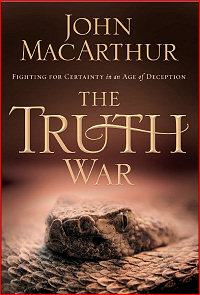
The following is excerpted from The Truth War (Nelson, 2007, pp. 165-68)

Why do so many evangelicals act as if false teachers in the church could never be a serious problem in this generation? Vast numbers seem convinced that they are “rich, have become wealthy, and have need of nothing’; and do not know that [they] are wretched, miserable, poor, blind, and naked” (Revelation 3:17).

In reality, the church today is quite possibly more susceptible to false teachers, doctrinal saboteurs, and spiritual terrorism than any other generation in church history. Biblical ignorance within the church may well be deeper and more widespread than at any other time since the Protestant Reformation. If you doubt that, compare the typical sermon of today with a randomly-chosen published sermon from any leading evangelical preacher prior to 1850. Also compare today’s Christian literature with almost anything published by evangelical publishing houses a hundred years ago or more.

Continue reading

Metamorphosis, Part 3 (questioning everything)

John MacArthur – Grace to You

I have examined and critiqued postmodernism elsewhere (see The Truth War, 2007). It should be sufficient for our purposes in this context to summarize the postmodern mind-set by describing it as dubiousness about practically everything. As we noted, the starting point for modernity was a rejection of biblical authority (setting aside belief in the supernatural as an untenable or merely irrelevant opinion). Instead, science and human reason were foolishly treated as reliable and authoritative. In the end, the disastrous failure of so many modern ideologies utterly debunked modern rationalism and delivered a deathblow to modern certitude. Postmodernism therefore subjects every idea and every authority to endless skepticism.

Modernity’s most basic assumption was that the way to achieve unshakable certainty is through a rigorous application of the scientific method. (Whatever could be tested and proved in the laboratory—or logically deduced from scientific “facts”—was deemed true; everything else was written off as mere superstition.) Moderns were convinced that a basic foundation of settled scientific knowledge would easily provide a trustworthy authority by which all truth claims could be tested. That process in turn would eventually bring about a uniform consensus regarding all the fundamental realities of life and human existence.

Continue reading

Metamorphosis, Part 2 (proliferating ignorance)


John MacArthur – Grace to You


The World Wide Web had quietly been implemented less than a year after the Soviet Union broke up. Still, by 1993, when the first edition of Ashamed of the Gospel hit the shelves, no one but the earliest Internet insiders had even heard about the Web—much less seen it. Most people had no clue how quickly or how drastically the Web would alter the world as we knew it.

I remember being told at a strategic planning retreat in 1996 that the World Wide Web would eventually become the primary vehicle for the dissemination of our radio broadcast and recorded sermons. (At the time, radio and cassette tapes were still the only media we were using for audio content.) When the men at Grace to You who stay abreast of new technologies predicted that within twenty years or so cassette tapes would be a totally dead technology, I thought they were exaggerating. “You can’t access the Internet in a car,” I pointed out. “Even if you could, who wants to carry a computer on the car seat, when it’s so much more convenient to pop in a cassette tape?”

Continue reading

Test yourselves to see if you are in the faith 2 Corinthians 13

John MacArthur – Grace to You – Bible Q & A

Test yourselves to see if you are in the faith; examine yourselves! (2 Corinthians 13:5)

The Corinthians, prompted by the evil insinuations of the false apostles, had demanded proof of Paul’s apostleship. He reluctantly defended himself, not for his own sake, but for the Lord’s, and so the Corinthians would not be cut off from the truth he preached to them. But in this passage, he turned the tables on his accusers and challenged them to test and examine themselves. The Greek text places the pronouns before the verbs for emphasis and literally reads, “Yourselves test to see if you are in the faith; yourselves examine.” Instead of arrogantly and foolishly challenging the genuineness of Paul’s relationship to the Lord, the Corinthians needed to examine the genuineness of their own salvation. The familiar New Testament terms peirazo (test) and dokimazo (examine) are used here as synonyms. They convey the idea of putting something to the test to determine its genuineness. The test was to see if the Corinthians were in the faith. Pistis (faith) refers here not to the subjective element of belief but to the objective body of Christian truth —the Christian faith.

Continue reading

Forgiving as You Are Forgiven

John MacArthur – Grace to you

“Forgive us our debts, as we also have forgiven our debtors. . . . For if you forgive men for their transgressions, your heavenly Father will also forgive you. But if you do not forgive men, then your Father will not forgive your transgressions” (Matt. 6:12, 14-15).

It’s possible to confess your sins and still not know the joy of forgiveness. How? Failure to forgive others! Christian educator J. Oswald Sanders observed that Jesus measures us by the yardstick we use on others. He didn’t say, “Forgive us because we forgive others,” but “Forgive us even as we have forgiven others.”

Continue reading