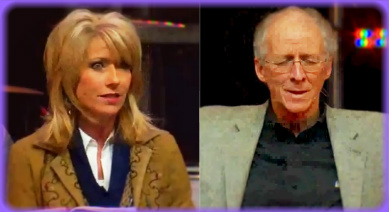
Never Make The Gospel Appeal to People’s Emotions

John McArthur explains the dangers of making emotional gospel pleas.

Let me tell you something. Never make the gospel appeal to people’s emotions…never…never. That’s why we don’t have some kind of an emotional appeal here and play all kinds of smaltzy music in the background. I don’t want you to do anything because we work your emotions up. Never appeal to people with any kind of gospel appeal that is directed at their emotions. Why? Because you can manipulate people’s emotions. And, frankly, most people have issues in their lives that make them sad and if you work well enough on their emotions, you’re clever enough at it, you can promise them happiness and when they make some kind of superficial step, they’ll have a momentary kind of relief. They’ll be a kind of newly stirred up feeling that they have. “Oh now, God’s on my side. Now I”m going to heaven. This is wonderful and you’ve accepted me and you’ve embraced me.” And that doesn’t signify anything at all. Continue reading

Turning Away From False Teachers

John MacArthur – Bible Q & A New Testament Commentaries

“Now I urge you, brethren, keep your eye on those who cause dissensions and hindrances contrary to the teaching which you learned, and turn away from them.” — Romans 16:17

The mature Christian is to keep his eye on those who cause dissensions and hindrances. Paul is not talking about hair-splitting over minor interpretations, or about immature believers who are divisive because of personal preferences, as disruptive and damaging as things can be. We are to “shun foolish controversies and genealogies and strife and disputes about the Law, for they are unprofitable and worthless” (Titus 3:9). We are to “refuse foolish and ignorant speculations, knowing that they produce quarrels” (2 Tim. 2:23). Paul is here talking about something immeasurably more serious. He is warning about those who challenge and undermine the teaching which you have learned, that is, the divinely-revealed apostolic teaching they had received.

Continue reading

Religious Deception

Prof. Johan Malan, University of the North, South Africa

Abstract: The kingdom of darkness infiltrated the Christian church with a view to adulterating it by proclaiming a counterfeit Jesus, a counterfeit spirit and a counterfeit gospel.

Scripture quotations are from the King James Version of the Holy Bible except where otherwise indicated. Only very archaic terms have been substituted, between brackets, with correlating terms from the New King James Version (NKJV). All pronouns referring to the Godhead are capitalised. Edited by Bernard and Kathleen Reeves of London.

A solemn warning

Since the start of the Christian era, many churches have shown a fatal inability to distinguish between the truth of God’s inspired Word and misrepresentations of it: “I marvel that ye are so soon removed from Him that called you into the grace of Christ unto another gospel: which is not another; but there be some that trouble you, and would pervert the gospel of Christ. But though we, or an angel from heaven, preach any other gospel unto you than that which we have preached unto you, let him be accursed” (Gal. 1:6-8).

Continue reading

Maturity in Essentials and Non-Essentials

By Pastor John Samson

“In essentials, unity; in non-essentials, liberty; and in all things, charity.” – Augustine

Doctrine divides! It divides truth from error. It divides the true teacher from the false teacher; the spirit of truth from the spirit of error; and the true Christ from the Anti-Christ.

In the Church, Christians hold differing views about important, yet non-essential matters. Let me explain. There are doctrines in the Bible that while very important, are not essential to salvation. For instance, whether or not someone believes in the baptism of infants or whether or not God still heals today, I think are important issues; yet, what someone believes about these is not essential to someone being included or excluded from the kingdom of God. Someone is not a “false teacher” who takes a different position on these issues. The same is true for doctrines such as whether someone is “pre-trib,” “mid-trib,” or “post-trib” in their belief about the end times, or for those who take different positions on the millennnium – “a”, “pre” or “post.” Sincere, godly, dedicated believers believe different things about these issues, but it does not mean that one person is saved and another damned because they have a different view.

Continue reading

Beth Moore and John Piper Lead Lectio Divina-Lite at Passion 2012

By on Jan 6, 2012

Apprising Ministries has been warning for years concerning the evil effects of the neo-liberal in the Emerging Church aka the Emergent Church.

It’s an incontrovertible fact that right from its hatching in hell corrupt Contemplative Spirituality/Mysticism (CSM), such as that taught by Living Spiritual Teacher and Quaker mystic Richard Foster along with his spiritual twin and Southern Baptist minister Dallas Willard, was a core doctrine.

Spreading as a spiritual cancer throughout apostatizing evangelicalism, we even see that it’s slithered all the way into the New Calvinst neo-reformed camp e.g. as in Acts 29 Network And Reformed Counter Reformation Spirituality? One of the fruits of CSM is a blurring of doctrinal lines, which is particularly dangerous in this time of postmodernism and growing spiritual blindness.

Continue reading

Charismatic Chaos – John MacArthur

Charismatic Chaos Part 1

Continue reading

Confronting Error with Condemnation, Not Conversation

Grace to You – John MacArthur

And now we come to the Word of God again, and Luke 20 is our text…Luke 20. We have arrived at the end of this chapter and we’ll look at the final three verses…Luke chapter 20 verses 45 through 47. Let me establish them in your mind, follow as I read. Luke chapter 20 beginning at verse 45.

“And while all the people were listening, He said to the disciples, ‘Beware of the scribes who like to walk around in long robes and love respectful greetings in the marketplaces, and chief seats in the synagogues and places of honor at banquets, who devour widows’ houses and for appearances sake offer long prayers. These will receive greater condemnation.”

Strong words. Unmistakable words. Backing up a little bit from this text and approaching it from afar off, we need to be reminded that the Bible warns us about false teachers from beginning to end. There have always been and there always will be false religious leaders who operate for Satan. They operate out of the kingdom of darkness, but they operate as if they are messengers from God.

Continue reading

Hyper-Calvinism: the perennial misnomer

GRANT SWART

In response to those who often refer to a group of people mistakenly labeled “hyper”-Calvinists, I felt it imperative to outline a few important distinctions between true Calvinist doctrine and what is referred to as “hyper”-Calvinism. If the 17 points I have listed below are those which supposedly distinguish and constitute “hyper”-Calvinism, then by that very implication, those points cannot also be what Calvinists believe. If those are the points which allegedly separate “hyper”-Calvinists from Calvinists, then those points cannot be ascribed to both sides, for then they would not be distinguishing points.

Nowhere in Calvin’s theology did he teach any of the 17 points which I list toward the end of this article, yet these points are perennially ascribed to those who agree with the doctrines of Grace. I might remind the reader here that TULIP was not Calvin’s invention, but was an acronym for the pronouncements of the Synod of Dort (1618) tasked with defending biblical doctrine, not Calvinism per se, against obvious destructive heresies of the time. Even so, it is clear that, when the doctrines as laid out in the five points of Calvinism or TULIP are understood, none of the distinguishing 17 points as I have listed below can be ascribed to TULIP. It is quite clear therefore that the term “hyper”-Calvinism is a misnomer and has no foundation in or relation to true Calvinism.

“Hyper”-Calvinism is a term which has been brandished as a whimsical weapon by those who Continue reading

A Survey of Heresies

I have worked through all these sermons/teachings and have found them very informative and detailed. I am sharing here for you the reader and my hope is you gain better Biblical understanding about false teachings and their origins.

By Phil Johnson

It’s important for Christians to have a grasp of heresies that the church has battled over the centuries, because they often return with new clothing, and the unprepared Christian is likely to fall into these old pits. Phil does an excellent job of looking at some of the major heresies that are revisiting the church today: Socinianism, Arianism, Pelagianism, Gnosticism, and Judaizing. This is an excellent 6 part series that will shore up some weak points in the church today.

Continue reading

The Modern Blasphemy of the Holy Spirit

John MacArthur – Grace to You

October 23, 2011

Selected Scriptures

Well now that I don’t have to preach on anything but what I want to preach on since I finished the New Testament, I find myself all over the place trying to decide what to preach on in sequence…a new kind of experience for me and I’m working on some kind of sequence that makes sense over the future. But I am sort of at the liberty point of my life where whatever is on my heart is where I can go, and this is a wonderful opportunity for me. And there is a subject that has concerned me for a long time and I have wanted to address this subject but it hasn’t been a part of preaching through the gospels in the way that it can be now and that is the subject of the Holy Spirit…the Holy Spirit.

After all the emphasis of so many years, 25 years of preaching through the four gospels, and much emphasis, of course, on the person of Christ as it should be, much emphasis on the character of God, and the nature of God as manifest in Christ and is seen elsewhere in Scripture, it is time now to give honor to the third member of the Trinity, namely the Holy Spirit. The Holy Spirit is the most forgotten, the most misrepresented, the most dishonored, the most grieved, the most abused and I might even say the most blasphemed of the members of the Trinity. That’s a sad thing.

When our Lord cleansed the temple in John 2, He said that He was, in a sense, fulfilling the attitude of David from Psalm 69, “Zeal for Your house has eaten Me up, the reproaches that fall on you are fallen on Me.” And what our Lord was saying was when God is dishonored, I feel the pain. “You have taken My Father’s house, which is to be a house of prayer, and turned it into a den of robbers. You’ve corrupted My Father’s house. You’ve blasphemed My Father’s name. You’ve dishonored My Father.”

Continue reading

The Call of Christ


A W Tozer –

Man – The Dwelling Place of God

Chapter 4

TO BE CALLED TO FOLLOW CHRIST is a high honor; higher indeed than any honor men can bestow upon each other.

Were all the nations of the earth to unite in one great federation and call a man to head that federation, that man would be honored above any other man that ever lived. Yet the humblest man who heeds the call to follow Christ has an honor far above such a man; for the nations of the earth can bestow only such honor as they possess, while the honor of Christ is supreme over all. God has given Him a name that is above every name.

This being true and being known to the heavenly intelligences, the methods we use to persuade men to follow Christ must seem to them extremely illogical if not downright wrong.

Evangelical Christians commonly offer Christ to mankind as a nostrum to cure their ills, a way out of their troubles, a quick and easy means to the achievement of personal ends. They use the right words, but their emphasis is awry. The message is so presented as to leave the hearer with the impression that he is being asked to give up much to gain more. And that is not good, however well intentioned it may be.

Continue reading

Altar Calls: Why you should refuse to “walk the aisle” (Part 1 of 3)

Grant Swart

In all likelihood, Charles Grandison Finney (1792-1875) can be attributed with being the “father” of the altar call. Years before our Lord effectually called me to repentance and salvation, I was once also duped into responding to an altar call which promised elaborate, but false, assurances of salvation. Wonderfully though, the Lord placed severe doubts in my mind at the time, regarding the possible validity of the ritual. What I regarded, back then as being my reliance on simple common sense, led me to distrust the embarrassing proceedings of the altar call I had responded to.

Needless to say, not much changed in my life as a result, in the days, weeks and months subsequent to that day. Great was and is the Grace of our Lord and true Saviour. I also now know that it was not only common sense which led me to doubt the honesty and biblical integrity of the altar call. I never responded to a single one again, praise be to the Lord. Continue reading

What is the Meaning of Anathema? Can a Church Pronounce an Anathema Upon Me?

By Dr Paul M Elliott

Our series on the subject of how Christians should deal with false teaching in the church generated some followup questions from readers. We take up the first today: “What is the meaning of anathema? Can a church pronounce an anathema upon a person or group?”

Several Related Questions

Continue reading

Is It Wrong to Leave a Church Because It Hasn’t Officially Endorsed the Heresy Within It?

By Dr Paul M Elliott

Part 11 of a series. Read part 10.

Our current series addresses these questions: “My church is no longer true to the Word of God on essential Christian truths. What should I do? Should I leave? Should I stay and try to fight error? Will I be guilty of schism if I do either one?”

Presently we’re dealing with some of the un-Biblical responses that are common today. In this installment we focus on the untenable position of those who say that a church doesn’t become a heretical body unless it officially endorses heresy.1

Another Fallacious Argument

Continue reading

What Must Christians Do When False Teachers Control a Church?

By Dr Paul M Elliott

Part 5 of a series. Read part 4.

Today we continue to address questions that trouble growing numbers of Christians: “My church is no longer true to the Word of God on essential Christian truths. What should I do? Should I leave? Should I stay and try to fight error? Will I be guilty of schism if I do either one?” Today’s focus is on the proper response when a church is controlled by false teachers.1

Recognizing the Conditions in Which We Live

We live in a time when many nominally Evangelical churches have ceased to bear (and in some cases have never borne) the marks of a true church of Jesus Christ that we discussed in a previous article. Neo-liberals — false teachers concerning the Gospel and much more — are in control of individual churches and even entire denominations, with the aid of the doctrinally indifferent. Typically this does not happen overnight. The downgrade takes years, sometimes even decades.

Continue reading