Avoiding Empty Philosophies – Tearing Down Strongholds

Bible Q & A With John MacArthur

2 Corinthians 10

For the weapons of our warfare are not of the flesh, but divinely powerful for the destruction of fortresses. We are destroying speculations and every lofty thing raised up against the knowledge of God, and we are taking every thought captive to the obedience of Christ, (2 Corinthians 10:4–5)

To successfully fight the spiritual war requires weapons from the heavenly arsenal. Only those divinely powerful weapons are suited for the destruction of the enemies’ fortresses. That term would convey to the New Testament reader the thought of a formidable stronghold. Corinth, like most major cities in Greece, had an acropolis. Located on a mountain near the city, the acropolis was a fortified place into which the inhabitants could retreat when attacked. Ochuroma (fortresses) was also used in extrabiblical Greek to refer to a prison. People under siege in a fortress were imprisoned there by the attacking forces. The word was also used to refer to a tomb.

Continue reading

Genesis 1: Fact or Framework?

John MacArthur – Grace to You

The Framework HypothesisOne popular view held by many old-earth advocates is known as the “framework hypothesis.” This is the belief that the “days” of creation are not even distinct eras, but overlapping stages of a long evolutionary process. According to this view, the six days described in Genesis 1 do not set forth a chronology of any kind, but rather a metaphorical “framework” by which the creative process is described for our finite human minds.

This view was apparently first set forth by liberal German theologians in the nineteenth century, but it has been adopted and propagated in recent years by some leading evangelicals, most notably Dr. Meredith G. Kline of Westminster theological seminary.

The framework hypothesis starts with the view that the “days” of creation in Genesis 1 are symbolic expressions that have nothing to do with time. Framework advocates note the obvious parallelism between days one and four (the creation of light and the placing of lights in the firmament), days two and five (the separation of air and water and the creation of fish and birds to inhabit air and water), and days three and six (the emergence of the dry land and the creation of land animals)–and they suggest that such parallelism is a clue that the structure of the chapter is merely poetic.

Thus, according to this theory, the sequence of creation may essentially be disregarded, as if some literary form in the passage nullified its literal meaning.

Continue reading

Here’s a side to the Christmas story that isn’t often told

From – Truth for Today  ~  A Daily Touch of God’s Grace , by John MacArthur

~ 25 December ~ Devotional ~

Why was Jesus Born?

For even the Son of Man did not come to be served, but to serve , and to give His life a ransom for many. Mark 10:45

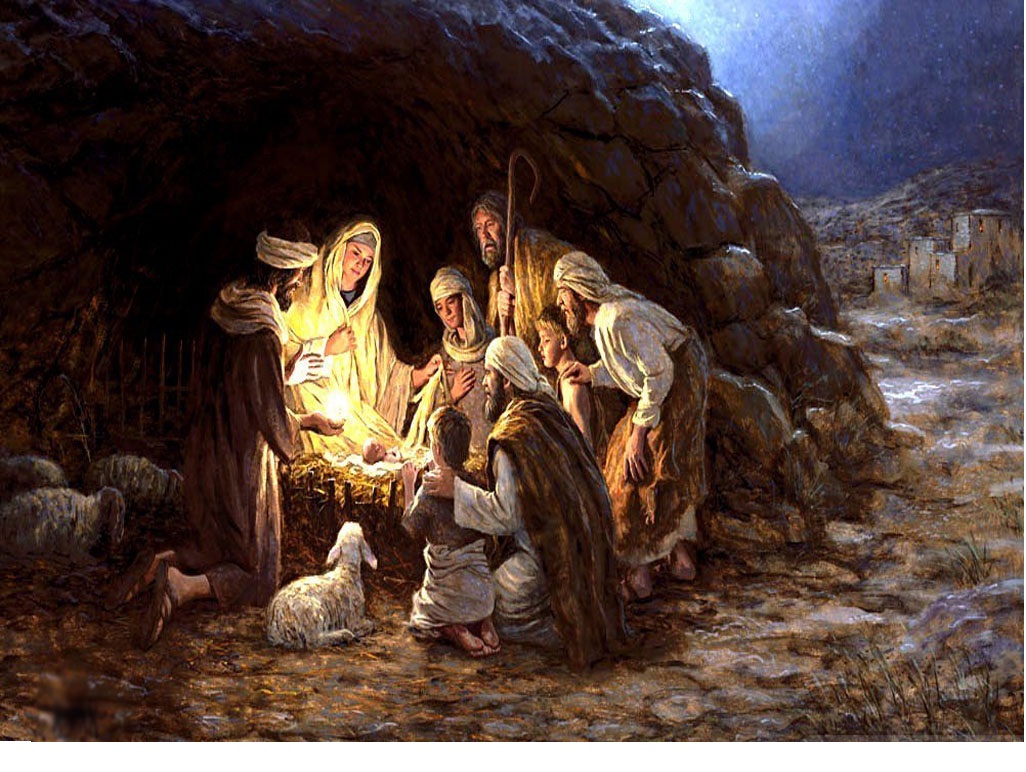
Here’s a side to the Christmas story that isn’t often told: Those soft little hands, fashioned by the Holy Spirit in Mary’s womb, were made so that nails might be driven through them. Those baby feet, pink and unable to walk, would one day walk up a dusty hill to be nailed to a cross. That sweet infant’s head with sparkling eyes and eager mouth was formed so that someday men might force a crown of thorns onto it. That tender body, warm and soft, wrapped in swaddling clothes, would one day be ripped open by a spear.

Jesus was born to die.

Don’t think I’m trying to put a damper on your Christmas spirit. Far from it – for Jesus’ death , though devised and carried out by men with evil intentions, was in no sense a tragedy. In fact , it represents the greatest victory over evil anyone has ever accomplished.

~John MacArthur~

This Devotional book available here

Christmas is coming! Quite so—but what is “Christmas?”

Xmas

by A. W. Pink

“Thus says the Lord—Do not learn the way of the heathen…for the CUSTOMS of the people are vain.” Jeremiah 10:1-3

Christmas is coming! Quite so—but what is “Christmas?” Does not the very term itself denote it’s source— “Christ-mass.” Thus it is of Roman origin, brought over from paganism. But, says someone, Christmas is the time when we commemorate the Savior’s birth. It is? And WHO authorized such commemoration? Certainly God did not. The Redeemer bade His disciples “remember” Him in His death, but there is not a word in scripture, from Genesis to Revelation, which tells us to celebrate His birth. Moreover, who knows when, in what month, He was born? The Bible is silent thereon. It is without reason that the only “birthday” commemorations mentioned in God’s Word are Pharaoh’s (Gen. 40:20) and Herod’s (Matt. 14:6)? Is this recorded “for our learning?” If so, have we prayerfully taken it to heart?

Continue reading

The Christian’s Sufficiency In Christ

John Calvin

Institutes of the Christian Religion

We see that our whole salvation and all its parts are comprehended in Christ [Acts 4:12]. We should therefore take care not to derive the least portion of it from anywhere else. If we seek salvation, we are taught by the very name of Jesus that it is “of him” [1 Cor 1:30]. If we seek any other gifts of the Spirit, they will be found in his anointing. If we seek strength, it lies in his dominion; if purity, in his conception; if gentleness, it appears in his birth. For by his birth he was made like us in all respects [Heb. 2:17] that he might learn to feel our pain [cf. Heb. 5:2].

Continue reading

Hyper-Calvinism: the perennial misnomer

GRANT SWART

In response to those who often refer to a group of people mistakenly labeled “hyper”-Calvinists, I felt it imperative to outline a few important distinctions between true Calvinist doctrine and what is referred to as “hyper”-Calvinism. If the 17 points I have listed below are those which supposedly distinguish and constitute “hyper”-Calvinism, then by that very implication, those points cannot also be what Calvinists believe. If those are the points which allegedly separate “hyper”-Calvinists from Calvinists, then those points cannot be ascribed to both sides, for then they would not be distinguishing points.

Nowhere in Calvin’s theology did he teach any of the 17 points which I list toward the end of this article, yet these points are perennially ascribed to those who agree with the doctrines of Grace. I might remind the reader here that TULIP was not Calvin’s invention, but was an acronym for the pronouncements of the Synod of Dort (1618) tasked with defending biblical doctrine, not Calvinism per se, against obvious destructive heresies of the time. Even so, it is clear that, when the doctrines as laid out in the five points of Calvinism or TULIP are understood, none of the distinguishing 17 points as I have listed below can be ascribed to TULIP. It is quite clear therefore that the term “hyper”-Calvinism is a misnomer and has no foundation in or relation to true Calvinism.

“Hyper”-Calvinism is a term which has been brandished as a whimsical weapon by those who Continue reading

A Survey of Heresies

I have worked through all these sermons/teachings and have found them very informative and detailed. I am sharing here for you the reader and my hope is you gain better Biblical understanding about false teachings and their origins.

By Phil Johnson

It’s important for Christians to have a grasp of heresies that the church has battled over the centuries, because they often return with new clothing, and the unprepared Christian is likely to fall into these old pits. Phil does an excellent job of looking at some of the major heresies that are revisiting the church today: Socinianism, Arianism, Pelagianism, Gnosticism, and Judaizing. This is an excellent 6 part series that will shore up some weak points in the church today.

Continue reading

Is Your Salvation Secure?

Grace to You – John MacArthur

Is Your Salvation Secure?
Scripture: Romans 8:28-30
Code: P07

For many years people have debated the issue of whether a Christian can lose his salvation. Some within Christendom believe you can lose your salvation; others say you can’t. That, perhaps more than any other single doctrine, has been a dividing issue in the church. How sad that is, because the Bible is clear about the matter. It is surprising that many Christians would deny or ignore the straightforward presentation of the doctrine of security in Romans chapter 8. There are other texts in the Bible that discuss the security of the believer, but none are as pointed as Romans 8:28-30.We find in those verses that everyone who has been redeemed by Jesus Christ, without exception, will be glorified.

The key phrase in this trilogy of verses is at the end of verse 28: “called according to His [God’s] purpose.” We are forever secure because that was God’s purpose. The Son of God and the Holy Spirit intercede for us so that the plan of God might come to pass. So our security is guaranteed not only by the purpose of God, but also by the outworking of that purpose through the intercessory ministries of the Son and the Spirit.

Continue reading

What the Bible Says about The DOCTRINES OF GRACE

Taken by Avalon - Vernelle Imaging

Romans 9:20-24

(20) But who are you, O man, to answer back to God? Will what is molded say to its molder, “Why have you made me like this?”  (21)  Has the potter no right over the clay, to make out of the same lump one vessel for honorable use and another for dishonorable use?  (22)  What if God, desiring to show his wrath and to make known his power, has endured with much patience vessels of wrath prepared for destruction,  (23)  in order to make known the riches of his glory for vessels of mercy, which he has prepared beforehand for glory–  (24)  even us whom he has called, not from the Jews only but also from the Gentiles?

Nathan Pitchford

“Ever since the Serpent first tempted Eve in the garden by casting doubt on God’s word and his character as he had revealed himself to her, mankind has always been engaged in the idolatrous pursuit of fashioning a god after his own imagination…There is no cure for this, but to cast off all our prior ideas of who we think God should be, or what we think he should mean when he speaks of his love, his grace, his justice, and his salvation, and to go to His Word for all our answers.” (from the Introduction)

DOCTRINES OF GRACE – CATEGORIZED SCRIPTURE LIST

God has recently given us the opportunity to discuss some theological issues with other Christians who believe differently than we do on a number of points, most notably the doctrines of grace. In such a circumstance, given the overwhelming supply of scriptural evidence that comes to bear on the topic, it seemed to me that the best approach would be a simple categorized scripture list: the fact that the entire paper would be scriptures, with the exception of a few brief explanatory notes, would underscore the truth that this is God’s own word and teaching; and the fact that it would be categorized would facilitate the ready comparison of scripture with scripture so as to lead one to a full-orbed understanding of the biblical teaching. Although I found a few good scripture lists of that nature available online, none of them was laid out in quite the progression that I was looking for, and so I developed my own. I’m posting it

Continue reading

Pictorials of Self-Proclaimed Gods, Messiahs, Modern-Day False Prohets and False Teachers


Mat 7:15-20  “Beware of false prophets, who come to you in sheep’s clothing but inwardly are ravenous wolves.  (16)  You will recognize them by their fruits. Are grapes gathered from thornbushes, or figs from thistles?  (17)  So, every healthy tree bears good fruit, but the diseased tree bears bad fruit.  (18)  A healthy tree cannot bear bad fruit, nor can a diseased tree bear good fruit.  (19)  Every tree that does not bear good fruit is cut down and thrown into the fire.  (20)  Thus you will recognize them by their fruits.

Continue reading

The Call of Christ


A W Tozer –

Man – The Dwelling Place of God

Chapter 4

TO BE CALLED TO FOLLOW CHRIST is a high honor; higher indeed than any honor men can bestow upon each other.

Were all the nations of the earth to unite in one great federation and call a man to head that federation, that man would be honored above any other man that ever lived. Yet the humblest man who heeds the call to follow Christ has an honor far above such a man; for the nations of the earth can bestow only such honor as they possess, while the honor of Christ is supreme over all. God has given Him a name that is above every name.

This being true and being known to the heavenly intelligences, the methods we use to persuade men to follow Christ must seem to them extremely illogical if not downright wrong.

Evangelical Christians commonly offer Christ to mankind as a nostrum to cure their ills, a way out of their troubles, a quick and easy means to the achievement of personal ends. They use the right words, but their emphasis is awry. The message is so presented as to leave the hearer with the impression that he is being asked to give up much to gain more. And that is not good, however well intentioned it may be.

Continue reading

Altar Calls: Why you should refuse to “walk the aisle” (Part 1 of 3)

Grant Swart

In all likelihood, Charles Grandison Finney (1792-1875) can be attributed with being the “father” of the altar call. Years before our Lord effectually called me to repentance and salvation, I was once also duped into responding to an altar call which promised elaborate, but false, assurances of salvation. Wonderfully though, the Lord placed severe doubts in my mind at the time, regarding the possible validity of the ritual. What I regarded, back then as being my reliance on simple common sense, led me to distrust the embarrassing proceedings of the altar call I had responded to.

Needless to say, not much changed in my life as a result, in the days, weeks and months subsequent to that day. Great was and is the Grace of our Lord and true Saviour. I also now know that it was not only common sense which led me to doubt the honesty and biblical integrity of the altar call. I never responded to a single one again, praise be to the Lord. Continue reading

8 Symptoms of False Doctrine

By ~ J.C. Ryle

Warnings to the Churches

Many things combine to make the present inroad of false doctrine peculiarly dangerous.

Continue reading

Does God Still Heal?

John MacArthur – Grace to You

(Part 9 of 13 of the Charismatic Chaos (Sermon Series)

Well as you know, we are involved in a study of the Charismatic movement, the contemporary movement, and tonight we come to a section entitled, “Does God Still Heal?” Now in the messages that I have been giving we have intersected with the thoughts about healing, and we have said some things about that in some of our prior studies and we’re not going to repeat those things, but there is much more that needs to be said tonight as we evaluate a movement that advocates healing. In fact, if there is anything that would be typically Charismatic or typically characteristic of the modern Pentecostal movement, third wave movement, or Charismatic movement, it would be a major emphasis on healing, and we need to understand that.

Let me begin with some illustrations that set the scene for us. A familiar name to anybody who studies the Charismatic movement and delves into the issues of healing is the name of a man, Hobart Freeman, a very interesting man, at one time a professor of Old Testament at Grace Theological Seminary, from which our own Dick Mahue graduated, and when he was a professor there in Old Testament, he was considered to be the finest communicator, the finest teacher there. In fact, Hobart Freeman wrote a very significant book entitled, “An Introduction to the Old Testament Prophets,” which in 1969, was published and printed by the Moody Bible Institute. So he was considered by everybody to be a mainline evangelical professor, one who not only understood but could adroitly teach the truth of Scripture.

Continue reading

You Will Know Them by Their Fruit


John MacArthur – Bible Q & A

You will know them by their fruits. Grapes are not gathered from thorn bushes, nor figs from thistles, are they? Even so, every good tree bears good fruit; but the bad tree bears bad fruit. A good tree cannot produce bad fruit, nor can a bad tree produce good fruit. Every tree that does not bear good fruit is cut down and thrown into the fire. So then, you will know them by their fruits. (Matthew 7:16–20)

After warning about false prophets, Jesus tells us what to watch for in identifying them. Because they are so extremely deceptive and dangerous ravenous spiritual and moral wolves in sheep’s clothing-the Lord would hardly have left us without means of determining who they are.

Jesus assures us that we will know them by their fruits. A fruit tree may be beautiful, decorative, and offer pleasant shade in the summer. But its primary purpose is to bear fruit, and it is therefore judged by what it produces and not by how it looks. (That understanding is the key to interpreting John 15 properly.)

Continue reading