STUDY GUIDE:”BEWARE THE PRETENDERS”

Part 1 of 6 Jude 1-2

THE ETERNAL SECURITY OF THE CHRISTIAN
by John F. MacArthur

A. The Analysis of the Epistle

The book of Jude is probably one of the most neglected books in the Bible. In spite of its short length, it is extremely important. The beginning of the Church Age is described in the Acts of the Apostles; its end is dealt with in the Epistle of Jude (which somebody has titled, “The Acts of the Apostates”). The book of Acts describes the deeds and teachings of men of God who began to build the church, and Jude, the last New Testament epistle, relates the deeds and teachings of evil men who will be living when the Church Age comes to an end. In fact, it is the only book in the Bible that is devoted to discussing the great apostasy (departure from the faith) that is to come before the return of Jesus Christ.

In the gospels, our Lord predicted that people under the name of Christianity would turn their backs on the truth. Paul, Peter, and John, along with Jude and James explicitly state or imply the reality of that apostasy. The Epistle of Jude plays a very important part in developing a complete understanding of that event. It details God’s attitude toward those who depart from the faith.

Continue reading

Christian Love


Quote by D L Moody

Galations 5

IT speaks in Galatians about love, the fruit of the Spirit being love, joy, peace, gentleness, long suffering,meekness and temperance. The way this writer has put it — and I think it is very beautiful — is that joy is love exultant, peace is love in repose, and long suffering is love enduring. It is all love, you see, a gentleness is love in society, and goodness is love in action, and faith is love on the battle-field, and meekness is love at school, and temperance is love in training.

Continue reading

It is Well with My Soul

hymn=it-is-well-with-my-soul

When peace, like a river, attendeth my way,
When sorrows like sea billows roll;
Whatever my lot, Thou has taught me to say,
It is well, it is well, with my soul.

Refrain
It is well, with my soul,
It is well, it is well, with my soul. Though Satan should buffet, though trials should come,
Let this blest assurance control,
That Christ has regarded my helpless estate,
And hath shed His own blood for my soul. Continue reading

Believer Encouragements

Taken from CH Spurgeon’s Morning and Evening, 5 February, Morning

“The Father sent the Son to be the Saviour of the world.” – 1 John 4:14

It is a sweet thought that Jesus Christ did not come forth without his Father’s permission, authority, consent, and assistance. He was sent of the Father, that he might be the Saviour of men. We are too apt to forget that, while there are distinctions as to the persons in the Trinity, there are no distinctions of honour. We too frequently ascribe the honour of our salvation, or at least the depths of its benevolence, more to Jesus Christ than we do the Father. This is a very great mistake. What if Jesus came? Did not his Father send him? If

Continue reading

2 Thessalonians 2:9-12

2 Thessalonians 2:9-12 (Amplified Bible)

9The coming [of the lawless one, the antichrist] is through the activity and working of Satan and will be attended by great power and with all sorts of [pretended] miracles and signs and delusive marvels–[all of them] lying wonders–

10And by unlimited seduction to evil and with all wicked deception for those who are perishing (going to perdition) because they did not welcome the Truth but refused to love it that they might be saved.

11Therefore God sends upon them a misleading influence, a working of error and a strong delusion to make them believe what is false,

12In order that all may be judged and condemned who did not believe in [who refused to adhere to, trust in, and rely on] the Truth, but [instead] took pleasure in unrighteousness.

Does God Cause Christians to Suffer?

John MacArthur – Grace to You

And we know that God causes all things to work together for good to those who love God, to those who are called according to His purpose. (Romans 8:28)

For Christians, this verse contains perhaps the most glorious promise in Scripture. It is breathtaking in its magnitude, encompassing absolutely everything that pertains to a believer’s life.

And we know (8:28a) In the context of the truths that follow in Romans 8, these three simple words express the Christians absolute certainty of eternal security in the Holy Spirit. Paul is not expressing his personal intuitions or opinions but is setting forth the inerrant truth of God’s Word. It is not Paul the man, but Paul the apostle and channel of God’s revelation who continues to declare the truth he has received from the Holy Spirit. He therefore asserts with God’s own authority that, as believers in Jesus Christ, we know beyond all doubt that every aspect of our lives is in God’s hands and will be divinely used by the Lord not only to manifest His own glory but also to work out our own ultimate blessing.

Continue reading

Guarding Against Sin

John MacArthur

“I, therefore, the prisoner of the Lord,
entreat you to walk in a manner worthy of the calling
with which you have been called.” – Ephesians 4:1

Knowing and obeying God’s Word helps us walk worthy by protecting us from sin.

While we are discussing the importance of knowing right doctrine before right duty, let’s see one way knowing the Bible helps us to walk worthy: it protects us from sin. From time to time you might hear people who have a fatalistic attitude toward sin saying, “I couldn’t help myself” or “The Devil made me do it.” Such excuses are foolish for Christians to make since God has given us the means to resist temptation. The psalmist said, “Thy word I have treasured in my heart, that I may not sin against Thee” (Ps. 119:11). Without knowledge, we are defenseless and vulnerable. Knowing God’s truth—by study and by application—enables us to say no to sin and yes to righteousness. Anyone who puts his faith in Jesus Christ but who does not keep God’s Word constantly at the forefront of his mind will find himself entrapped in sin again and again.

Continue reading

A Straying Lamb

A Straying lamb

The Shepherd loved His little lamb,
And gave it His tender care…
And followed it with His loving eyes
As it wandered here and there.

And as He sat by His grazing flock
Who so meekly His voice obeyed,
He pondered sadly His little lamb
As again and again it strayed.

The little lamb had a loving heart,
And adored His Shepherd, true,
But would turn aside and seek his own way
As lambs will so often do. Continue reading

Persistent Prayer

From Holy Trinity Lutheran Church, Hacienda Heights, California.

A sermon by Rev. William Cwirla. Luke 18:1-8 / 21 Pentecost (Proper 23) / 17 October 2010 /

In Nomine Iesu

Persistence. That’s the key idea in today’s Gospel. Persistent prayer. Think of how easily we get discouraged. We quit when things don’t go our way. We leave when things get uncomfortable. When the going gets rough, we check out. We pray, and when God doesn’t deliver on our terms, we hang up and stop talking. We have a case of spiritual ADD, I’m afraid. Our attention wanders, our prayers falter, we are easily discouraged.

Jesus told a parable about persistence in prayer. It comes immediately after Jesus’ teaching His disciples about the suddenness and speediness of His coming, and how there will be no time to get things in order, and how for the remainder of this life they should be like a bunch of buzzards and live off His death, for “where the body is, there the vultures will gather.” Continue reading

Abide with us.

Modern Reformation

The Pelagian Captivity of the Church

R. C. Sproul

Shortly after the Reformation began, in the first few years after Martin Luther posted the Ninety-Five Theses on the church door at Wittenberg, he issued some short booklets on a variety of subjects. One of the most provocative was titled The Babylonian Captivity of the Church. In this book Luther was looking back to that period of Old Testament history when Jerusalem was destroyed by the invading armies of Babylon and the elite of the people were carried off into captivity. Luther in the sixteenth century took the image of the historic Babylonian captivity and reapplied it to his era and talked about the new Babylonian captivity of the Church. He was speaking of Rome as the modern Babylon that held the Gospel hostage with its rejection of the biblical understanding of justification. You can understand how fierce the controversy was, how polemical this title would be in that period by saying that the Church had not simply erred or strayed, but had fallen-that it’s actually now Babylonian; it is now in pagan captivity.

Faith & Reason Conference Gauteng – 12 May 2010

By GV Swart – 22 May 2010

The conference was held at Kerk Sonder Mure in Centurion, which was kindly provided to the organisers free of charge. In itself I believe a charitable gesture and certainly not a cheap one. The venue is state of the art modern church buildings / auditorium with all the expected bells and whistles. Sound systems, lighting, stages, projection systems, CCTV in various areas, large auditorium seating +/-2000, other smaller conference rooms, kitchen areas, gardens, parking lots, guards on duty, foyer with book stalls, etc.

First impressions on arrival were formed by a large GDOP (Global Day of Prayer 2010) banner prominently positioned on the corner outside the building. organisers, participating speakers, presenters and audience members who were gathering within the building, however, presented quite a different picture. Wonderful how God works to enable His Truth to be promoted via all means. The venue certainly had no relevance to the message which issued from it; simply a set of walls enclosing a group of God’s people for a few hours.

Prof William Lane Craig, Pastor Ray Ciervo and Mike Willenborg, three Americans from what constituted the main body of the Faith and Reason team 2010, did presentations. Details of each presentation are far too extensive to mention here. Suffice to say that their impeccable preparations, evident depth of knowledge of the subject and most strikingly, their motivation by means of true faith made for an event which I will certainly not easily forget. Once again it glaringly exposes the dire need for quality impartation of the Word in our country, and the severe lack of guidance with which we currently struggle. Another fact which comes to mind is that these speakers needed no media assistance (TV, music, slideshows, side acts) to bolster their presentations.

Continue reading

Christians vs Non-Christians

Sakkie Spangenberg & Hansie Wolmarans (non-Christians)

Prof. William Lane Craig and Prof. Michael Licona (Christians)

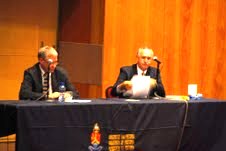
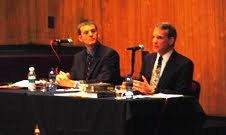
Faith & Reason Conference – Christians vs Non-Christians

By Grant Swart.

Faith & Reason Conference Gauteng debate took place on Wednesday evening, 12 May 2010 at the University of Pretoria.

TOPIC: “How should we understand the narratives about Jesus’ resurrection?”

Participants:

Prof. William Lane Craig and Prof. Michael Licona  (Christians)

Prof. Sakkie Spangenberg and Prof. Hansie Wolmarans  (Non-Christians)

The Americans are learned, and obviously very adept and experienced at this type of debate. They are unphased by inferior arguments, especially when such arguments are completely unsustainable, undefendable and ridiculous. Their knowledge of the Word and the power which it has in Truth, puts them into a different league on the floor, naturally. Praise His Omnipotence.

Continue reading

John MacArthur on Larry King live……a while ago

One of those nice to haves……….. 🙂

Enjoy !!

_________________________________________________________

Articles placed or written on this blog are generally the position held by, and in agreement with, the blog administrators’ opinions. Further commentary by the administrators of this blog will therefore be limited. Public comments which do appear in response to the articles on this blog, are not necessarily representative of the opinion of the administrators of this blog or to be regarded as necessarily Biblically correct.

What is the river of life?

Placed by Avalon 

The precise phrase “river of life” does not appear in the Bible. However, Revelation 22:1-2 does refer to “the river of the water of life, as clear as crystal, flowing from the throne of God and of the Lamb.” The Apostle John, in his vision of the New Jerusalem, describes the river as flowing “down the middle of the great street of the city.”

The “water of life” referred to here cannot be physical water as we know it because Revelation 21:1 tells us there is “no longer any sea.” He goes on to say that there is no need for sun or moon because the glory of God and the Lamb give it light (Revelation 21:23). This would indicate that the hydrological cycle as we know it on earth does not exist in the New Jerusalem. Therefore, the water flowing from the throne is literally the water of eternal life, crystal clear to reflect the glory of God in a dazzling, never-ending stream. The fact that the stream emanates from the throne tells us that eternal life flows from God to His people.

Continue reading