Among those branches of divine truth which, without special teaching, we cannot enter into, is, that of the two natures in a believer. And yet, though every child of God must in all ages have been experimentally acquainted with the inward conflict between flesh and spirit, nature and grace; and though authors innumerable have written on such subjects as sanctification, the trial of faith, the strength of grace, the power of sin, the deceitfulness of the heart, the commencement and progress, decline and restoration, of the life of God in the soul, yet how few even of these really spiritual and experimental writers have laid out the truth of the case as made known in the Scriptures, and felt in the experience of the saints! How blind have many gracious writers, as, for instance, Dr. Owen, and most of the Puritan authors, been to the distinctness of flesh and spirit! In fact, as it seems to us, many good men have been afraid of the real, actual truth. Our Puritan ancestors especially, living in a day when profanity and ungodliness ran down the streets like water, and holiness, therefore, of heart and life was powerfully urged as the distinctive feature of the children of God, intuitively shrank from anything that seemed in its faintest coloring opposed to their view of gospel sanctification. They feared to believe, and dreaded to proclaim, that “the carnal mind is enmity against God; that it is not subject to the law of God, neither indeed could be.” They seemed to think, if they once admitted that the flesh, the carnal mind, underwent no spiritual change; in other words, could not be sanctified; it was opening a wide and open door to the worst Antinomianism. Continue reading →
“And Judas Iscariot, one of the twelve, went unto the chief priests, to betray him unto them. And when they heard it, they were glad, and promised to give him money. And he sought how he might conveniently betray him. And the first day of unleavened bread, when they killed the passover, his disciples said unto him, Where wilt thou that we go and prepare that thou mayest eat the passover? And he sendeth forth two of his disciples, and saith unto them, Go ye into the city, and there shall meet you a man bearing a pitcher of water: follow him. And wheresoever he shall go in, say ye to the goodman of the house, The Master saith, Where is the guestchamber, where I shall eat the passover with my disciples? And he will shew you a large upper room furnished and prepared: there make ready for us. And his disciples went forth, and came into the city, and found as he had said unto them: and they made ready the passover.” (Mark 14:10-16)
In Mark 14 we have come to that solemn evening which preceded the most significant event in history. We should always read the things recorded here with great care, asking God the Holy Spirit to be our Teacher, asking him to inscribe the lessons in these verses upon our hearts with the finger of omnipotent grace.
From old eternity, before the worlds were made, the Lord God ordained the sacrificial, sin-atoning death of his darling Son at Calvary. He predestined the time, place, and means of his Son’s death as well as its sure accomplishments. God set forth his Son to be the propitiation for our sins, to satisfy his justice for the sins of his people, to put away our sins, so that he might be both just and the Justifier of all who believe on the Lord Jesus Christ.
The holy, just, and true God demands satisfaction for sin. Satisfaction could be made only by the sacrifice of his dear Son. Therefore, as it is written, “When the fulness of time was come, God sent forth his Son, made of a woman, made under the law, to redeem them that were under the law, that we might receive the adoption of sons.”
The Lord Jesus lived as our representative for 33 years in perfect righteousness. He worked out a perfect righteousness for us. But his obedience in life alone could never save anyone. Justice must be satisfied. Our debt had to be paid. Our sins must be punished to the full satisfaction of divine justice. Therefore, “In due time Christ died for the ungodly.” Continue reading →
Amos 8:11-12 “Behold, the days come, saith the Lord GOD, that I will send a famine in the land, not a famine of bread, nor a thirst for water, but of hearing the words of the LORD: 12 And they shall wander from sea to sea, and from the north even to the east, they shall run to and fro to seek the word of the LORD, and shall not find it.”
Listen to sermon :
2 Timothy 3:1-5
Subject: The Judgment of God
Date: Tuesday Evening — March 23, 2010
Tape # Z-82b
Reading: Rex Bartley and Romans 1:14-42
Introduction:
We are living in perilous times! I cannot imagine a more difficult time in which to live for the glory of God, seeking to do the will of God. I cannot imagine a more difficult time in which to faithfully preach the Gospel of Christ.
The moral decadence around us is astonishing!
Adultery!
Fornication!
Homosexuality!
Materialism!
Greed!
Even among those who profess to be the children of God, even among those who hold to the doctrines of the Gospel, the doctrines of grace. I see a general laxity, carelessness and open disregard for the love of God (Ephesians 4:17-20).
(Ephesians 4:17-20) “This I say therefore, and testify in the Lord, that ye henceforth walk not as other Gentiles walk, in the vanity of their mind, 18 Having the understanding darkened, being alienated from the life of God through the ignorance that is in them, because of the blindness of their heart: 19 Who being past feeling have given themselves over unto lasciviousness, to work all uncleanness with greediness. 20 But ye have not so learned Christ.”
The self-centered lawlessness of this age is shocking! There is, in our generation as never before, a general contempt for authority, which is just an outward expression of man’s contempt for God.
Where is the child who respects the authority of his parents!
Where is the student who respects the authority of his teachers!
Where is the wife who respects the authority of her husband?
Where is the man who respects the authority of civil government?
Where is the politician, or elected official who respects the constitution he is sworn to uphold and serves the people he was elected to serve?
Yet, this is the most religious generation that has ever lived!Continue reading →
Who hath saved us, and called us with an holy calling, not according to our works, but according to his own purpose and grace, which was given us in Christ Jesus before the world began,
(2 Timothy 1:9 KJV)
The foolish shall not stand in thy sight: thou hatest all workers of iniquity.
(Psalms 5:5 KJV)
But God commendeth his love toward us, in that, while we were yet sinners, Christ died for us.
(Romans 5:8 KJV)
As it is written, Jacob have I loved, but Esau have I hated. What shall we say then? Is there unrighteousness with God? God forbid. For he saith to Moses, I will have mercy on whom I will have mercy, and I will have compassion on whom I will have compassion.
(Romans 9:13-15 KJV)
The LORD trieth the righteous: but the wicked and him that loveth violence his soul hateth. Upon the wicked he shall rain snares, fire and brimstone, and an horrible tempest: this shall be the portion of their cup. For the righteous LORD loveth righteousness; his countenance doth behold the upright.
(Psalms 11:5-7 KJV)
But ye believe not, because ye are not of my sheep, as I said unto you. My sheep hear my voice, and I know them, and they follow me: (John 10:26-27 KJV)
Behold my servant, whom I uphold; mine elect, in whom my soul delighteth; I have put my spirit upon him: he shall bring forth judgment to the Gentiles. He shall not cry, nor lift up, nor cause his voice to be heard in the street. A bruised reed shall he not break, and the smoking flax shall he not quench: he shall bring forth judgment unto truth. He shall not fail nor be discouraged, till he have set judgment in the earth: and the isles shall wait for his law. Thus saith God the LORD, he that created the heavens, and stretched them out; he that spread forth the earth, and that which cometh out of it; he that giveth breath unto the people upon it, and spirit to them that walk therein:
(Isaiah 42:1-5 KJV)
I the LORD have called thee in righteousness, and will hold thine hand, and will keep thee, and give thee for a covenant of the people, for a light of the Gentiles; To open the blind eyes, to bring out the prisoners from the prison, and them that sit in darkness out of the prison house. I am the LORD: that is my name: and my glory will I not give to another, neither my praise to graven images. Behold, the former things are come to pass, and new things do I declare: before they spring forth I tell you of them.
(Isaiah 42:6-9 KJV)
He shall not fail nor be discouraged, till he have set judgment in the earth: and the isles shall wait for his law.
(Isaiah 42:4 KJV)
Thank you Derek Green for sharing this video. Lord bless your heart my friend.
WHAT IS YOUR HOPE?
Lay the foundation of your hope in Jesus Christ. Begin with Christ and end with Christ. As Christ Jesus becomes more to you, self will grow less and less. If your faith puffs you up – it is not the faith of Christ. God will help us when we are weak. He will bless us as long as we confess our dependence upon His blessing. He will fill us when we are empty. He will feed us when we are hungry. He will be our all when we are nothing. He will forgive us when we are guilty. But the moment we begin to boast in ourselves and feel sufficient, we will be left to learn, in no uncertain terms, that we are naked, poor, blind, and miserable. Terrible will be the day when proud rebels discover, too late, the dust and ashes of human merit. ~ Henry Mahan
“That calling or condition of life is best for us, and to be chosen by us, which is best for our souls, that which least exposes us to sin and gives us most opportunity of serving and enjoying God.” – Matthew Henry
“I marvel that ye are so soon removed from him that called you into the grace of Christ unto another gospel: Which is not another; but there be some that trouble you, and would pervert the gospel of Christ. But though we, or an angel from heaven, preach any other gospel unto you than that which we have preached unto you, let him be accursed. As we said before, so say I now again, If any man preach any other gospel unto you than that ye have received, let him be accursed. For do I now persuade men, or God? or do I seek to please men? for if I yet pleased men, I should not be the servant of Christ.” (Galatians 1:6-10)
It is utterly astonishing to a believer that anyone, having heard and having professed to believe the gospel of God’s free, sovereign, saving grace in Christ, could be enticed to abandon it for another gospel (Which is no gospel at all!) of legality, works, or a mixture of grace and works (Rom. 11:5-6) But that is exactly what had happened in Galatia. Paul’s purpose in writing this epistle was to expose and reprove those as heretics who attempt to mix the works of men with the work of Christ, and to establish God’s elect in the gospel of God’s grace and glory in Christ.
False teachers had crept into the Galatian churches perverting the gospel of Christ. While professing to be followers of Christ, they sought to mingle the works of the law with faith in Christ. They were persuading the people to abandon the gospel Paul had taught them, adding to faith in Christ the works of the law. The apostle Paul had taught them that Christ crucified is the only, all-sufficient, and effectual Savior of men, and that faith in him is the only way we can receive his finished salvation (Rom. 5:11). He had proved the truth of all his declarations by miracles. These Galatians professed to believe the gospel as it was preached and confirmed by the apostle. They had been so thankful for Paul bringing the gospel to them that they received him as an angel of God, and would have, had it been possible, plucked out their own eyes and given them to him. Yet, within a short time, these converts were induced by the eloquent discourses of false teachers to renounce Paul and the gospel of Christ, and to receive in its place a message contrary to the glorious gospel Paul had taught them. Therefore, he wrote this letter by divine inspiration, filled with indignation, sorrow, and astonishment. Continue reading →
It comes as a great surprise to many that the Word of God was deliberately written in such a way as to confuse unbelieving people. To the believer, to the sinner who has been born of God and granted eyes to see, ears to hear, and a heart to believe, it is a Book unsealed, open, and clear. To the unbeliever, it is a book of confusion.
This fact is nowhere more obviously demonstrated than in the comments generally given about the Book of Ecclesiastes. The vast majority of that which I have seen written about and heard spoken about this Book describes it as a book of pessimism. Most tell us that this Book of Solomon’s wisdom is little more than the rantings of a disappointed man, frustrated with life. Nothing could be further from the truth.
One thing that makes this Book so confusing to many is that it is a Book full of errors. It is divinely inspired; but it is full of errors. Let me show you.
In chapter 3 Solomon tells us that there is no difference between men and beasts, and that man dies like a dog and returns to dust (vv. 19-20). Continue reading →
“And he spake this parable unto certain which trusted in themselves that they were righteous, and despised others: Two men went up into the temple to pray; the one a Pharisee, and the other a publican. The Pharisee stood and prayed thus with himself, God, I thank thee, that I am not as other men [are], extortioners, unjust, adulterers, or even as this publican. I fast twice in the week, I give tithes of all that I possess. And the publican, standing afar off, would not lift up so much as [his] eyes unto heaven, but smote upon his breast, saying, God be merciful to me a sinner. I tell you, this man went down to his house justified [rather] than the other: for every one that exalteth himself shall be abased; and he that humbleth himself shall be exalted.” (Luke 18:9-14)
Self-righteousness is the subject of the parable before us. I cannot imagine a subject more disgustingly repugnant, or more commonly and universally indulged. Luke gives us an inspired introduction to the parable in verse 9. —“And he spake this parable unto certain which trusted in themselves that they were righteous, and despised others.” That which our Lord here denounces is self-righteousness. The purpose of our Lord in this parable is to show the folly and danger of self-righteousness. Continue reading →
But chiefly them that walk after the flesh in the lust of uncleanness, and despise government. Presumptuous are they, selfwilled, they are not afraid to speak evil of dignities. Whereas angels, which are greater in power and might, bring not railing accusation against them before the Lord. But these, as natural brute beasts, made to be taken and destroyed, speak evil of the things that they understand not; and shall utterly perish in their own corruption; And shall receive the reward of unrighteousness, as they that count it pleasure to riot in the day time. Spots they are and blemishes, sporting themselves with their own deceivings while they feast with you; Having eyes full of adultery, and that cannot cease from sin; beguiling unstable souls: an heart they have exercised with covetous practices; cursed children: Which have forsaken the right way, and are gone astray, following the way of Balaam the son of Bosor, who loved the wages of unrighteousness; But was rebuked for his iniquity: the dumb ass speaking with man’s voice forbad the madness of the prophet. These are wells without water, clouds that are carried with a tempest; to whom the mist of darkness is reserved for ever. For when they speak great swelling words of vanity, they allure through the lusts of the flesh, through much wantonness, those that were clean escaped from them who live in error. While they promise them liberty, they themselves are the servants of corruption: for of whom a man is overcome, of the same is he brought in bondage. For if after they have escaped the pollutions of the world through the knowledge of the Lord and Saviour Jesus Christ, they are again entangled therein, and overcome, the latter end is worse with them than the beginning. For it had been better for them not to have known the way of righteousness, than, after they have known it, to turn from the holy commandment delivered unto them. But it is happened unto them according to the true proverb, The dog is turned to his own vomit again; and the sow that was washed to her wallowing in the mire.
(2 Peter 2:10-22 KJV)
Two great errors of false teachers
2Pe_2:10-22
There were and are false preachers and teachers in the Christian church, just as there were false teachers among the Jews. We are warned to mark them and beware of them (Mat_7:15-16; 2Ti_4:3-4).
2Pe_2:10. These false teachers and preachers (besides denying the true gospel of redemption through Christ alone—2Pe_2:1) are guilty of two great errors. Continue reading →
“This parable spake Jesus unto them: but they understood not what things they were which he spake unto them. Then said Jesus unto them again, Verily, verily, I say unto you, I am the door of the sheep. All that ever came before me are thieves and robbers: but the sheep did not hear them. I am the door: by me if any man enter in, he shall be saved, and shall go in and out, and find pasture. The thief cometh not, but for to steal, and to kill, and to destroy: I am come that they might have life, and that they might have it more abundantly. I am the good shepherd: the good shepherd giveth his life for the sheep. But he that is an hireling, and not the shepherd, whose own the sheep are not, seeth the wolf coming, and leaveth the sheep, and fleeth: and the wolf catcheth them, and scattereth the sheep. The hireling fleeth, because he is an hireling, and careth not for the sheep. I am the good shepherd, and know my sheep, and am known of mine. As the Father knoweth me, even so know I the Father: and I lay down my life for the sheep. And other sheep I have, which are not of this fold: them also I must bring, and they shall hear my voice; and there shall be one fold, and one shepherd. Therefore doth my Father love me, because I lay down my life, that I might take it again. No man taketh it from me, but I lay it down of myself. I have power to lay it down, and I have power to take it again. This commandment have I received of my Father. There was a division therefore again among the Jews for these sayings. And many of them said, He hath a devil, and is mad; why hear ye him? Others said, These are not the words of him that hath a devil. Can a devil open the eyes of the blind?” (John 10:6-21)
George Whitefield once declared, “As God can send a nation or people no greater blessing than to give them faithful, sincere, and upright ministers, so the greatest curse that God can possibly send upon a people in this world, is to give them over to blind, unregenerate, carnal, lukewarm, and unskilled guides. And yet, in all ages, we find that there have been many wolves in sheep’s clothing, many that daubed with untempered mortar, that prophesied smoother things than God did allow.”
Wolves in sheep’s clothing were prevalent in the days of Isaiah, Jeremiah, and Ezekiel. Continue reading →
Nevertheless he saved them for his name’s sake, that he might make his mighty power to be known. (Psalms 106:8 KJV)
“A Just God and a Saviour”
Isaiah 45:21
The Lord our God, the one true and living God of heaven and earth, is a God who freely and abundantly forgives sin through the blood of his Son, the Lord Jesus Christ. This is what God himself says, “I, even I, am he that blotteth out thy transgressions for mine own sake, and will not remember thy sins.”
The People Forgiven
Who are the people to whom God will be merciful? They are not good, righteous, and morally upright men and women. So long as a man thinks that he is good and righteous, he will never obtain mercy from God. The characters to whom God says he will be merciful are sinners. The grace and lovingkindness of Jehovah is reserved for sinners. Until you see that your supposed righteousness is an abomination to God, you will never obtain the righteousness of God in Christ (Romans 10:1-4). Every promise of the gospel is made to sinners. — “The Son of man came not to call the righteous, but sinners to repentance”(Matthew 11:28-30; Isaiah 1:4-6, 18; 55:6-7). The grace and mercy of God is for Continue reading →
This is a Bible Survey type of book, with 67 chapters, an introduction and one on each book of the Bible. The main focus of this work is to see Christ in each book of Scripture. Pastor Fortner does a good work in this book.
Chapter 1 GENESIS The Book of Beginnings (Exert)
I want to take you through the entire Volume of Holy Scripture, book by book, show you the message of each book and its
relation to the whole Word of God. That will be the easy part. Here’s the tough part—I plan to cover one entire book in each
of the succeeding chapters. We will begin, of course, with Genesis, the book of beginnings.
What I hope to do in these studies is to give you a zoomlens view of Holy Scripture. I trust the Lord will use them to help you see clearly that the message of this Book, from beginning to end is Jesus Christ and him crucified, and that you will be able to grasp more fully the whole truth of God, the whole of Divine Revelation.
We read in Genesis 1:1-3—”In the beginning God created the heaven and the earth. And the earth was without form, and void; and darkness was upon the face of the deep. And the Spirit of God moved upon the face of the waters. And God
said, Let there be light: and there was light.” Continue reading →
But ye believe not, because ye are not of my sheep, as I said unto you. (John 10:26 KJV)
Listent to sermon
There was a division therefore again among the Jews for these sayings. And many of them said, He hath a devil, and is mad; why hear ye him? Others said, These are not the words of him that hath a devil. Can a devil open the eyes of the blind? And it was at Jerusalem the feast of the dedication, and it was winter. And Jesus walked in the temple in Solomon’s porch. Then came the Jews round about him, and said unto him, How long dost thou make us to doubt? If thou be the Christ, tell us plainly. Jesus answered them, I told you, and ye believed not: the works that I do in my Father’s name, they bear witness of me. But ye believe not, because ye are not of my sheep, as I said unto you. My sheep hear my voice, and I know them, and they follow me: And I give unto them eternal life; and they shall never perish, neither shall any man pluck them out of my hand. My Father, which gave them me, is greater than all; and no man is able to pluck them out of my Father’s hand. (John 10:19-29 KJV) Continue reading →
2 Corinthians 6:11-18 KJV (11) O ye Corinthians, our mouth is open unto you, our heart is enlarged. (12) Ye are not straitened in us, but ye are straitened in your own bowels. (13) Now for a recompence in the same, (I speak as unto my children,) be ye also enlarged. (14) Be ye not unequally yoked together with unbelievers: for what fellowship hath righteousness with unrighteousness? and what communion hath light with darkness? (15) And what concord hath Christ with Belial? or what part hath he that believeth with an infidel? (16) And what agreement hath the temple of God with idols? for ye are the temple of the living God; as God hath said, I will dwell in them, and walk in them; and I will be their God, and they shall be my people. (17) Wherefore come out from among them, and be ye separate, saith the Lord, and touch not the unclean thing; and I will receive you, (18) And will be a Father unto you, and ye shall be my sons and daughters, saith the Lord Almighty.
“Verily, verily, I say unto you, He that entereth not by the door into the sheepfold, but climbeth up some other way, the same is a thief and a robber. But he that entereth in by the door is the shepherd of the sheep. To him the porter openeth; and the sheep hear his voice: and he calleth his own sheep by name, and leadeth them out. And when he putteth forth his own sheep, he goeth before them, and the sheep follow him: for they know his voice. And a stranger will they not follow, but will flee from him: for they know not the voice of strangers. This parable spake Jesus unto them: but they understood not what things they were which he spake unto them.”
(John 10:1-6)
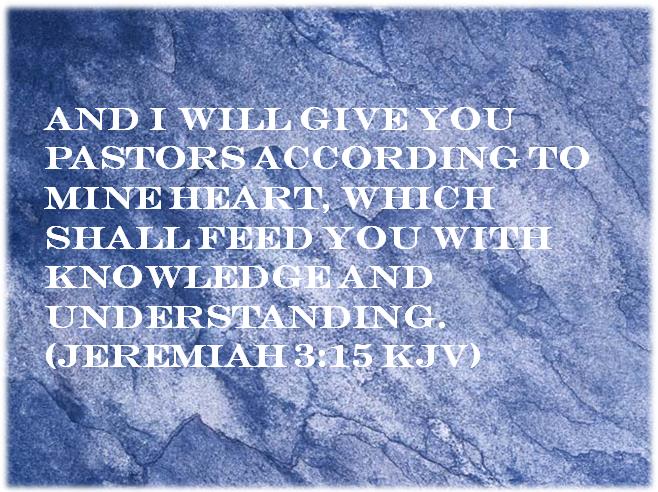
The Lord God made a promise to his church in Jeremiah 3:15. It is a promise made to those people to whom the God of heaven declares, “I am married unto you…I will bring you to Zion.” This is God’s promise to his people for all time. — “I will give you pastors according to mine heart, which shall feed you with knowledge and understanding.”
Those pastors who are the ascension gifts of Christ to his church, who are pastors after God’s own heart, feed the sheep with knowledge, gospel knowledge, Bible knowledge, the knowledge of God, of Christ, of grace, and knowledge of man in his fallen state and in his redeemed state. They constantly proclaim the Word of the Lord. They constantly call eternity bound sinners to Christ, and urge God’s people to “walk in the old paths, where is the good way” that you may “find rest for your souls.” They feed God’s people with understanding, too, understanding you, understanding the things of God, and understanding the times.
When the Lord God gives his church pastors after his own heart, who feed his sheep with knowledge and understanding, his sheep shall “fear no more, are no longer dismayed, neither shall they be lacking” (Jeremiah 23:4). Blessed are those people, blessed is that church to whom God gives such a pastor! Continue reading →
The Works of Henry Mahan, Volume 1 containing The Gospel According To Isaiah, Chapter 20
Someone asked an old minister of the gospel, “Is your creed in print?” He replied, “Yes, you will find it all in Isaiah, Chapter 53.” Here is the gospel of God’s grace in one chapter.
(Vs. 1) “Our report” is our message of the love, mercy, and grace of God in Christ Jesus. It is the testimony of Cod concerning Jesus Christ (Rom. 1:1-4). There has never lived a prophet who did not mourn the fact that men would not believe the good news of grace.
“The arm of the Lord” is Christ Jesus, the wisdom and POWER of God; for the gospel of Christ is the power of Cod unto salvation (Rom. 1:16). Natural men do not see, hear, nor understand how God can be just and justifier, righteous and merciful to sinners through the obedience and death of Christ, the substitute (I Cor. 2:8-14). He must be revealed to the heart by the Holy Spirit.
(Vs. 2) “A tender plant”signifies His lowly entrance into the world. He came not full grown in the pomp and glory of men but as a tiny, frail, helpless infant, born of a woman (Gal. 4:4-5).
“A root out of a dry ground” reveals the condition of David’s house and the nation of Israel at this time. There was nothing left of the glory of David’s kingdom, only dry ground, its king an unlikely son of a carpenter (John 6:42).
“No form … no comeliness … no beauty.” In sending our Redeemer into the world, the Lord God rejected and refused all fleshly, human attraction. Anything that would attract the eye of the flesh or support of the natural mind was refused. “My kingdom is not of this world” (John 1:10-11). Continue reading →










 For the Love of His Truth