For the Love of the Truth

For the Love of the Truth

John MacArthur

Grace to You

Selected Scriptures

To acknowledge that the church often needs to fight for truth is not to suggest that the gospel–our one message to a lost world–is somehow a declaration of war. It most certainly is not; it is a manifesto of peace and a plea for reconciliation with God (2 Corinthains 5:18-20). Conversely, those who are not reconciled to God are at war with Him all the time, and the gospel is a message about the only way to end that war. So ironically, the war to uphold the truth is the only hope of peace for the enemies of God.

Continue reading

A Living Lesson on Forgiveness

John MacArthur

Grace to You

Philemon 1-3

We are going to begin this morning a study of a brand new book in the New Testament, the book of Philemon. And I want you to turn to it, it’s just very brief, one chapter, 25 verses, a lesson on forgiveness. The little book of Philemon, for those of you who are wandering around in the index of your Bible, is tucked between Titus and Hebrews.

Of all of the human qualities that make men in any sense like God, none is more divine than forgiveness. God is a God of forgiveness. In fact, in Exodus chapter 34 God identifies Himself in that way. Verse 6 says, “Then the Lord passed by in front of Him and proclaimed,” this is the Lord speaking of Himself, “The Lord, the Lord God compassionate and gracious, slow to anger and abounding in loving kindness and truth who keeps loving kindness for thousands who forgives iniquity, transgression and sin.” He says I am the God of forgiveness. That is who I am.

Solomon said, “It is a man’s glory to overlook a transgression,” Proverbs 19:11. Man is never more like God than when he forgives

Continue reading

Meadow verses in the Bible

Psalm 65:13
The meadows are clothed with flocks, the valleys also are covered with grain; they shout for joy and sing together.

Continue reading

Psalm 65

O God of Our Salvation

To the choirmaster. A Psalm of David. A Song.

65:1 Praise is due to you, [1] O God, in Zion,
and to you shall vows be performed.
2 O you who hear prayer,
to you shall all flesh come.
3 When iniquities prevail against me,
you atone for our transgressions.
4 Blessed is the one you choose and bring near,
to dwell in your courts!
We shall be satisfied with the goodness of your house,
the holiness of your temple!

Continue reading

The Greatness of Being a Slave

The Greatness of Being a Slave

John MacArthur

Mark 10:35-45

The most profound reality for every believer is a relationship with Jesus Christ. He is our Savior, our teacher, and our friend. But the Bible teaches that at the most basic level Jesus is our Lord, our Master, which means we are His slaves.

Peruse most Bible translations and it’s easy to miss that crucial reality. That’s because many find the notion of slavery to be a cruel and embarrassing concept. John MacArthur’s new book, Slave, uncovers the conspiracy, bringing the doctrine of our slavery to Christ to its proper place in our thinking.

Embrace for yourself what the Bible really teaches about slavery—your relationship with Jesus Christ will never be the same.

http://www.gty.org/Shop/Books/451170_Slave-The-Hidden-Truth-About-Your-Identity-in-Christ-Hardcover

Continue reading

A Mighty Fortress in the Storm


A Mighty Fortress in the Storm – Psalm 46 God is our refuge and strength

1 God is our refuge and strength, a very present help in trouble.
2 Therefore will not we fear, though the earth be removed, and though the mountains be carried into the midst of the sea;
3 Though the waters thereof roar and be troubled, though the mountains shake with the swelling thereof. Selah.

Psalm 46 is a very well-known and comforting Psalm. It is well-known that Martin Luther would sing it when he felt discouraged or sore-tried in his fight against Rome. We read that there were moments when Luther would feel something akin to despair, and he would ask with the Psalmist: “Why art thou cast down, O my soul?” In such hours, he would say to Melanchthon, “Come, Philip, let us sing the 46th Psalm” and the two friends would sing it together using Luther’s famous paraphrase of it.

But this Psalm is not only a comfort in times of ecclesiastical or political conflict. It is of great comfort whenever we are facing an uncertain tomorrow or anticipate a severe trial.

Every Christian may sing this Psalm, for this Psalm is given by our Lord, that we may sing with Him. He speaks of Himself apart from us, but once in verse 10 where He says, “I am God.” But everywhere else, He puts Himself as one amongst us that we may sing with Him as ‘we’ and ‘us’.

Continue reading

STUDY GUIDE:”BEWARE THE PRETENDERS”

Part 1 of 6 Jude 1-2

THE ETERNAL SECURITY OF THE CHRISTIAN
by John F. MacArthur

A. The Analysis of the Epistle

The book of Jude is probably one of the most neglected books in the Bible. In spite of its short length, it is extremely important. The beginning of the Church Age is described in the Acts of the Apostles; its end is dealt with in the Epistle of Jude (which somebody has titled, “The Acts of the Apostates”). The book of Acts describes the deeds and teachings of men of God who began to build the church, and Jude, the last New Testament epistle, relates the deeds and teachings of evil men who will be living when the Church Age comes to an end. In fact, it is the only book in the Bible that is devoted to discussing the great apostasy (departure from the faith) that is to come before the return of Jesus Christ.

In the gospels, our Lord predicted that people under the name of Christianity would turn their backs on the truth. Paul, Peter, and John, along with Jude and James explicitly state or imply the reality of that apostasy. The Epistle of Jude plays a very important part in developing a complete understanding of that event. It details God’s attitude toward those who depart from the faith.

Continue reading

Christian Love


Quote by D L Moody

Galations 5

IT speaks in Galatians about love, the fruit of the Spirit being love, joy, peace, gentleness, long suffering,meekness and temperance. The way this writer has put it — and I think it is very beautiful — is that joy is love exultant, peace is love in repose, and long suffering is love enduring. It is all love, you see, a gentleness is love in society, and goodness is love in action, and faith is love on the battle-field, and meekness is love at school, and temperance is love in training.

Continue reading

Believer Encouragements

Taken from CH Spurgeon’s Morning and Evening, 5 February, Morning

“The Father sent the Son to be the Saviour of the world.” – 1 John 4:14

It is a sweet thought that Jesus Christ did not come forth without his Father’s permission, authority, consent, and assistance. He was sent of the Father, that he might be the Saviour of men. We are too apt to forget that, while there are distinctions as to the persons in the Trinity, there are no distinctions of honour. We too frequently ascribe the honour of our salvation, or at least the depths of its benevolence, more to Jesus Christ than we do the Father. This is a very great mistake. What if Jesus came? Did not his Father send him? If

Continue reading

2 Thessalonians 2:9-12

2 Thessalonians 2:9-12 (Amplified Bible)

9The coming [of the lawless one, the antichrist] is through the activity and working of Satan and will be attended by great power and with all sorts of [pretended] miracles and signs and delusive marvels–[all of them] lying wonders–

10And by unlimited seduction to evil and with all wicked deception for those who are perishing (going to perdition) because they did not welcome the Truth but refused to love it that they might be saved.

11Therefore God sends upon them a misleading influence, a working of error and a strong delusion to make them believe what is false,

12In order that all may be judged and condemned who did not believe in [who refused to adhere to, trust in, and rely on] the Truth, but [instead] took pleasure in unrighteousness.

Does God Cause Christians to Suffer?

John MacArthur – Grace to You

And we know that God causes all things to work together for good to those who love God, to those who are called according to His purpose. (Romans 8:28)

For Christians, this verse contains perhaps the most glorious promise in Scripture. It is breathtaking in its magnitude, encompassing absolutely everything that pertains to a believer’s life.

And we know (8:28a) In the context of the truths that follow in Romans 8, these three simple words express the Christians absolute certainty of eternal security in the Holy Spirit. Paul is not expressing his personal intuitions or opinions but is setting forth the inerrant truth of God’s Word. It is not Paul the man, but Paul the apostle and channel of God’s revelation who continues to declare the truth he has received from the Holy Spirit. He therefore asserts with God’s own authority that, as believers in Jesus Christ, we know beyond all doubt that every aspect of our lives is in God’s hands and will be divinely used by the Lord not only to manifest His own glory but also to work out our own ultimate blessing.

Continue reading

Hermeneutics in Everyday Life

From the Beacon Deacon Web Site

Suppose you’re traveling to work and you see a stop sign. What do you do? That depends on how you exegete the stop sign.

1. A postmodernist deconstructs the sign (knocks it over with his car), ending forever the tyranny of the north-south traffic over the east-west traffic.

Continue reading

Modern Reformation

The Pelagian Captivity of the Church

R. C. Sproul

Shortly after the Reformation began, in the first few years after Martin Luther posted the Ninety-Five Theses on the church door at Wittenberg, he issued some short booklets on a variety of subjects. One of the most provocative was titled The Babylonian Captivity of the Church. In this book Luther was looking back to that period of Old Testament history when Jerusalem was destroyed by the invading armies of Babylon and the elite of the people were carried off into captivity. Luther in the sixteenth century took the image of the historic Babylonian captivity and reapplied it to his era and talked about the new Babylonian captivity of the Church. He was speaking of Rome as the modern Babylon that held the Gospel hostage with its rejection of the biblical understanding of justification. You can understand how fierce the controversy was, how polemical this title would be in that period by saying that the Church had not simply erred or strayed, but had fallen-that it’s actually now Babylonian; it is now in pagan captivity.

Faith & Reason Conference Gauteng – 12 May 2010

By GV Swart – 22 May 2010

The conference was held at Kerk Sonder Mure in Centurion, which was kindly provided to the organisers free of charge. In itself I believe a charitable gesture and certainly not a cheap one. The venue is state of the art modern church buildings / auditorium with all the expected bells and whistles. Sound systems, lighting, stages, projection systems, CCTV in various areas, large auditorium seating +/-2000, other smaller conference rooms, kitchen areas, gardens, parking lots, guards on duty, foyer with book stalls, etc.

First impressions on arrival were formed by a large GDOP (Global Day of Prayer 2010) banner prominently positioned on the corner outside the building. organisers, participating speakers, presenters and audience members who were gathering within the building, however, presented quite a different picture. Wonderful how God works to enable His Truth to be promoted via all means. The venue certainly had no relevance to the message which issued from it; simply a set of walls enclosing a group of God’s people for a few hours.

Prof William Lane Craig, Pastor Ray Ciervo and Mike Willenborg, three Americans from what constituted the main body of the Faith and Reason team 2010, did presentations. Details of each presentation are far too extensive to mention here. Suffice to say that their impeccable preparations, evident depth of knowledge of the subject and most strikingly, their motivation by means of true faith made for an event which I will certainly not easily forget. Once again it glaringly exposes the dire need for quality impartation of the Word in our country, and the severe lack of guidance with which we currently struggle. Another fact which comes to mind is that these speakers needed no media assistance (TV, music, slideshows, side acts) to bolster their presentations.

Continue reading

Christians vs Non-Christians

Sakkie Spangenberg & Hansie Wolmarans (non-Christians)

Prof. William Lane Craig and Prof. Michael Licona (Christians)

Faith & Reason Conference – Christians vs Non-Christians

By Grant Swart.

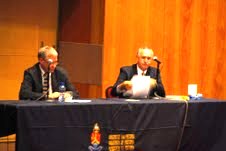
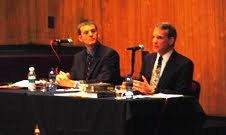
Faith & Reason Conference Gauteng debate took place on Wednesday evening, 12 May 2010 at the University of Pretoria.

TOPIC: “How should we understand the narratives about Jesus’ resurrection?”

Participants:

Prof. William Lane Craig and Prof. Michael Licona  (Christians)

Prof. Sakkie Spangenberg and Prof. Hansie Wolmarans  (Non-Christians)

The Americans are learned, and obviously very adept and experienced at this type of debate. They are unphased by inferior arguments, especially when such arguments are completely unsustainable, undefendable and ridiculous. Their knowledge of the Word and the power which it has in Truth, puts them into a different league on the floor, naturally. Praise His Omnipotence.

Continue reading